
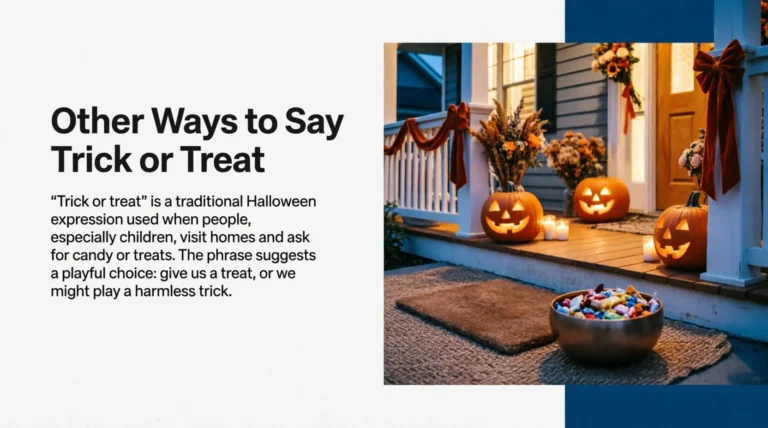
“Trick or treat” is the classic phrase children say when they visit homes on Halloween to ask for candy or other treats.
It is friendly, playful, and strongly connected with Halloween traditions in English-speaking countries.
But English learners may want other ways to say trick or treat to sound more creative, natural, or age-appropriate.
Using different phrases can also help you understand Halloween conversations, cards, social media posts, school activities, and workplace events.
Some alternatives sound funny and playful, while others are simple and polite.
In this guide, you will learn 22 alternatives to trick or treat, including their meanings, examples, tones, and best uses.
You will also learn which phrases work well for children, friends, parties, written messages, and casual Halloween conversations.
What Does “Trick or Treat” Mean?
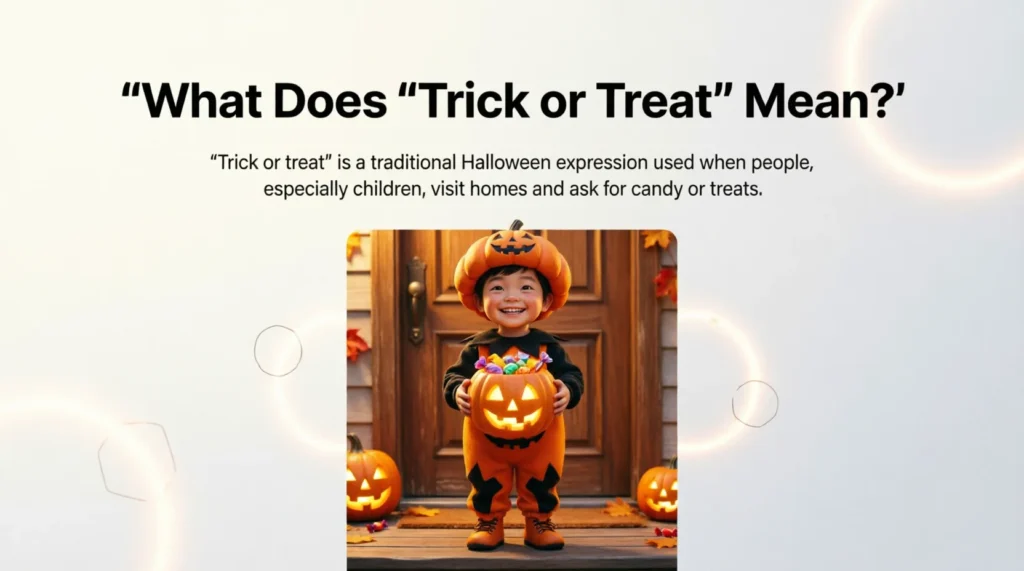
“Trick or treat” is a traditional Halloween expression used when people, especially children, visit homes and ask for candy or treats.
The phrase suggests a playful choice: give us a treat, or we might play a harmless trick.
Grammar
Trick or treat can work as both a phrase and a noun.
As a spoken expression:
“Trick or treat!”
As a noun:
“The children went trick-or-treating.”
As a verb:
“We are going trick-or-treating tonight.”
The expression is usually associated with Halloween, so it is not normally used as a general way to ask someone for food or gifts.
When to Use “Trick or Treat”
“Trick or treat” is mainly used in informal and festive situations.
Informal and spoken use
Children commonly say it when they visit houses on Halloween.
“Trick or treat!”
It is also common in Halloween movies, school events, family conversations, and party activities.
Written use
You may see trick or treat in:
- Halloween invitations
- Greeting cards
- Social media captions
- School announcements
- Party decorations
- Children’s books
- Halloween advertisements
For example:
“Get ready for a night of trick or treat!”
Formal use
The phrase is not formal business English. However, it can appear in a professional setting when the topic is a Halloween celebration.
For example:
“Our office will host a trick-or-treat event for employees’ families.”
Here, the phrase describes an activity rather than serving as a request.
Is “Trick or Treat” Professional or Polite to Say?
“Trick or treat” is polite within the right Halloween context, but it is informal.
There is nothing rude about the phrase when children use it at Halloween. It is a familiar cultural expression.
However, you would not normally use it in a business meeting to ask a colleague for something. Saying “trick or treat” during a serious presentation could sound childish or out of place.
In professional communication, it is better to use phrases such as:
- Halloween treat, please.
- Would you like to share some Halloween treats?
- Please enjoy a Halloween treat.
- We are celebrating Halloween with some treats.
The right choice depends on your audience and purpose.
Pros and Cons of Using “Trick or Treat”
Pros
- Easy to understand: Most English speakers recognize it.
- Friendly: It has a playful Halloween tone.
- Traditional: It is strongly connected with Halloween.
- Short: Children can say it quickly when visiting homes.
- Natural: It is the standard expression for Halloween door-to-door candy collecting.
Cons
- Informal: It is not suitable for serious or formal communication.
- Context-specific: It mainly relates to Halloween.
- Child-focused: It may sound unusual when used by adults outside a party setting.
- Limited meaning: It does not work as a general synonym for asking for a favor or gift.
- Cultural: People unfamiliar with Halloween traditions may not immediately understand the custom.
22 Other Ways to Say Trick or Treat
Below are 22 alternatives to trick or treat. Some are direct playful alternatives, while others communicate the same Halloween idea in a more descriptive or creative way.
1. “Treat, Please!”
Meaning: A simple and polite request for a Halloween treat.
Explanation: “Treat, please!” removes the playful threat of a trick and focuses only on receiving candy or another treat. It is especially useful for young children or situations where you want a gentle expression.
Example Sentence:
“Treat, please! Your Halloween costume looks great!”
Best Use: Casual, Friendly
Worst Use: Formal business writing
Tone: Friendly
2. “Halloween Treat, Please!”
Meaning: A polite request for a Halloween treat.
Explanation: This phrase clearly tells the listener what you are asking for. It is easy for English learners because the meaning is direct.
Example Sentence:
“Halloween treat, please! Do you have any chocolate?”
Best Use: Casual, Family, School
Worst Use: Formal corporate documents
Tone: Friendly
3. “Can I Have a Treat?”
Meaning: A direct request for candy or another small Halloween gift.
Explanation: This is one of the easiest alternatives for children learning English. It sounds natural and polite when spoken with a friendly voice.
Example Sentence:
“Can I have a treat? I love your decorations!”
Best Use: Casual, Family
Worst Use: Formal business communication
Tone: Friendly
4. “May I Have a Treat?”
Meaning: A more polite way to ask for a treat.
Explanation: “May I have a treat?” sounds slightly more polite than “Can I have a treat?” It is useful when teaching children polite English.
Example Sentence:
“May I have a treat, please?”
Best Use: Polite, School, Family
Worst Use: Very casual conversations where a playful phrase is expected
Tone: Polite
5. “Got Any Treats?”
Meaning: A casual way to ask whether someone has Halloween treats.
Explanation: This phrase is short and conversational. It sounds more like something friends or older children might say than a traditional Halloween greeting.
Example Sentence:
“Got any treats for us?”
Best Use: Casual, Informal
Worst Use: Formal communication
Tone: Casual
6. “Any Candy for Me?”
Meaning: A playful request for candy.
Explanation: This phrase focuses specifically on candy. It works well when talking to a friend, family member, or someone handing out Halloween sweets.
Example Sentence:
“Any candy for me? I came dressed as a vampire!”
Best Use: Casual, Halloween parties
Worst Use: Formal settings
Tone: Playful
7. “Can We Get Some Candy?”
Meaning: A friendly request for candy.
Explanation: “Can we get some candy?” works well when several children arrive together. It is not a direct replacement for “trick or treat,” but it expresses the same basic purpose.
Example Sentence:
“Can we get some candy? We love your Halloween decorations!”
Best Use: Casual, Spoken English
Worst Use: Formal writing
Tone: Friendly
8. “Candy, Please!”
Meaning: A short and polite request for candy.
Explanation: This is simple enough for young English learners. Adding please makes the request sound more polite.
Example Sentence:
“Candy, please! Thank you!”
Best Use: Children, Casual
Worst Use: Professional communication
Tone: Friendly
9. “Share Some Halloween Goodies!”
Meaning: A playful invitation to share Halloween treats.
Explanation: Goodies is an informal word for enjoyable food, sweets, or small treats. This phrase sounds warm and festive.
Example Sentence:
“Come on, share some Halloween goodies with us!”
Best Use: Casual, Parties
Worst Use: Formal business writing
Tone: Playful
10. “Give Us a Halloween Treat!”
Meaning: A playful request for a Halloween treat.
Explanation: This phrase sounds more direct than “Can I have a treat?” It works well in a playful Halloween setting, especially when used with a smile.
Example Sentence:
“Give us a Halloween treat!”
Best Use: Casual, Halloween events
Worst Use: Serious professional situations
Tone: Emphatic
11. “What’s the Treat?”
Meaning: A playful question asking what treat is available.
Explanation: “What’s the treat?” can create curiosity about the candy or food being offered. It is more of a question than a traditional Halloween greeting.
Example Sentence:
“What’s the treat tonight—chocolate or cookies?”
Best Use: Casual, Parties
Worst Use: Formal requests
Tone: Playful
12. “Halloween Candy, Please!”
Meaning: A direct and polite request for Halloween candy.
Explanation: This phrase is very clear. It can be useful for young learners who want a simple alternative to the traditional expression.
Example Sentence:
“Halloween candy, please!”
Best Use: Children, Casual
Worst Use: Formal business settings
Tone: Friendly
13. “Do You Have Any Treats?”
Meaning: A polite question asking whether treats are available.
Explanation: This is more indirect than “Give us a treat.” It can sound polite because you are asking whether treats are available instead of demanding them.
Example Sentence:
“Do you have any treats for the little ghosts?”
Best Use: Casual, Friendly
Worst Use: Formal corporate writing unless discussing an event
Tone: Neutral
14. “Can We Have Some Halloween Goodies?”
Meaning: A friendly request for Halloween sweets or snacks.
Explanation: This phrase sounds warm and cheerful. Goodies makes the sentence more playful than simply saying “food.”
Example Sentence:
“Can we have some Halloween goodies?”
Best Use: Casual, Family, Parties
Worst Use: Formal professional situations
Tone: Friendly
15. “Treat Time!”
Meaning: A cheerful announcement that it is time for treats.
Explanation: “Treat time!” is not a direct request. Instead, it creates a fun Halloween mood. It works especially well for parties, classrooms, and social media captions.
Example Sentence:
“Costumes are ready—treat time!”
Best Use: Parties, Social Media, Casual
Worst Use: Formal business letters
Tone: Playful
16. “Let’s Get Some Candy!”
Meaning: A cheerful statement about going to get candy.
Explanation: This phrase works well when talking about the activity rather than speaking directly to someone at a door.
Example Sentence:
“The costumes are ready. Let’s get some candy!”
Best Use: Casual, Family, Friends
Worst Use: Formal communication
Tone: Energetic
17. “Time for Halloween Treats!”
Meaning: An announcement that Halloween treats are being served or collected.
Explanation: This is a useful alternative for Halloween parties and school events. It sounds more suitable for a group activity than door-to-door trick-or-treating.
Example Sentence:
“Everyone is ready. It’s time for Halloween treats!”
Best Use: School, Parties, Events
Worst Use: Serious business discussions
Tone: Friendly
18. “Who Has the Treats?”
Meaning: A playful question asking who has the Halloween candy.
Explanation: This phrase creates a fun sense of excitement. It works best among friends, families, or children at a Halloween gathering.
Example Sentence:
“Who has the treats? I can smell the chocolate!”
Best Use: Casual, Parties
Worst Use: Formal situations
Tone: Playful
19. “Bring on the Treats!”
Meaning: A lively way to say that you are ready for treats.
Explanation: “Bring on” means to introduce or provide something with enthusiasm. This expression sounds energetic rather than polite or formal.
Example Sentence:
“The costumes are on. Bring on the treats!”
Best Use: Casual, Social Media, Parties
Worst Use: Formal business emails
Tone: Emphatic
20. “Let’s Go Trick-or-Treating!”
Meaning: An invitation to go from house to house collecting Halloween treats.
Explanation: This is not a replacement for the words children say at the door. Instead, it is an alternative way to describe or invite someone to take part in the Halloween activity.
Example Sentence:
“Put on your costumes. Let’s go trick-or-treating!”
Best Use: Casual, Family
Worst Use: Formal workplace communication
Tone: Friendly
21. “Who’s Ready for Halloween Treats?”
Meaning: A cheerful question asking whether people are ready for Halloween treats.
Explanation: This works especially well at parties, school events, and family gatherings. It focuses on excitement rather than making a direct request.
Example Sentence:
“Who’s ready for Halloween treats?”
Best Use: Parties, Events, Social Media
Worst Use: Formal documents
Tone: Friendly
22. “Halloween Fun, Treats, and Smiles!”
Meaning: A cheerful expression celebrating Halloween treats and fun.
Explanation: This is a creative alternative rather than a direct synonym. It is useful for posters, captions, invitations, and event promotions.
Example Sentence:
“Halloween fun, treats, and smiles are waiting for everyone!”
Best Use: Social Media, Posters, Events
Worst Use: Direct door-to-door requests
Tone: Cheerful
Quick Comparison of Top Alternatives
| Alternative | Tone | Best Setting | Direct Request? |
|---|---|---|---|
| Treat, Please! | Friendly | Casual | Yes |
| Can I Have a Treat? | Friendly | Family | Yes |
| Do You Have Any Treats? | Neutral | Casual | Yes |
| Bring on the Treats! | Emphatic | Parties | No |
| Let’s Get Some Candy! | Energetic | Family/Friends | No |
| Time for Halloween Treats! | Friendly | Events | No |
| Halloween Candy, Please! | Polite | Children | Yes |
The best alternative depends on what you are trying to do. If you are asking someone for candy, “Treat, please!” or “Can I have a treat?” works naturally. If you are creating a party caption, “Bring on the treats!” may sound more exciting.
How to Choose the Right Alternative
When choosing synonyms for trick or treat, think about the situation first.
For young children, simple phrases are best:
“Candy, please!”
For a polite request:
“May I have a treat?”
For a group:
“Can we have some Halloween goodies?”
For a Halloween party:
“Time for Halloween treats!”
For social media:
“Bring on the treats!”
For an invitation:
“Who’s ready for Halloween treats?”
This approach helps English learners understand an important lesson: a synonym is not always a perfect replacement. Two phrases may have similar meanings but different uses.
For example, “trick or treat” is a traditional phrase spoken at someone’s door. “Treat time!” creates a festive mood but does not serve the same grammatical purpose.
Why Word Choice Matters
Learning other ways to say trick or treat is useful because English has many ways to express a similar idea.
Compare these examples:
“Candy, please!”
“Bring on the treats!”
“May I have a treat?”
All three relate to Halloween treats, but their tones are different.
“Candy, please!” is short and polite.
“Bring on the treats!” is energetic and playful.
“May I have a treat?” sounds more polite and careful.
This is why learning alternatives can make your English sound more natural. You learn not only vocabulary but also tone, context, politeness, and audience awareness.
Frequently Asked Questions
1. What is another way to say “trick or treat”?
Some natural alternatives include “Treat, please!”, “Can I have a treat?”, “Halloween candy, please!”, and “Do you have any treats?”
2. What is a polite way to say “trick or treat”?
“May I have a treat, please?” is a polite alternative. It sounds gentle and respectful.
3. Is “trick or treat” formal English?
No. “Trick or treat” is informal and strongly associated with Halloween. It is perfectly normal in festive situations but is not suitable for most formal business communication.
4. Can adults say “trick or treat”?
Yes. Adults can use it at Halloween parties, community events, costume events, or when participating in trick-or-treating with children. The context makes it natural.
5. Are all alternatives exact synonyms for “trick or treat”?
No. Some alternatives express the same purpose, while others describe Halloween treats or the activity. For example, “Let’s go trick-or-treating!” describes the activity rather than replacing what someone says at the door.
Conclusion
Knowing other ways to say trick or treat can make your English more flexible and expressive.
The traditional phrase is still the clearest choice for Halloween door-to-door activities, but alternatives such as “Treat, please!”, “Can I have a treat?”, and “Bring on the treats!” can add different tones.
Choose your words based on your audience, setting, and purpose.
English learners should not only memorize synonyms but also learn when each phrase sounds natural.
Try these alternatives in Halloween conversations, party invitations, classroom activities, and social media posts to build confidence and sound more natural in English.

Alden Rowen is the author behind Meanings Path, sharing clear and reliable insights into the meanings, origins, and significance of words, names, and phrases. His goal is to make language simple, useful, and easy to understand.