
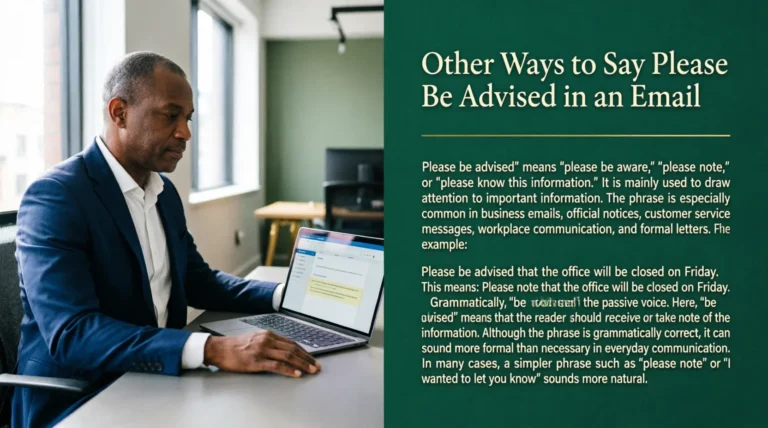
Choosing the right words in an email can make a big difference.
The phrase “please be advised” is common in business writing, but it can sometimes sound stiff, formal, or even a little cold.
That is why many English learners and professionals look for other ways to say please be advised in an email.
The good news is that you have many options.
You can use a phrase that sounds formal, friendly, neutral, or more direct, depending on your message and reader.
For example, “please note” is short and professional, while “I’d like to let you know” sounds warmer.
In this guide, you will learn 15 useful alternatives to please be advised, along with meanings, examples, tones, and the best situations for each phrase.
These options can help you write emails that sound clear, natural, and confident in 2026.
What Does “Please Be Advised” Mean?
“Please be advised” means “please be aware,” “please note,” or “please know this information.”
It is mainly used to draw attention to important information. The phrase is especially common in business emails, official notices, customer service messages, workplace communication, and formal letters.
For example:
Please be advised that the office will be closed on Friday.
This means:
Please note that the office will be closed on Friday.
Grammatically, “be advised” uses the passive voice. Here, “be advised” means that the reader should receive or take note of the information.
Although the phrase is grammatically correct, it can sound more formal than necessary in everyday communication. In many cases, a simpler phrase such as “please note” or “I wanted to let you know” sounds more natural.
When to Use “Please Be Advised”
“Please be advised” works best when you need to highlight information that the reader should know.
Formal and Business Emails
It is often used in professional settings.
Please be advised that your appointment has been moved to Monday.
This is suitable for an official notification.
Customer Service
Businesses may use it to explain changes, policies, deadlines, or important instructions.
Please be advised that refunds may take up to five business days.
Written Notices
The phrase works well in formal notices and announcements.
Please be advised that parking will not be available after 6 p.m.
Spoken English
You can say it when speaking, but it may sound overly formal in casual conversation.
Instead of saying:
“Please be advised that I will arrive late.”
A friend would normally say:
“Just so you know, I’ll be late.”
The key is context. “Please be advised” is not wrong. It is simply more formal than many modern alternatives.
Is It Professional or Polite to Say “Please Be Advised”?
Yes. “Please be advised” is professional and grammatically correct.
However, its tone can feel formal, distant, or official. In some emails, that is useful. In others, a warmer phrase may be better.
For example:
Please be advised that your request has been approved.
This sounds official and businesslike.
A warmer version is:
I’m happy to let you know that your request has been approved.
Both sentences are correct, but the second one feels more personal.
In modern workplace communication, clear and simple language is often preferred. Therefore, choosing an alternative to “please be advised” can make your email sound more natural without losing professionalism.
Pros and Cons of Using “Please Be Advised”
Pros
- Professional: It works well in formal business communication.
- Clear: It tells the reader that important information follows.
- Direct: It quickly introduces a notice or update.
- Useful for official messages: It fits policies, announcements, and formal notifications.
- Widely understood: Most English speakers understand its meaning.
Cons
- Can sound stiff: It may feel more formal than needed.
- Can sound cold: It does not always create a friendly tone.
- May sound bureaucratic: Some readers associate it with official notices.
- Less natural in casual emails: Friends and close coworkers may prefer simpler language.
- Can feel repetitive: Using it too often can make emails sound mechanical.
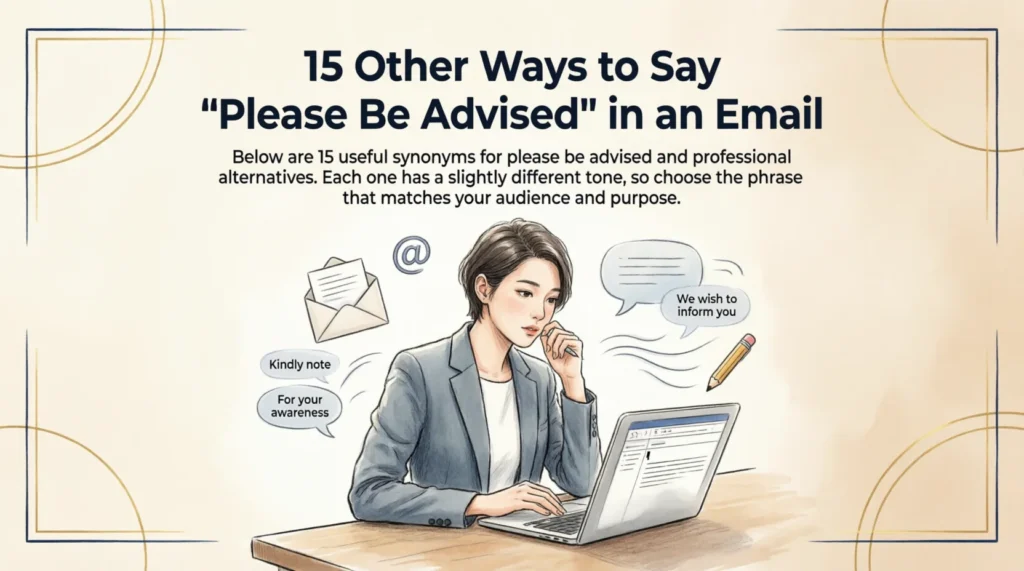
15 Other Ways to Say “Please Be Advised” in an Email
Below are 15 useful synonyms for please be advised and professional alternatives. Each one has a slightly different tone, so choose the phrase that matches your audience and purpose.
1. Please Note
Meaning: Pay attention to or take notice of the following information.
Explanation: “Please note” is one of the best alternatives to “please be advised.” It is professional, short, and natural. It works well in business emails, announcements, instructions, and customer communication.
Example Sentence:
Please note that the meeting will begin at 10 a.m. instead of 11 a.m.
Best Use: Formal, Business, Professional
Worst Use: Very casual conversations with close friends
Tone: Neutral
2. Please Be Aware
Meaning: Know about or understand something important.
Explanation: “Please be aware” is useful when the information may affect the reader. It sounds professional but is usually easier and more natural than “please be advised.”
Example Sentence:
Please be aware that the building will be closed during the public holiday.
Best Use: Business, Formal, Workplace
Worst Use: Very personal or relaxed conversations
Tone: Neutral
3. Kindly Note
Meaning: Please take notice of this information.
Explanation: “Kindly note” is a polite and formal expression. It is common in professional emails, especially when giving instructions or reminders. However, it can sound slightly old-fashioned in some varieties of English.
Example Sentence:
Kindly note that all applications must be submitted by Friday.
Best Use: Formal, Business
Worst Use: Casual chats or friendly personal emails
Tone: Formal
4. I’d Like to Let You Know
Meaning: I want to give you some information.
Explanation: This phrase sounds more personal and friendly. It is a good choice when you want to inform someone without sounding too official.
Example Sentence:
I’d like to let you know that your order has been shipped.
Best Use: Business, Customer Service, Friendly Professional Emails
Worst Use: Very formal legal notices
Tone: Friendly
5. Please Keep in Mind
Meaning: Remember or consider this information.
Explanation: Use “please keep in mind” when the information is something the reader should consider while making a decision or taking action.
Example Sentence:
Please keep in mind that delivery times may vary during the holiday season.
Best Use: Business, Advice, Professional Communication
Worst Use: Extremely formal announcements where a direct notice is required
Tone: Friendly / Neutral
6. Please Take Note
Meaning: Pay attention to this information.
Explanation: “Please take note” clearly tells the reader that something deserves attention. It is formal and direct.
Example Sentence:
Please take note of the updated payment instructions below.
Best Use: Formal, Business, Instructions
Worst Use: Casual conversations
Tone: Formal
7. I Wanted to Let You Know
Meaning: I wanted to give you some information.
Explanation: This is one of the most natural choices for everyday professional emails. It sounds polite without being too formal.
Example Sentence:
I wanted to let you know that the project deadline has been extended.
Best Use: Business, Workplace, Friendly Emails
Worst Use: Legal or highly official notices
Tone: Friendly
8. Just to Let You Know
Meaning: I am giving you this information so you are aware of it.
Explanation: “Just to let you know” is casual and friendly. It works especially well when the information is useful but not extremely serious.
Example Sentence:
Just to let you know, the office will close at 3 p.m. today.
Best Use: Informal, Casual, Friendly Workplace Emails
Worst Use: Formal legal communication
Tone: Friendly
9. I’d Like to Bring to Your Attention
Meaning: I want you to notice or consider something important.
Explanation: This phrase is more formal and emphatic. It is useful when you need to highlight an issue, mistake, requirement, or important detail.
Example Sentence:
I’d like to bring to your attention a change in our company policy.
Best Use: Formal, Business, Professional
Worst Use: Casual messages
Tone: Emphatic
10. Please Be Informed
Meaning: Please know or take notice of this information.
Explanation: “Please be informed” is another formal alternative. It is often used for official announcements or notifications. However, in everyday business English, “please note” usually sounds more natural.
Example Sentence:
Please be informed that the service will be unavailable tomorrow.
Best Use: Formal, Official Notices
Worst Use: Casual workplace conversations
Tone: Formal
11. For Your Information
Meaning: This information is being shared so that you know about it.
Explanation: “For your information,” often shortened to FYI, is common in workplace emails. It usually introduces information rather than a direct request.
Example Sentence:
For your information, the updated schedule is attached to this email.
Best Use: Business, Workplace
Worst Use: When you need the reader to take immediate action
Tone: Neutral
12. I’d Like to Inform You
Meaning: I want to officially give you some information.
Explanation: This phrase is clear and formal. It is useful when communicating an important update, decision, or official change.
Example Sentence:
I’d like to inform you that your application has been approved.
Best Use: Formal, Business, Official Communication
Worst Use: Casual messages
Tone: Formal
13. Please Keep in Mind That
Meaning: Remember that this fact is important when considering something.
Explanation: This version is especially useful when the information may affect a decision or expectation. It is softer than a warning but still draws attention to an important point.
Example Sentence:
Please keep in mind that processing times may be longer during busy periods.
Best Use: Business, Customer Service, Professional Advice
Worst Use: Short emergency instructions
Tone: Neutral
14. I’d Like to Make You Aware
Meaning: I want you to know about something.
Explanation: This phrase directly focuses on awareness. It is polite and professional and can work well when introducing an issue that needs attention.
Example Sentence:
I’d like to make you aware of a change to our return policy.
Best Use: Business, Professional Emails
Worst Use: Very casual conversations
Tone: Neutral
15. Please Take This Into Consideration
Meaning: Please think about this information before making a decision.
Explanation: This is not a direct replacement for “please be advised” in every situation. It works best when you want the reader to consider a fact, condition, or possible result.
Example Sentence:
Please take this into consideration when planning the project timeline.
Best Use: Business, Professional Advice, Formal Communication
Worst Use: Simple announcements where no decision is required
Tone: Emphatic
Quick Comparison of the Best Alternatives
| Alternative | Tone | Best Use |
|---|---|---|
| Please Note | Neutral | Business emails |
| Please Be Aware | Neutral | Workplace communication |
| Kindly Note | Formal | Official emails |
| I’d Like to Let You Know | Friendly | Customer service |
| Please Keep in Mind | Friendly | Advice and reminders |
| I’d Like to Bring to Your Attention | Emphatic | Important issues |
| Just to Let You Know | Friendly | Casual workplace emails |
If you are unsure which expression to choose, “please note” is usually a safe option. It is short, clear, and professional.
How to Choose the Right Alternative
The best formal ways to say please be advised depend on your relationship with the reader and the purpose of your email.
For a Formal Business Email
Choose:
Please note
Please be aware
Kindly note
I’d like to inform you
These phrases are suitable for managers, clients, customers, and official communication.
For a Friendly Workplace Email
Choose:
I wanted to let you know
I’d like to let you know
Just to let you know
These expressions feel more natural when communicating with coworkers you know well.
When You Need to Highlight an Important Issue
Choose:
I’d like to bring to your attention
Please take note
Please keep in mind
These phrases make the important part of your message stand out.
When You Want to Sound Simple and Natural
Choose:
Please note
It is often better to use simple English than unnecessarily formal language.
“Please Be Advised” vs. “Please Note”
These two phrases are very similar, but they do not always feel the same.
Please be advised that the office will close at 4 p.m.
This sounds formal and official.
Please note that the office will close at 4 p.m.
This sounds simpler and more natural.
For most modern workplace emails, “please note” is often the stronger choice because it gives the same information with fewer words.
“Please Be Advised” vs. “I’d Like to Let You Know”
The main difference is tone.
Please be advised that your appointment has changed.
This sounds official.
I’d like to let you know that your appointment has changed.
This sounds warmer and more personal.
If you are communicating with a customer or colleague and want to build a friendly relationship, the second option may work better.
Common Mistakes to Avoid
When using alternatives to please be advised, avoid choosing a phrase only because it sounds more formal.
More formal does not always mean better.
For example, this can sound unnecessarily stiff:
Kindly be informed that your request has been received.
A simpler version is often better:
We’ve received your request.
Likewise, avoid using “please be advised” for every piece of information. If the message is simple, direct language can make your writing stronger.
Instead of:
Please be advised that the meeting starts at 9 a.m.
You can write:
The meeting starts at 9 a.m.
The best professional writing is usually clear, polite, and appropriate for the situation.
FAQs
What is the most professional alternative to “please be advised”?
“Please note” is one of the safest and most natural professional alternatives. It is clear, polite, and suitable for most business emails.
Is “please be advised” rude?
No. “Please be advised” is not rude, but it can sound formal, distant, or official. A friendlier alternative may be better for casual communication.
What is a friendly way to say “please be advised”?
You can say “I wanted to let you know” or “I’d like to let you know.” Both sound polite and warm.
Can I use “FYI” instead of “please be advised”?
Sometimes. FYI, meaning “for your information,” works when you are simply sharing information. It is less suitable when you expect the reader to take action.
What is the best alternative to “please be advised” in an email?
For most professional emails, “please note” is an excellent choice. For a warmer tone, use “I wanted to let you know.”
Conclusion
Using different expressions can make your English sound more natural, confident, and flexible.
While “please be advised” is correct and professional, it can sometimes feel too formal for modern workplace communication.
The best other ways to say please be advised in an email include “please note,” “please be aware,” “I wanted to let you know,” and “please keep in mind.” Each phrase has a slightly different tone and purpose.
Before choosing an alternative, think about your reader, your relationship, and the message you want to deliver.
With practice, you can move easily between formal, neutral, and friendly English and make every email sound more natural.

Alden Rowen is the author behind Meanings Path, sharing clear and reliable insights into the meanings, origins, and significance of words, names, and phrases. His goal is to make language simple, useful, and easy to understand.