
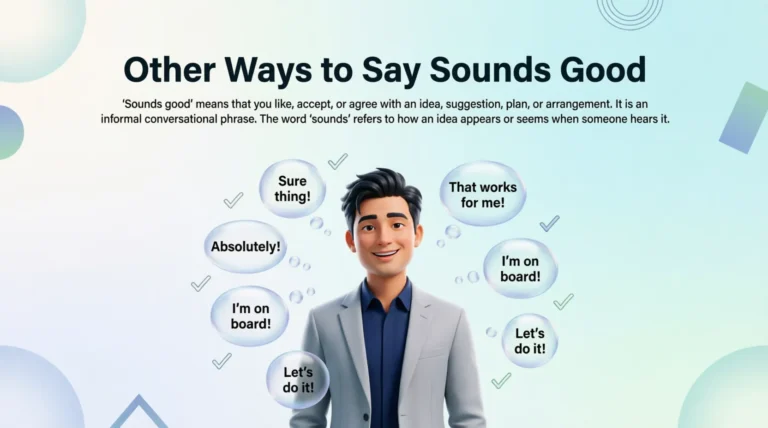
Saying “sounds good” is a simple way to show that you agree with an idea, plan, suggestion, or request.
It is common in everyday English and works well in many conversations.
However, using the same phrase again and again can make your communication feel repetitive.
Learning other ways to say sounds good can help you sound more natural, confident, and flexible.
Different alternatives also show different levels of enthusiasm, politeness, and professionalism.
For example, “That works for me” is useful at work, while “Awesome!” is better for a casual chat.
In this guide, you will learn 22 useful synonyms for sounds good and understand when to use each one.
These alternatives to sounds good will help you communicate clearly in emails, meetings, messages, and everyday conversations.
What Does “Sounds Good” Mean?
“Sounds good” means that you like, accept, or agree with an idea, suggestion, plan, or arrangement.
It is an informal conversational phrase. The word “sounds” refers to how an idea appears or seems when someone hears it.
For example:
“How about meeting at 3 p.m.?”
“Sounds good!”
Here, the speaker means, “I agree with that plan” or “That works for me.”
“Sounds good” is usually friendly and positive. It can be used in spoken English, text messages, chats, and informal emails.
When to Use “Sounds Good”
You can use “sounds good” in many everyday situations.
In Casual Conversations
It works well with friends, family, and people you know well.
“Let’s grab dinner tonight.”
“Sounds good!”
At Work
You can use it with coworkers when the workplace is relaxed.
“I’ll send you the updated report this afternoon.”
“Sounds good.”
For very formal communication, however, a more professional phrase may be better.
In Text Messages
“Sounds good” is extremely common in texts and online chats.
“I’ll call you after work.”
“Sounds good!”
In Emails
It can work in friendly workplace emails, but it may sound slightly casual in formal business communication.
Instead, you might write:
“That works for me.”
or
“I agree with this approach.”
Is It Professional or Polite to Say “Sounds Good”?
Yes, “sounds good” is polite and positive, but its level of professionalism depends on the situation.
In a friendly workplace, it is perfectly acceptable.
“The meeting will start at 10 instead.”
“Sounds good. Thanks for letting me know.”
In a formal email to a client, manager, or senior executive, you may want a more polished expression.
For example:
“That works well for me.”
or
“I’m happy to proceed with this plan.”
The key is to match your words to the relationship and situation.
Pros and Cons of Using “Sounds Good”
Pros
- Simple: It is easy to understand.
- Friendly: It creates a positive tone.
- Natural: Native speakers use it often.
- Flexible: It works in many everyday situations.
- Quick: It is useful for short replies.
Cons
- Can sound repetitive: Using it too often may make your language less varied.
- Can be too casual: It may not fit very formal situations.
- May show limited enthusiasm: Sometimes you want to sound more excited.
- Can be vague: It does not always explain exactly what you agree with.
22 Alternatives to “Sounds Good”
Below are 22 useful other ways to say sounds good, ranging from casual expressions to professional phrases.
1. That Works for Me
Meaning: I agree with the plan or suggestion.
Explanation: This is one of the best alternatives to “sounds good.” It clearly shows that a plan is acceptable to you. It is especially useful when discussing times, dates, meetings, or arrangements.
Example Sentence: “Tuesday at 2 p.m. works for me.”
Best Use: Business, Formal, Neutral
Worst Use: When you want to show strong excitement.
Tone: Neutral
2. That Sounds Great
Meaning: I think the idea is very good.
Explanation: This phrase is slightly more enthusiastic than “sounds good.” It shows agreement while adding a stronger positive feeling.
Example Sentence: “You’re planning a team lunch on Friday? That sounds great!”
Best Use: Friendly, Casual, Business
Worst Use: Very formal legal or official documents.
Tone: Friendly
3. Perfect
Meaning: The idea or arrangement is exactly right.
Explanation: “Perfect” is short and confident. It is useful when someone gives you a time, solution, or arrangement that you completely accept.
Example Sentence: “Let’s meet at 4 p.m.” — “Perfect!”
Best Use: Casual, Business
Worst Use: Situations where you need to express a detailed response.
Tone: Emphatic
4. Great
Meaning: I like or approve of the idea.
Explanation: This is a simple and flexible response. It is common in both spoken conversations and workplace chats.
Example Sentence: “I’ll send the files before lunch.” — “Great, thank you.”
Best Use: Friendly, Business, Casual
Worst Use: Highly formal written communication.
Tone: Friendly
5. Absolutely
Meaning: I completely agree.
Explanation: “Absolutely” shows stronger agreement than “sounds good.” It can communicate confidence and enthusiasm.
Example Sentence: “Can we move the meeting to Thursday?” — “Absolutely.”
Best Use: Business, Friendly, Formal
Worst Use: When you are not actually certain or do not fully agree.
Tone: Emphatic
6. I’m In
Meaning: I want to participate or join.
Explanation: This is a casual way to accept an invitation, activity, or plan. It is common among friends and coworkers in relaxed settings.
Example Sentence: “We’re going hiking this weekend.” — “I’m in!”
Best Use: Informal, Casual
Worst Use: Formal business emails.
Tone: Friendly
7. Count Me In
Meaning: Include me in the plan.
Explanation: This phrase shows that you want to participate. It is warmer and more enthusiastic than a simple agreement.
Example Sentence: “We’re ordering pizza for the team. Count me in!”
Best Use: Casual, Friendly
Worst Use: Formal client communication.
Tone: Friendly
8. I’m Good With That
Meaning: I accept or agree with that.
Explanation: This is a natural conversational alternative. It works well when someone proposes an option and you have no objection.
Example Sentence: “Would you prefer to meet online?” — “I’m good with that.”
Best Use: Informal, Casual, Workplace
Worst Use: Very formal business letters.
Tone: Neutral
9. I Agree
Meaning: I have the same opinion or accept the suggestion.
Explanation: “I agree” is direct and clear. It is more neutral than many casual alternatives and can work in professional settings.
Example Sentence: “I think we should review the proposal again.” — “I agree.”
Best Use: Business, Formal, Neutral
Worst Use: When you want to sound especially excited.
Tone: Neutral
10. That’s Fine With Me
Meaning: I accept the suggestion or arrangement.
Explanation: This phrase shows that you have no problem with something. It is useful when discussing plans or choices.
Example Sentence: “We can start the meeting at noon.” — “That’s fine with me.”
Best Use: Neutral, Business, Informal
Worst Use: When you want to communicate strong excitement.
Tone: Neutral
11. I’m Happy With That
Meaning: I am satisfied with the suggestion or result.
Explanation: This phrase communicates clear acceptance. It can sound more polished than “sounds good.”
Example Sentence: “We can use the updated design.” — “I’m happy with that.”
Best Use: Business, Professional, Friendly
Worst Use: When you strongly disagree with the proposal.
Tone: Friendly
12. I’m Happy to Proceed
Meaning: I am willing and ready to continue.
Explanation: This is a strong formal way to say sounds good. It is particularly useful in professional emails and business discussions.
Example Sentence: “If everything looks correct, we can begin tomorrow.” — “I’m happy to proceed.”
Best Use: Formal, Business
Worst Use: Casual conversations with close friends.
Tone: Formal
13. That’s a Good Idea
Meaning: I think the suggestion is useful or positive.
Explanation: This phrase directly praises someone’s suggestion. It is useful when you want to explain why you agree.
Example Sentence: “Why don’t we create a shared document?” — “That’s a good idea.”
Best Use: Business, Friendly, Casual
Worst Use: When you want to express complete acceptance of an entire plan.
Tone: Neutral
14. That Makes Sense
Meaning: I understand and agree that the idea is logical.
Explanation: “That makes sense” is useful when someone explains a reason, decision, or solution. It focuses more on logic than excitement.
Example Sentence: “We should postpone the launch because the testing is not finished.” — “That makes sense.”
Best Use: Business, Formal, Neutral
Worst Use: When you simply want to accept an invitation.
Tone: Neutral
15. Sounds Perfect
Meaning: The proposed plan is exactly what I want.
Explanation: This is a stronger and more enthusiastic version of “sounds good.” It works well when confirming arrangements.
Example Sentence: “I’ll pick you up at 7:30.” — “Sounds perfect!”
Best Use: Friendly, Casual, Business
Worst Use: Very formal documents.
Tone: Emphatic
16. Excellent
Meaning: Very good; I strongly approve.
Explanation: “Excellent” sounds more polished and professional. It can be useful when responding positively in workplace conversations.
Example Sentence: “The client approved the proposal.” — “Excellent.”
Best Use: Business, Formal
Worst Use: Casual conversations where it may sound overly formal.
Tone: Formal
17. Fantastic
Meaning: Extremely good or exciting.
Explanation: This word expresses strong enthusiasm. It is ideal when you want your response to sound energetic and positive.
Example Sentence: “We got permission to use the new office.” — “Fantastic!”
Best Use: Friendly, Casual, Workplace
Worst Use: Serious situations where an excited tone would be inappropriate.
Tone: Emphatic
18. I’m All for It
Meaning: I strongly support the idea.
Explanation: This expression shows clear support. It is more enthusiastic than simply saying “sounds good.”
Example Sentence: “I think we should offer flexible working hours.” — “I’m all for it.”
Best Use: Informal, Friendly, Workplace
Worst Use: Very formal correspondence.
Tone: Emphatic
19. I’m on Board
Meaning: I agree with and support the plan.
Explanation: “I’m on board” is common in workplace English. It shows that you support a decision or are willing to participate.
Example Sentence: “We want to change the project schedule.” — “I’m on board with that.”
Best Use: Business, Workplace
Worst Use: Highly formal academic or legal writing.
Tone: Neutral
20. Agreed
Meaning: I agree with the proposal or decision.
Explanation: “Agreed” is concise and professional. It is especially useful in meetings, workplace chats, and emails.
Example Sentence: “Let’s focus on the most important tasks first.” — “Agreed.”
Best Use: Business, Formal, Neutral
Worst Use: When you need to provide a detailed explanation.
Tone: Neutral
21. I’d Be Happy to
Meaning: I am willing to do something.
Explanation: This is a polite and professional response when someone asks you to complete an action. It sounds warmer than simply saying “yes.”
Example Sentence: “Could you review the document?” — “I’d be happy to.”
Best Use: Business, Formal, Professional
Worst Use: When you do not actually want to do the task.
Tone: Friendly
22. Let’s Do It
Meaning: I agree and want to move forward.
Explanation: This phrase shows strong enthusiasm and readiness to act. It is much more energetic than “sounds good.”
Example Sentence: “Are you ready to launch the new campaign?” — “Let’s do it!”
Best Use: Casual, Friendly, Informal Workplace
Worst Use: Formal emails or serious official decisions.
Tone: Emphatic
Quick Comparison of Top Alternatives
| Phrase | Tone | Best Setting |
|---|---|---|
| That Works for Me | Neutral | Business |
| That Sounds Great | Friendly | Casual & Workplace |
| I Agree | Neutral | Formal & Business |
| I’m Happy to Proceed | Formal | Professional |
| That Makes Sense | Neutral | Business |
| I’m on Board | Friendly/Neutral | Workplace |
| Let’s Do It | Emphatic | Casual |
FAQs About Other Ways to Say “Sounds Good”
1. What is the best formal way to say “sounds good”?
“That works for me” is one of the best professional alternatives. “I’m happy to proceed” is also useful when you want to sound more formal.
2. What is a friendly way to say “sounds good”?
You can say “That sounds great,” “Perfect,” “Awesome,” or “Let’s do it.” These expressions sound warm and positive.
3. Is “sounds good” professional?
Yes. “Sounds good” is polite and acceptable in many workplaces. However, more formal alternatives may be better for clients, official emails, and highly professional situations.
4. What can I say instead of “sounds good” in an email?
Try “That works for me,” “I agree,” “That makes sense,” or “I’m happy to proceed.” Choose the phrase based on how formal the email is.
5. What is the difference between “sounds good” and “sounds great”?
Both show agreement. “Sounds great” usually expresses more enthusiasm, while “sounds good” is more neutral.
Conclusion
Learning other ways to say sounds good gives you more control over your English.
You can choose a casual phrase such as “I’m in” with friends or a professional option such as “I’m happy to proceed” at work.
Some expressions show simple agreement, while others show excitement, support, or strong approval.
The best phrase depends on your audience, relationship, and situation.
Instead of repeating “sounds good” every time, try different alternatives and notice how they change your tone.
With regular practice, these synonyms for sounds good can help you sound more natural, fluent, and confident in English.

Alden Rowen is the author behind Meanings Path, sharing clear and reliable insights into the meanings, origins, and significance of words, names, and phrases. His goal is to make language simple, useful, and easy to understand.