The word “pardon” is a polite way to ask someone to repeat what they said, or to show that you are sorry for a small mistake.
It is correct English, but it can sound formal or old-fashioned in some everyday situations.
That is why learning other ways to say pardon can help you sound more natural and confident.
The best alternative depends on the situation.
You may say “Could you repeat that?” in a professional meeting, “Sorry?” with a friend, or “Excuse me?” when you did not hear someone clearly.
Choosing the right phrase also changes your tone.
Some expressions sound warm and friendly, while others are more formal and respectful.
This guide explains 20 alternatives to pardon, with meanings, examples, tones, and practical advice for English learners and professionals.
What Does “Pardon” Mean?
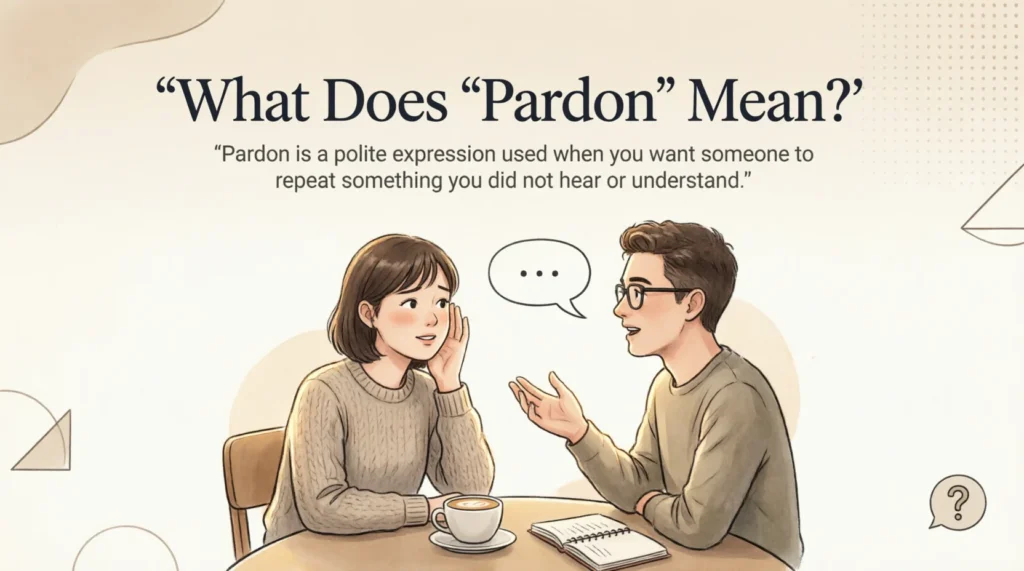
Pardon is a polite expression used when you want someone to repeat something you did not hear or understand.
For example:
“Pardon? Could you say that again?”
It can also be used as a polite apology:
“Pardon me for interrupting.”
As a verb, pardon can mean to forgive someone. For example:
“Please pardon my mistake.”
However, in everyday conversation, people often use “pardon?” as a short request for repetition.
Grammar of “Pardon”
Pardon can work as a verb, noun, or polite expression.
- Pardon? — a polite request to repeat something.
- Pardon me. — a polite apology or request for attention.
- Please pardon my mistake. — asking someone to forgive an error.
- A pardon — an act of officially forgiving someone, especially in a legal context.
For everyday English, the first two uses are the most useful.
When to Use “Pardon”
You can use pardon in both spoken and written English, but the situation matters.
Formal situations
Pardon works well when you want to sound respectful.
“Pardon, could you clarify the last point?”
It may be suitable when speaking with a customer, senior colleague, teacher, or someone you do not know well.
Informal situations
With friends and family, “Sorry?” or “What was that?” may sound more natural.
“Sorry? I didn’t hear you.”
Pardon? is still correct, but it can sound more careful or formal than necessary.
Professional communication
In business settings, avoid very casual expressions such as “Huh?” or “What?”. A phrase such as “Could you repeat that, please?” sounds clearer and more professional.
Written English
In an email or formal message, it is often better to write a complete sentence.
Instead of:
“Pardon?”
Try:
“Could you please repeat the last part of your message?”
This sounds more professional and gives the reader a clear request.
Is It Professional or Polite to Say “Pardon”?
Yes. Pardon is polite and grammatically correct. It has a respectful tone and is often associated with formal or careful English.
However, polite does not always mean natural in every situation.
For example, saying “Pardon?” to a close friend is perfectly acceptable, but “Sorry?” may sound more relaxed.
In a workplace, pardon can be useful when you did not hear someone clearly. Still, a longer phrase can be even better because it removes ambiguity.
Compare these examples:
- “Pardon?” — polite and brief.
- “Sorry, could you repeat that?” — polite and friendly.
- “Could you please repeat the last point?” — professional and clear.
- “What?” — direct and potentially rude.
The key is to match your words to the person, setting, and tone.
Pros and Cons of Using “Pardon”
Pros
- It is polite.
- It is short and easy to say.
- It works in formal situations.
- It can show respect.
- It is useful when you did not hear someone.
- It can be used as a polite apology.
Cons
- It may sound formal in casual conversation.
- Some learners may use it too often.
- “Pardon?” does not always explain what you need repeated.
- Younger speakers may prefer “Sorry?” or “Can you say that again?”
- In professional writing, a complete sentence is often clearer.
Learning several synonyms for pardon gives you more control over your English. You can choose a phrase that fits the situation instead of using the same expression every time.
20 Alternatives to “Pardon”
1. Sorry?
Meaning: A polite way to ask someone to repeat something.
Explanation: Sorry? is one of the most common everyday alternatives to pardon. It is short, natural, and easy to use. The rising tone of your voice usually shows that you want the person to repeat what they said.
Example Sentence:
“Sorry? I didn’t catch your name.”
Best Use: Informal, Casual, Friendly
Worst Use: Very formal written communication where a complete request would be clearer.
Tone: Friendly / Neutral
2. Excuse me?
Meaning: A polite request for clarification or repetition.
Explanation: Excuse me? can be used when you did not hear someone. It can also get someone’s attention. Because it has several uses, your tone and context are important.
Example Sentence:
“Excuse me? Could you repeat the address?”
Best Use: Formal, Business, Spoken
Worst Use: Extremely casual conversations where it may sound unnecessarily formal.
Tone: Polite / Formal
3. Could you repeat that, please?
Meaning: A polite request for someone to say something again.
Explanation: This is one of the clearest formal ways to say pardon. It tells the listener exactly what you need. It works especially well in meetings, classrooms, interviews, and customer service.
Example Sentence:
“Could you repeat that, please? I missed the last part.”
Best Use: Business, Formal, Professional
Worst Use: Very quick conversations with close friends.
Tone: Formal / Polite
4. Could you say that again?
Meaning: A polite request for repetition.
Explanation: This phrase is slightly more relaxed than “Could you repeat that, please?” It is useful in both professional and everyday conversations.
Example Sentence:
“Could you say that again? I was looking at the report.”
Best Use: Business, Informal, Spoken
Worst Use: Situations where you need a highly formal written request.
Tone: Neutral / Friendly
5. Would you mind repeating that?
Meaning: A polite way to ask someone to say something again.
Explanation: Would you mind… makes the request softer. It is useful when you want to show extra courtesy.
Example Sentence:
“Would you mind repeating that? I want to make sure I understood correctly.”
Best Use: Formal, Business, Professional
Worst Use: Very fast, casual conversations where a shorter phrase is more natural.
Tone: Formal / Respectful
6. Could you clarify that?
Meaning: A request for someone to explain something more clearly.
Explanation: This is not exactly the same as pardon. Use it when you heard the words but did not understand the meaning. It is especially useful in professional communication.
Example Sentence:
“Could you clarify that point before we continue?”
Best Use: Business, Formal, Academic
Worst Use: When you simply did not hear the speaker.
Tone: Professional / Neutral
7. Could you speak up, please?
Meaning: A polite request for someone to speak louder.
Explanation: Use this phrase when you heard the speaker but their voice was too quiet. It is a useful alternative when the problem is volume rather than understanding.
Example Sentence:
“Could you speak up, please? I’m having trouble hearing you.”
Best Use: Business, Classroom, Formal
Worst Use: When the speaker is already speaking loudly.
Tone: Polite / Neutral
8. I didn’t catch that.
Meaning: A friendly way to say that you did not hear or understand something.
Explanation: Catch here means understand or hear. This phrase is very common in natural spoken English. It sounds less formal than pardon.
Example Sentence:
“Sorry, I didn’t catch that. What did you say?”
Best Use: Informal, Casual, Friendly
Worst Use: Very formal documents.
Tone: Friendly / Casual
9. I didn’t hear you.
Meaning: A direct statement that you could not hear what someone said.
Explanation: This phrase is simple and clear. It works well when background noise, distance, or a quiet voice causes the problem.
Example Sentence:
“I didn’t hear you. Could you say it again?”
Best Use: Casual, Informal, Spoken
Worst Use: Situations where you need a very polished business tone.
Tone: Neutral / Friendly
10. Can you say that again?
Meaning: A direct but polite request for repetition.
Explanation: This is common in everyday English. Can you… is less formal than could you…, but it is still polite when spoken with a friendly tone.
Example Sentence:
“Can you say that again? I was distracted for a second.”
Best Use: Informal, Casual, Workplace conversations
Worst Use: Highly formal letters or official communication.
Tone: Friendly / Neutral
11. What did you say?
Meaning: A question asking someone to repeat their words.
Explanation: This phrase is common, but its tone depends heavily on your voice. A soft tone can sound normal. A sharp tone can sound annoyed.
Example Sentence:
“What did you say? I couldn’t hear you.”
Best Use: Casual, Informal
Worst Use: Formal business meetings when a more polite phrase is available.
Tone: Neutral / Casual
12. What was that?
Meaning: A casual request for repetition.
Explanation: This expression is more informal than pardon. It is common among friends, family members, and people who are comfortable with each other.
Example Sentence:
“What was that? I didn’t hear the last sentence.”
Best Use: Casual, Informal
Worst Use: Formal customer service or professional correspondence.
Tone: Casual / Friendly
13. I’m sorry, I didn’t hear you.
Meaning: A polite statement explaining that you missed what someone said.
Explanation: This phrase is helpful because it explains the reason for your request. It sounds more courteous than simply saying “What?”
Example Sentence:
“I’m sorry, I didn’t hear you. Could you repeat the question?”
Best Use: Formal, Business, Everyday
Worst Use: Situations where you need an extremely short response.
Tone: Polite / Friendly
14. Sorry, I missed that.
Meaning: A friendly way to say you did not hear or understand something.
Explanation: Missed that is natural conversational English. It is useful when someone speaks quickly or when you become distracted for a moment.
Example Sentence:
“Sorry, I missed that. Did you say Tuesday or Thursday?”
Best Use: Casual, Workplace, Informal
Worst Use: Very formal legal or official writing.
Tone: Friendly / Neutral
15. I beg your pardon?
Meaning: A very polite or formal request for repetition.
Explanation: I beg your pardon? is a traditional expression. It can sound elegant and formal, but in some situations it may sound old-fashioned. It can also express surprise or offense, depending on the speaker’s tone.
Example Sentence:
“I beg your pardon? Could you explain what you mean?”
Best Use: Formal, Polite
Worst Use: Relaxed conversations where simple modern English is preferred.
Tone: Formal / Emphatic
16. Could you repeat the last part?
Meaning: A specific request to hear the final part again.
Explanation: This is more precise than simply saying pardon. It tells the speaker exactly what you missed, which is helpful in meetings, presentations, and lessons.
Example Sentence:
“Could you repeat the last part? I want to write down the deadline.”
Best Use: Business, Academic, Professional
Worst Use: Very casual conversations where the detail is unnecessary.
Tone: Professional / Neutral
17. Could you go over that again?
Meaning: A request for someone to repeat or explain something.
Explanation: Go over means review or explain something again. It is especially useful when you did not fully understand an explanation rather than simply failing to hear it.
Example Sentence:
“Could you go over that again? I’m not sure how this process works.”
Best Use: Business, Academic, Professional
Worst Use: When you only need one word repeated.
Tone: Friendly / Professional
18. I didn’t quite understand.
Meaning: A polite way to say that something was not clear.
Explanation: This phrase focuses on understanding rather than hearing. It is useful when the speaker’s words were audible but the meaning was unclear.
Example Sentence:
“I didn’t quite understand. Could you explain the last point?”
Best Use: Business, Formal, Academic
Worst Use: When you simply could not hear the person.
Tone: Polite / Neutral
19. Could you explain that again?
Meaning: A polite request for another explanation.
Explanation: This is a strong choice when a topic is difficult or confusing. It asks for more than repetition. You are asking the speaker to explain the idea again.
Example Sentence:
“Could you explain that again? I’m new to this process.”
Best Use: Business, Academic, Professional
Worst Use: When you only missed a few words.
Tone: Polite / Professional
20. Sorry, could you say that one more time?
Meaning: A warm and polite request for repetition.
Explanation: This phrase combines an apology with a clear request. It sounds natural in everyday English and can also work in friendly workplace conversations.
Example Sentence:
“Sorry, could you say that one more time? I want to make sure I have the correct number.”
Best Use: Informal, Workplace, Friendly
Worst Use: Highly formal documents where a more formal sentence may be better.
Tone: Friendly / Polite
Quick Comparison of the Best Alternatives
| Alternative | Tone | Best Setting | Formality |
|---|---|---|---|
| Sorry? | Friendly | Everyday conversation | Low |
| Excuse me? | Polite | Public or professional settings | Medium |
| Could you repeat that, please? | Professional | Business | High |
| Could you clarify that? | Professional | Meetings and academic settings | High |
| I didn’t catch that. | Friendly | Casual conversation | Low |
| Would you mind repeating that? | Respectful | Formal situations | High |
| Could you say that again? | Neutral | Everyday and workplace English | Medium |
The best alternatives to pardon depend on what actually happened. If you did not hear the speaker, ask them to repeat the words. If you heard the words but did not understand them, ask them to clarify or explain.
How to Choose the Right Alternative
Choosing the right expression is easier when you think about three things: relationship, setting, and meaning.
If you are talking to a friend
Use:
- Sorry?
- What did you say?
- Can you say that again?
- I didn’t catch that.
These phrases sound natural and relaxed.
If you are in a business meeting
Use:
- Could you repeat that, please?
- Could you clarify that?
- Would you mind repeating that?
- Could you repeat the last part?
These expressions sound respectful and professional.
If you did not understand an idea
Do not always say pardon. Try:
- Could you clarify that?
- Could you explain that again?
- I didn’t quite understand.
- Could you go over that again?
These phrases show that you need an explanation, not simply repetition.
If you cannot hear someone
Try:
- Could you speak up, please?
- I’m sorry, I didn’t hear you.
- Could you say that again?
This makes the problem clear.
Common Mistakes English Learners Make
One common mistake is using “What?” in every situation. While it is grammatically correct, it can sound abrupt.
For example:
“What?”
may sound annoyed.
A better choice is:
“Sorry, could you repeat that?”
Another mistake is using “I don’t understand” when the real problem is that you could not hear the speaker.
Compare:
“I didn’t hear you.”
This means the sound was unclear.
“I didn’t understand.”
This means you heard the words but did not understand their meaning.
This small difference can make your English much more precise.
Another mistake is assuming that every synonym for pardon has exactly the same meaning. They do not. Some expressions ask for repetition, while others ask for clarification, attention, or an apology.
FAQs
1. What is the most natural alternative to “pardon”?
“Sorry?” is one of the most natural alternatives in everyday spoken English. In professional situations, “Could you repeat that, please?” is often a better choice.
2. What is a formal way to say “pardon”?
You can say “Could you repeat that, please?”, “Would you mind repeating that?”, or “Could you clarify that?” These expressions work well in professional settings.
3. Is “excuse me” the same as “pardon”?
They can have a similar meaning when you did not hear someone. However, excuse me can also be used to get attention, make a polite interruption, or apologize for moving past someone.
4. Is “pardon?” old-fashioned?
Pardon? is not incorrect or obsolete. However, it can sound more formal than “Sorry?” or “Could you say that again?” in some modern conversations.
5. What should I say instead of “pardon” at work?
Try “Could you repeat that, please?” or “Could you clarify that point?” These phrases are clear, polite, and professional.
Conclusion
Learning other ways to say pardon can make your English sound more natural and flexible.
Pardon is polite, but it is only one option.
In casual conversations, “Sorry?” or “I didn’t catch that” may sound warmer.
In professional settings, “Could you repeat that, please?” or “Could you clarify that?” can sound clearer and more confident.
The key is to choose words that match the situation.
Try these alternatives in conversations, meetings, classes, and emails.
With practice, you will know when to sound casual, friendly, respectful, or highly professional.

Alden Rowen is the author behind Meanings Path, sharing clear and reliable insights into the meanings, origins, and significance of words, names, and phrases. His goal is to make language simple, useful, and easy to understand.