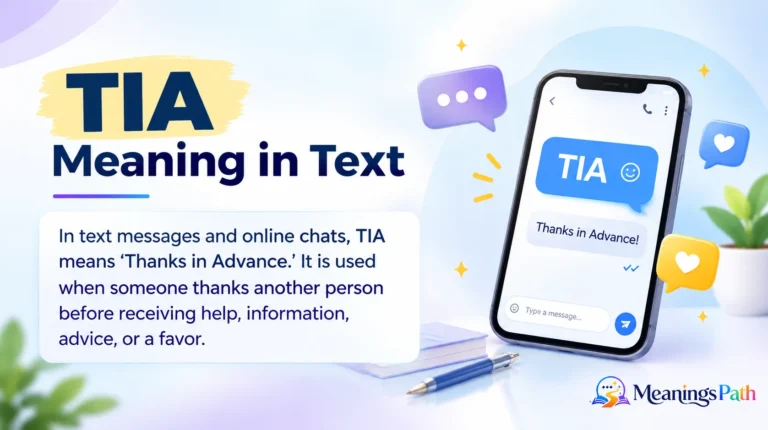
The TIA meaning text usually refers to “Thanks in Advance.” People use TIA in text messages, emails, and online discussions when they want to thank someone before that person has helped them.
For example, someone might write, “Can you send me the notes? TIA!” to show appreciation for a favor they are asking for. It is a short and convenient way to sound polite without typing a full sentence.
You may see TIA in WhatsApp messages, Instagram comments, workplace emails, online forums, and group chats.
Although “Thanks in Advance” is the most common meaning in everyday written communication, TIA can have other meanings in medical or specialized contexts.
In this guide, you will learn what TIA means, how people use it, whether it sounds polite or demanding, and how to reply when someone includes it in a message.
| Quick detail | Answer |
|---|---|
| Term | TIA |
| Most common meaning | Thanks in Advance |
| Full form | Thanks in Advance |
| Typical tone | Polite, friendly, or professional |
| Common usage | Text messages, emails, requests, and online discussions |
What Does TIA Mean in Text & Chat?
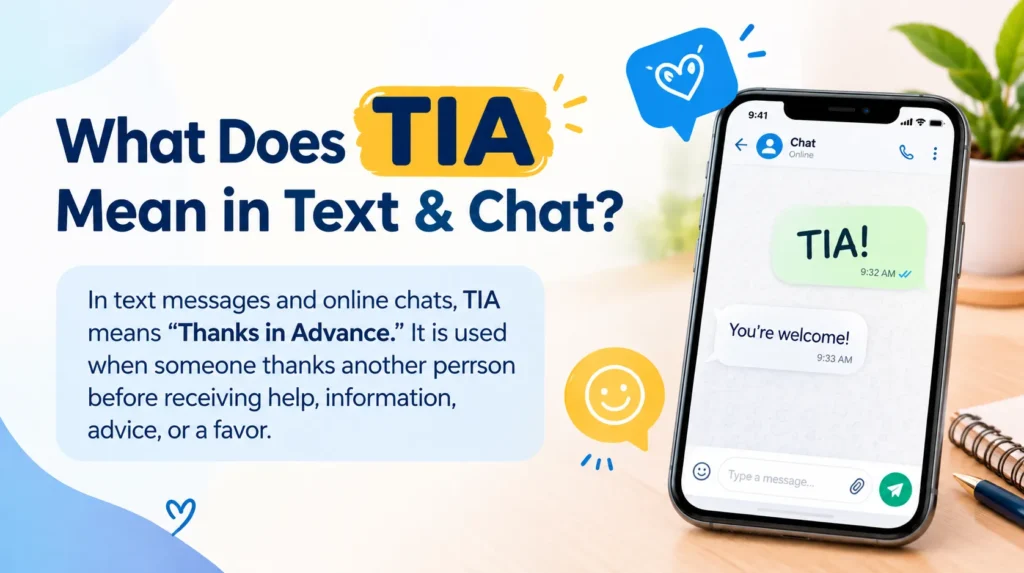
In text messages and online chats, TIA means “Thanks in Advance.” It is used when someone thanks another person before receiving help, information, advice, or a favor.
For example:
- “Can you share the meeting notes? TIA!”
- “Does anyone know how to fix this problem? TIA.”
- “Please send me the address when you can. TIA 😊”
In each example, the sender is expressing appreciation ahead of time. They expect that someone may help, but they have not received that help yet.
Why Do People Use TIA?
People use TIA to keep messages short while showing appreciation. Instead of writing “Thank you in advance for your help,” they can use three letters.
It is especially useful when asking a group of people for information or requesting a small favor. You may see it in class groups, work chats, community forums, and online discussions.
Is TIA Polite or Rude?
TIA is usually polite, but its tone depends on the rest of the message. A friendly request followed by TIA can sound warm and appreciative.
However, if someone gives a demanding instruction and adds TIA, the message may sound as if they expect others to help without asking. For example, “Send this to me now. TIA.” can sound pushy because of the words “now” and the lack of a polite request.
To keep the tone friendly, use TIA with a clear, respectful request. It is also helpful to thank someone again after they actually help you.
Full Form, Stands For & Short Meaning of TIA
The full form of TIA in everyday messages is “Thanks in Advance.” It expresses gratitude for help that the sender hopes to receive.
The phrase has three parts:
- Thanks: Shows appreciation.
- In: Connects the expression.
- Advance: Means before something happens.
Together, the words communicate that the sender is thankful before the other person completes the requested action.
TIA Meaning in Simple English
In simple English, TIA means “Thank you beforehand.”
For example:
Person A: “Could you explain this question to me? TIA!”
Person B: “Sure! Send me the question, and I’ll help.”
Person A uses TIA to thank Person B before receiving an explanation.
TIA vs. Thank You
TIA and “thank you” both express appreciation, but they are used at different stages.
| Expression | When it is used | Example |
|---|---|---|
| TIA | Before receiving help | “Can you check this? TIA.” |
| Thank you | Before or after help, depending on context | “Thank you for checking this.” |
| Thanks in advance | Before expected help | “Thanks in advance for your time.” |
| Thanks anyway | When help is unavailable or no longer needed | “Thanks anyway for trying.” |
TIA is convenient in short messages, while the full phrase may sound more natural in a formal email.
Can TIA Have Other Full Forms?
Yes. TIA can have other meanings in specialized settings. In medicine, for example, it can stand for “transient ischemic attack,” a temporary interruption of blood flow to part of the brain that requires urgent medical attention.
However, in ordinary texts and emails, “Thanks in Advance” is the likely meaning when the sender is asking for help or information. Always consider the subject of the conversation before deciding which expansion applies.
Origin, History & First Known Use of TIA
TIA developed as a convenient abbreviation for “Thanks in Advance,” a phrase people use when requesting help or information. The full expression makes sense in letters and emails because the sender can show gratitude before the recipient responds.
The abbreviation fits the broader habit of shortening common phrases in digital communication. Text messages, emails, and online discussions often use initial letters to save typing time and make requests quicker to read.
How Did TIA Become Common in Written Communication?
The full phrase “Thanks in Advance” is useful whenever a person asks another person to do something. TIA shortens it without changing the basic idea.
For example, someone posting a question in an online community may want to thank several people who could offer an answer. Adding TIA provides a brief expression of appreciation at the end of the request.
It is also useful in workplace communication, where people often need to request documents, feedback, or information from colleagues.
When Was TIA First Used?
There is no single verified first-use date that should be presented as the origin of TIA in every context. Abbreviations can develop gradually, and the same letters may be used independently for different phrases.
It would therefore be misleading to name a specific person, website, or year as the definite source without reliable evidence.
Why Has the Abbreviation Remained Useful?
TIA is short, recognizable to many readers, and easy to add to a request. It can help a message sound appreciative without requiring a long closing sentence.
Still, the abbreviation is not suitable for every audience. If you are writing to someone who may not know it, spelling out “Thanks in advance” is clearer and more professional.
How People Use TIA in Daily Conversations
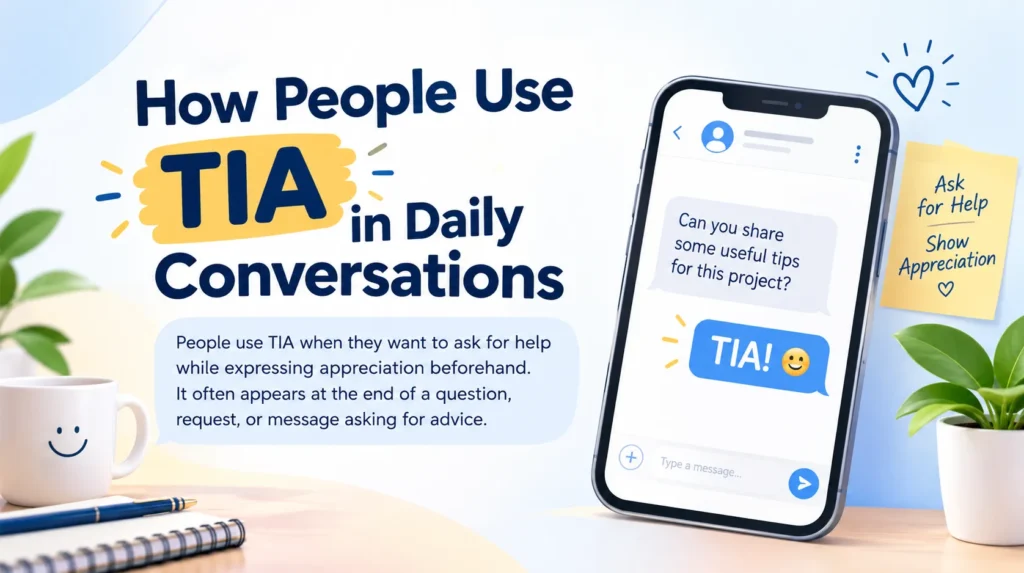
People use TIA when they want to ask for help while expressing appreciation beforehand. It often appears at the end of a question, request, or message asking for advice.
Its meaning stays the same in most everyday situations, but its tone can change with the wording around it.
Asking for Information
One common use is asking a question in a group chat or online community.
Person A: “Does anyone know which bus goes to the city center? TIA!”
Person B: “Take the number 12 bus from the main stop.”
TIA shows that Person A appreciates anyone who can provide a useful answer.
Requesting a Favor From a Friend
Friends may use TIA when asking for notes, a photo, or a small favor.
Person A: “Can you send me the pictures from yesterday? TIA 😊”
Person B: “Of course! I’ll send them now.”
The smile emoji helps the request sound friendly. The sender is thanking the other person before the pictures arrive.
Using TIA at Work
TIA can appear in informal workplace messages when a colleague needs a document or review.
For example:
“Could you review the attached file before the meeting? TIA.”
This is brief and understandable. However, the full expression may be better when writing to a senior manager, a new client, or someone who expects formal language.
Can TIA Sound Demanding?
Yes, if the request sounds like an order rather than a question. “Finish this today. TIA.” may suggest that the sender assumes the other person must comply.
A more considerate version is: “Could you finish this today if your schedule allows? Thanks in advance for your help.”
The words around TIA matter more than the abbreviation itself. A respectful request makes the appreciation feel genuine.
TIA Meaning Across WhatsApp, Instagram, TikTok & Snapchat
TIA generally means “Thanks in Advance” across WhatsApp, Instagram, TikTok, and Snapchat when it appears in a request for help or information. Its basic meaning does not usually change between these platforms.
What changes is the type of request. On a messaging app, someone may ask a friend for a favor. On a public platform, a person may ask viewers to answer a question.
| Platform | Common use | Example |
|---|---|---|
| Asking friends or groups for help | “Can someone send the notes? TIA.” | |
| Requesting information in comments or messages | “Does anyone know the name of this place? TIA.” | |
| TikTok | Asking viewers for information | “What song is playing here? TIA!” |
| Snapchat | Making a quick request to a friend | “Can you send that photo? TIA 😊” |
| Requesting help or a response | “Please review the file. Thanks in advance.” |
TIA Meaning on WhatsApp
On WhatsApp, TIA is often used in personal chats and group conversations. Someone may use it when asking classmates for homework details or asking friends to share a document.
For example:
Person A: “Can anyone tell me the assignment deadline? TIA.”
Person B: “It’s due on Friday.”
The abbreviation keeps the message short while expressing appreciation.
TIA Meaning on Instagram
On Instagram, TIA may appear in comments, captions, or direct messages. It is useful when asking followers to identify a product, name a location, or explain something shown in a post.
For example, “Does anyone know where this café is? TIA!” invites people to provide information.
TIA Meaning on TikTok
On TikTok, someone might use TIA in a comment when asking about a song, a product, or something in a video. It signals that the person appreciates answers in advance.
The abbreviation does not guarantee that the information received will be accurate. If the question concerns an important subject, check the answer before relying on it.
TIA Meaning on Snapchat
On Snapchat, TIA usually keeps its standard meaning when used in a request. A person might ask a friend to send a picture or share information and add TIA at the end.
It does not automatically mean “snap back.” Unlike some platform-specific abbreviations, TIA usually means “Thanks in Advance” when the message is a request.
Different Meanings of TIA in Other Fields
Although “Thanks in Advance” is common in casual messages, TIA has meanings in other fields. Context is especially important because one of its medical meanings is very different from its texting meaning.
TIA in Medicine
In medicine, TIA stands for “transient ischemic attack.” It describes a temporary interruption of blood flow to part of the brain. It can cause stroke-like symptoms, even if those symptoms later go away.
A suspected TIA needs urgent medical assessment because it may signal an increased risk of a future stroke. Anyone experiencing sudden weakness, facial drooping, difficulty speaking, or other possible stroke symptoms should seek emergency medical help rather than wait for the symptoms to pass.
In a medical report or conversation with a healthcare professional, TIA should not be interpreted as “Thanks in Advance” without checking the context.
TIA in Everyday Email Communication
In emails, TIA generally means “Thanks in Advance.” It is often placed at the end of a request, just before the sender’s name or signature.
Example:
“Could you send me the updated schedule when you have a moment? TIA.”
Here, the sender is expressing gratitude before receiving the schedule.
TIA in Other Specialized Settings
Other organizations and technical fields may assign their own meanings to TIA. The abbreviation alone is not enough to identify every possible expansion.
To work out the meaning, consider:
- Whether the discussion concerns health, work, or casual messaging.
- Whether the letters appear beside medical terms or symptoms.
- Whether the sender is requesting help or sharing information.
- Whether the document defines the abbreviation.
In most ordinary text conversations involving a favor, “Thanks in Advance” is the natural interpretation.
Common Confusions, Mistakes & Wrong Interpretations
TIA is easy to understand once you know the common meaning, but a few mistakes can lead to confusion.
Thinking TIA Is Always Medical
TIA has a medical meaning, but that does not make it the correct interpretation in every conversation.
If a friend writes, “Can you send me the address? TIA,” the phrase almost certainly means “Thanks in Advance.” If a doctor uses TIA in a discussion about sudden neurological symptoms, the medical meaning may apply.
The subject of the conversation is the most useful clue.
Assuming TIA Is Always Polite
TIA expresses appreciation, but the complete message can still sound demanding.
For example, “Do this immediately. TIA.” may feel like an order. The abbreviation does not automatically make an unreasonable request polite.
A better approach is to ask clearly, allow room for the other person’s schedule, and show appreciation without expecting an automatic yes.
Using TIA Before Every Request
Using TIA in every message can make your writing sound repetitive. It is most useful when you are asking someone for information or assistance.
If you are simply sharing news or saying hello, TIA may not fit. Use it when there is a clear reason to expect a response or favor.
Forgetting to Thank Someone Afterwards
TIA expresses appreciation in advance, but it does not prevent you from thanking the person again once they help.
For example:
Person A: “Could you send me the notes? TIA!”
Person B: “Here they are.”
Person A: “Thanks so much for sending them!”
The final thank-you acknowledges the actual help and makes the exchange feel more personal.
Confusing TIA With Other Abbreviations
TIA is different from expressions such as FYI and TY.
| Abbreviation | Meaning | Main purpose |
|---|---|---|
| TIA | Thanks in Advance | Thanks someone before help arrives |
| TY | Thank You | Expresses gratitude |
| FYI | For Your Information | Shares useful information |
| THX | Thanks | Informal expression of gratitude |
| NP | No Problem | Responds to thanks or a request |
| PLS | Please | Makes a request more explicit |
Knowing the difference helps you choose the right expression for your message.
Similar Terms, Alternatives & Related Slang
Several abbreviations can help you express appreciation or ask for assistance in a short message. However, they do not all have the same meaning as TIA.
TIA vs. TY
TIA means “Thanks in Advance,” while TY means “Thank You.”
Use TIA when you are requesting help and thanking someone before they respond. Use TY when you want to express gratitude, often after someone has helped.
Example:
Person A: “Can you check this document? TIA.”
Person B: “I’ve corrected the spelling.”
Person A: “TY! I appreciate it.”
Both expressions are useful, but they fit different stages of the interaction.
TIA vs. FYI
FYI means “For Your Information.” It introduces information that the sender believes may be useful to the reader.
TIA expresses gratitude before expected help. FYI does not necessarily involve a request or a favor.
For example:
- TIA: “Can you share the meeting time? TIA.”
- FYI: “FYI, the meeting starts at 10 a.m.”
The first asks for information, while the second provides it.
TIA vs. Thanks in Advance
The full phrase and the abbreviation mean the same thing. The main difference is style.
“Thanks in advance” is clearer for a broad audience and fits professional emails. TIA is shorter and often suits casual chats, online forums, and familiar colleagues.
Other Ways to Say TIA
If you prefer a different expression, try one of these:
- “Thank you for your help.”
- “I appreciate your time.”
- “Thanks for looking into this.”
- “I would be grateful for your advice.”
- “Thank you for considering my request.”
- “I appreciate your assistance.”
Choose the wording based on the situation. A short message to a friend can be casual, while a request to a client may need a more formal expression.
Examples of TIA in Real Chat Situations
These examples show how TIA works in different conversations. Notice how the request and the relationship between the people affect the tone.
Example 1: Asking for Class Notes
Person A: “Can someone send me today’s notes? TIA!”
Person B: “I’ll send you the pictures in a minute.”
Meaning: Person A thanks the group in advance for sharing the notes. The tone is casual and polite.
Example 2: Requesting Directions
Person A: “Does anyone know the easiest way to reach the station? TIA.”
Person B: “Take the main road and turn left at the bank.”
Meaning: TIA expresses appreciation for information the sender hopes to receive.
Example 3: Asking a Friend for a Photo
Person A: “Can you send me the group photo when you get a chance? TIA 😊”
Person B: “Of course! I’ll send it tonight.”
Meaning: The request is friendly. The smile emoji adds warmth.
Example 4: A Work-Related Request
Person A: “Could you review the presentation before tomorrow’s meeting? TIA.”
Person B: “Yes, I’ll check it this afternoon.”
Meaning: TIA keeps the request brief. The wording remains professional because it asks rather than demands.
Example 5: Asking for a Recommendation
Person A: “Can anyone recommend a good book for beginners? TIA!”
Person B: “Try a short mystery novel. It’s a fun way to start.”
Meaning: The sender invites suggestions and expresses appreciation before receiving them.
Example 6: A Potentially Pushy Message
Person A: “Send me the file right now. TIA.”
Person B: “I’ll send it when I can. Please give me a little time.”
Meaning: Although TIA normally expresses gratitude, the phrase “right now” makes the request sound demanding. The reply sets a reasonable boundary.
Example 7: Asking for Help With Technology
Person A: “Does anyone know how to fix this Wi-Fi problem? TIA 🙏”
Person B: “Try restarting the router first.”
Meaning: The sender asks for technical advice. The folded-hands emoji can suggest hope or appreciation, depending on the sender’s style.
Example 8: Clarifying an Abbreviation
Person A: “I saw TIA in a message. What does it mean?”
Person B: “Usually, it means Thanks in Advance when someone asks for help.”
Meaning: The sender asks about the abbreviation itself. The reply explains the common texting meaning.
Example 9: Thanking Someone Before a Favor
Person A: “Could you water my plants while I’m away this weekend? TIA!”
Person B: “Sure, no problem. Have a great trip!”
Meaning: The sender thanks the other person before the favor takes place. The reply accepts the request warmly.
Example 10: A More Formal Request
Person A: “Could you share the updated schedule when convenient? Thanks in advance for your help.”
Person B: “Certainly. I’ll send the revised schedule shortly.”
Meaning: This example uses the full phrase instead of the abbreviation. It is suitable for a more formal exchange.
How to Reply When Someone Says TIA
When someone uses TIA, they are usually asking for help or information and expressing appreciation before receiving it. Your reply should depend on whether you can help, need more details, or want to decline.
If You Can Help
Give a clear response and, if possible, explain what you will do.
Person A: “Can you send me the notes? TIA!”
Person B: “Sure! I’ll send them in a few minutes.”
You do not need to mention TIA in your reply. A simple, friendly answer is enough.
If You Need More Information
Ask a question before trying to help.
Person A: “Can you help me fix this issue? TIA.”
Person B: “Of course. What error message are you seeing?”
This response shows willingness to help while making it clear that you need more details.
If You Cannot Help
You can decline politely without feeling pressured by the phrase.
Person A: “Could you cover my shift tomorrow? TIA.”
Person B: “I’m sorry, but I can’t cover it tomorrow. I hope you find someone.”
TIA does not mean you are required to agree to a request. The sender can express appreciation, but you still have the right to say no.
If the Request Sounds Rude
Focus on the actual request rather than the abbreviation.
Person A: “Finish this for me now. TIA.”
Person B: “I can review it when I have time, but I can’t promise to finish it immediately.”
This response stays calm while making your limits clear.
Quick Reply Guide
| Situation | Suggested reply |
|---|---|
| You can help | “Sure, happy to help!” |
| You need more details | “Can you explain what you need?” |
| You are busy | “I’ll take a look when I’m available.” |
| You cannot help | “Sorry, I’m unable to help with that.” |
| The request is unclear | “Could you clarify what you mean?” |
| The request is demanding | “I’ll help if I can, but I need some time.” |
The best response is clear, respectful, and honest. You can appreciate the sender’s message without agreeing to something you cannot do.
Is TIA Still Popular? Trends & Online Usage
TIA remains a recognizable abbreviation in many written conversations, especially where people ask questions, request favors, or share information online. However, its exact popularity in 2026 varies by audience and platform. Without reliable current usage data, it would be inaccurate to claim that everyone uses it regularly.
The expression remains practical because it is short and easy to add to a request. People who know the abbreviation can understand the sender’s intention without reading a long closing sentence.
Why People Continue to Use TIA
TIA can be useful for several reasons:
- It keeps a request brief.
- It expresses appreciation before help arrives.
- It works in group chats and online discussions.
- It can make a simple request sound more considerate when the wording is polite.
- It saves space in casual messages.
Still, the abbreviation cannot replace a respectful request. A message that sounds like an order may remain demanding even if it ends with TIA.
Is TIA Suitable for Professional Communication?
TIA can work in informal workplace chats and familiar email exchanges. For a new client, a formal request, or an important business email, writing “Thanks in advance” in full may be a better choice.
For example, “Could you review the attached report? Thanks in advance for your time.” sounds clear and professional.
Should You Use TIA in 2026?
Use TIA when your audience understands common texting abbreviations and you want to keep a request short. If clarity and formality matter more, write the complete phrase.
The main point is that TIA expresses expected gratitude, not a guarantee that the other person will help. A polite request should always leave room for the other person’s choice and availability.
Frequently Asked Questions
What does TIA mean in text messages?
TIA usually means “Thanks in Advance.” It is used when someone asks for help, information, or a favor and wants to express appreciation before receiving it.
What does TIA mean on WhatsApp?
On WhatsApp, TIA generally means “Thanks in Advance.” People often use it in group chats or private messages when asking others to share information or help with something.
Is TIA rude or polite?
TIA is usually polite, but the tone depends on the complete message. A respectful request sounds appreciative, while a demanding instruction followed by TIA may sound pushy.
What does TIA mean in an email?
In an email, TIA usually stands for “Thanks in Advance.” It appears at the end of a request to thank the recipient before they respond or provide assistance.
What does TIA mean in medical terms?
In medicine, TIA stands for “transient ischemic attack.” It refers to a temporary interruption of blood flow to part of the brain and requires urgent medical assessment because it can signal a risk of stroke.
How should I reply when someone writes TIA?
If you can help, respond with something like “Sure, happy to help!” If you need more details, ask a question. If you cannot help, decline politely.
What is the difference between TIA and TY?
TIA means “Thanks in Advance,” while TY means “Thank You.” TIA is commonly used before receiving help, while TY expresses gratitude more generally, including after someone helps.
Can I use TIA in a professional email?
Yes, especially in informal workplace communication. For a formal email or an unfamiliar recipient, writing “Thanks in advance” in full is usually clearer and more professional.
Does TIA mean “Thanks in Advance” on Instagram?
Usually, yes. If someone uses TIA in an Instagram comment or message while asking for information, it generally means “Thanks in Advance.”
Does TIA mean the other person must help me?
No. TIA expresses appreciation before a response, but it does not create an obligation. The other person can accept, decline, or respond when they are available.
Conclusion
The TIA meaning text is usually “Thanks in Advance.” People use this abbreviation when asking for help, information, advice, or a favor and want to show appreciation before receiving a response.
It is common in text messages, emails, WhatsApp groups, social-media comments, and online discussions.
TIA can make a short request feel friendly, but the surrounding words still matter. A respectful question followed by TIA is generally polite, while a demanding instruction may sound pushy despite the abbreviation.
The term can also have a different meaning in specialized settings, particularly in medicine, where it stands for “transient ischemic attack.”
When you see TIA, consider the subject and purpose of the message before interpreting it. Use the abbreviation when your audience understands it, and choose the full phrase when clarity or formality matters.
Understanding these small differences will help you communicate more clearly and confidently online.

Alden Rowen is the author behind Meanings Path, sharing clear and reliable insights into the meanings, origins, and significance of words, names, and phrases. His goal is to make language simple, useful, and easy to understand.