
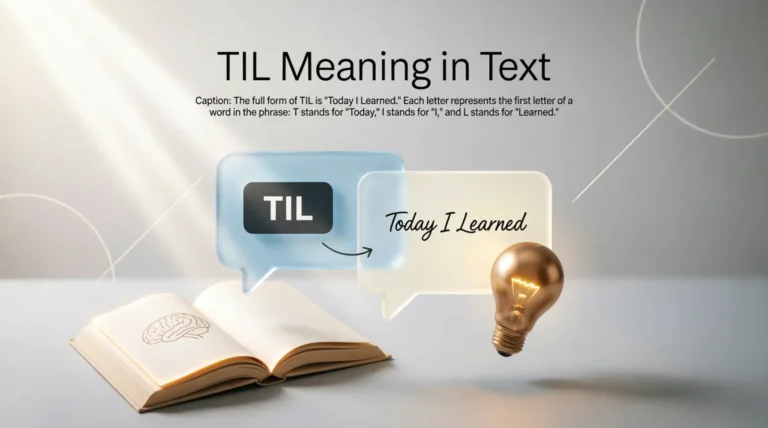
The TIL meaning in text is “Today I Learned.” People use this abbreviation when they discover a new fact, learn something surprising, or find out information they did not know before.
It is common in online discussions, text messages, social media posts, and internet communities. For example, someone might write, “TIL that dolphins have names for each other!” to share an interesting discovery with friends.
TIL is a simple way to introduce new information without writing a long introduction. It can appear in casual conversations, educational posts, funny discoveries, or serious discussions.
Although its main meaning stays the same in most online settings, the tone depends on the information being shared. In this guide, you will learn what TIL means, how to use it, where it appears, and how to reply when someone sends it in a message.
| Quick detail | Answer |
|---|---|
| Term | TIL |
| Most common meaning | Today I Learned |
| Full form | Today I Learned |
| Typical tone | Informative, casual, or surprised |
| Common usage | Text messages, social media, online discussions |
What Does TIL Mean in Text & Chat?
TIL means “Today I Learned” in text messages and online conversations. People use it to share a new fact, an unexpected discovery, or information they have just learned. It often appears at the beginning of a sentence, followed by the fact or discovery.
For example:
- “TIL that octopuses have three hearts.”
- “TIL my favorite movie was filmed in another country.”
- “TIL you can freeze some types of cheese.”
In each example, the sender is sharing something they recently discovered. The information does not have to be brand new to the world. It only needs to be new to the person sharing it.
Why Do People Use TIL?
People use TIL because it makes a message shorter and gives readers a clear signal that something interesting is coming. Instead of writing, “I learned something new today,” they can simply write TIL.
The abbreviation can introduce many kinds of information, including:
- Interesting facts about nature or science.
- Historical events people did not know about.
- Useful tips and everyday skills.
- Surprising facts about movies, music, or celebrities.
- Personal discoveries about school, work, or daily life.
Is TIL Formal or Informal?
TIL is mainly informal. It works well in friendly chats, online communities, and casual posts. It can also appear in educational discussions when the writer wants a relaxed tone.
However, in a formal report or professional email, writing “I learned today that…” may be more suitable. The full phrase is clearer for readers who are unfamiliar with internet abbreviations.
Full Form, Stands For & Short Meaning of TIL
The full form of TIL is “Today I Learned.” Each letter represents the first letter of a word in the phrase: T stands for “Today,” I stands for “I,” and L stands for “Learned.”
Its purpose is simple. It tells readers that the sender has discovered or understood something new.
| Term | Full form | Explanation |
|---|---|---|
| TIL | Today I Learned | Introduces a new fact or discovery |
| TIL that… | Today I Learned that… | Introduces a specific piece of information |
| TIL! | Today I Learned! | Shows excitement or surprise about a discovery |
What Does TIL Stand For in Simple English?
In simple English, TIL means “I learned this today.” It is a quick way to share new knowledge with other people.
For example:
Person A: “TIL that honey can last for a very long time when stored properly.”
Person B: “Really? I didn’t know that!”
Here, Person A shares a fact, and Person B responds with surprise.
Does TIL Have Other Full Forms?
TIL can have other meanings in specialized settings, depending on the subject. However, in everyday texting and online discussions, “Today I Learned” is the standard interpretation.
If you see TIL in a technical document, a workplace message, or a field-specific discussion, check the surrounding words before deciding what it means. Not every use of the same three letters refers to internet slang.
For ordinary text messages, though, you can usually understand TIL as a way to introduce something new that the sender has learned.
Origin, History & First Known Use of TIL
TIL is part of the wider tradition of shortening phrases in written communication. People often use initial letters to make messages faster to type and easier to scan. Over time, many of these shortcuts have become familiar parts of internet language.
The phrase “Today I Learned” fits naturally into conversations where people share discoveries. Rather than giving a long introduction, a writer can place TIL before a fact and let the information speak for itself.
How Did TIL Become an Internet Expression?
TIL became especially recognizable through online communities that encourage users to share interesting facts. It is also widely understood in social-media discussions, where short introductions help readers quickly understand a post.
The abbreviation is useful because it works with almost any topic. Someone can share a scientific fact, a piece of history, a language tip, or a personal discovery using the same three letters.
When Was TIL First Used?
There is no need to assign TIL a single exact invention date to explain its meaning. Without reliable evidence establishing the first use, naming a particular person, year, or platform as its origin would be misleading.
It is more accurate to say that TIL developed as part of internet shorthand and became familiar through online fact-sharing and discussion.
Why Is the Phrase Still Useful?
The phrase tells readers what to expect. They know the writer is about to share information they have newly discovered.
This makes TIL useful in both short messages and longer posts. It also creates a friendly tone, as if the writer is saying, “Here is something interesting I just found out.”
How People Use TIL in Daily Conversations
People use TIL when they discover something and want to share it with others. The discovery can be useful, funny, surprising, educational, or even personal.
The abbreviation is flexible. It can introduce a quick fact in a private message or a longer explanation in an online discussion.
Sharing Interesting Facts
One common use is sharing a fact that catches the sender’s attention.
For example:
Person A: “TIL that bananas are berries in botanical terms.”
Person B: “Wait, what? That’s surprising!”
Person A is sharing information that may be unfamiliar to the recipient. The tone is informative and slightly excited.
Talking About Personal Discoveries
TIL can also introduce something the sender has learned about their own life.
Person A: “TIL the library near my house stays open later on Fridays.”
Person B: “That’s useful! We should study there sometime.”
The abbreviation does not always introduce a scientific or historical fact. It can describe an ordinary discovery that makes daily life easier.
Using TIL for Humor
People sometimes share a surprising or amusing discovery with TIL.
Person A: “TIL I’ve been pronouncing that word wrong for years 😂”
Person B: “Don’t worry, it happens to everyone!”
The laughing emoji suggests that the sender finds the situation funny rather than upsetting.
Can TIL Be Used in Serious Conversations?
Yes. TIL can introduce serious information, such as a historical detail or an important lesson. However, the abbreviation itself usually creates a casual tone.
For example, someone might use TIL to introduce a fact about health, safety, or education. In those situations, the writer should make sure the information is accurate rather than assuming that a short, confident statement is automatically true.
TIL Meaning Across WhatsApp, Instagram, TikTok & Snapchat
TIL generally means “Today I Learned” across WhatsApp, Instagram, TikTok, and Snapchat. The main meaning does not usually change from one platform to another. What changes is how people present the information and how much detail they include.
| Platform | How TIL may be used | Example |
|---|---|---|
| Sharing a discovery with friends | “TIL our school has an online library.” | |
| Introducing an interesting fact in a caption or message | “TIL this building is over 100 years old.” | |
| TikTok | Sharing a fact discovered while watching or researching content | “TIL why cats sometimes knead blankets.” |
| Snapchat | Sending a quick discovery to a friend | “TIL this shortcut saves so much time!” |
| Online forums | Starting a post about a newly discovered fact | “TIL how this everyday item works.” |
TIL Meaning on WhatsApp
On WhatsApp, TIL is useful when sharing a fact with friends, family, or a group. It can introduce a quick discovery without making the message sound too formal.
For example:
Person A: “TIL the shop near us delivers on Sundays.”
Person B: “Good to know! I’ll remember that.”
The meaning is the same as in other casual chats.
TIL Meaning on Instagram
On Instagram, people may use TIL in captions, comments, or direct messages. It can introduce an interesting fact about a place, a person, a hobby, or a topic shown in a post.
The abbreviation gives the caption a conversational feel. The writer can then explain the discovery in the rest of the caption.
TIL Meaning on TikTok
On TikTok, TIL may introduce a fact learned from a video or from further research. A creator or commenter can use it to share a discovery with other viewers.
However, a video containing TIL is not automatically accurate. Readers should still check surprising claims, especially when they concern health, money, or safety.
TIL Meaning on Snapchat
On Snapchat, TIL can appear in a short message or a caption attached to a Snap. It generally means “Today I Learned,” just as it does elsewhere.
There is no special Snapchat-only meaning that should automatically replace the standard expansion.
Different Meanings of TIL in Other Fields
Although “Today I Learned” is the usual meaning in casual online communication, TIL may have other interpretations in specialized settings. The right interpretation depends on the subject and the way the abbreviation is used.
TIL in Workplace or Technical Writing
In a workplace document, TIL might be used as an internal abbreviation defined by a team or organization. In technical discussions, the same letters may refer to a specialized term.
There is no single alternative expansion that applies to every workplace or technical field. If the document defines TIL in a glossary or earlier section, follow that definition.
TIL in Education
In educational conversations, TIL commonly retains its everyday meaning. Students may use it to share something they learned during a lesson, while teachers or online educators may use the phrase to introduce a new fact.
For example:
Person A: “TIL why the Moon has phases.”
Person B: “Can you explain it to me?”
The abbreviation helps introduce a learning moment without changing the underlying subject.
How to Identify a Specialized Meaning
If TIL appears in an unfamiliar context, use these clues:
- The topic: Is the discussion about learning, technology, business, or another field?
- The sentence: Does TIL introduce a fact, or is it part of a technical label?
- The document: Does the writer define the abbreviation elsewhere?
- The audience: Is the conversation casual or meant for specialists?
Do not invent a full form when the context is unclear. Ask the sender or check the relevant document for clarification.
Common Confusions, Mistakes & Wrong Interpretations
TIL is usually easy to understand, but people can still misread it if they have never seen the abbreviation before.
Confusing TIL With a Typing Mistake
Someone who does not know internet slang may think TIL is a typo or an incomplete word. In most casual online conversations, however, it is an intentional abbreviation for “Today I Learned.”
For example, “TIL that some birds can recognize human faces” is a complete introduction to a fact. The writer is not necessarily making a spelling mistake.
Thinking TIL Means the Fact Is Newly Discovered
TIL describes what the writer has learned, not when the information was first discovered by the world.
For example, a person might write “TIL that the Earth orbits the Sun.” The fact is not new to science, but it may be new to that person.
This is an important distinction. The abbreviation does not prove that the information is new, unusual, or scientifically verified.
Assuming TIL Is Always Funny
TIL can introduce humorous facts, but humor is not part of its basic meaning. A message can be serious, educational, neutral, or playful.
Compare these examples:
- “TIL my favorite author wrote under another name.” — Informative.
- “TIL I’ve been using this kitchen tool backward 😂” — Playful.
- “TIL how this safety feature works.” — Educational.
The topic and wording create the tone, not the abbreviation alone.
Believing TIL Guarantees Accuracy
A person can share incorrect information after writing TIL. The abbreviation simply introduces a claim about something they learned.
If a fact seems surprising or important, verify it before sharing it further. This is especially useful when the claim concerns health, money, science, or public safety.
Confusing TIL With Similar Abbreviations
TIL is different from abbreviations such as FYI, which means “for your information,” and IMO, which means “in my opinion.”
TIL focuses on a new discovery. FYI introduces information that someone may find useful, while IMO signals a personal view.
Understanding this difference helps you choose the right expression when writing your own messages.
Similar Terms, Alternatives & Related Slang
Several abbreviations serve a similar purpose in online conversations, but each has a slightly different meaning.
| Term | Full form | Main purpose |
|---|---|---|
| TIL | Today I Learned | Shares a new discovery |
| FYI | For Your Information | Passes along useful information |
| IMO | In My Opinion | Introduces a personal view |
| IDK | I Don’t Know | Shows uncertainty or lack of knowledge |
| BTW | By The Way | Adds another point |
| PSA | Public Service Announcement | Shares a message intended to inform people |
| AFAIK | As Far As I Know | Shows that information is based on current knowledge |
| TIL that… | Today I Learned that… | Introduces a specific fact |
TIL vs. FYI
TIL and FYI can both appear before a fact, but they have different purposes.
TIL usually emphasizes that the sender has just learned something. FYI means the sender is passing along information that may be useful to the recipient.
For example:
- TIL: “TIL that the museum offers free entry on certain days.”
- FYI: “FYI, the museum offers free entry on certain days.”
The first focuses on the sender’s discovery. The second simply brings the information to someone’s attention.
TIL vs. IMO
IMO means “in my opinion.” It introduces a personal view rather than a newly learned fact.
For example:
Person A: “IMO, this is the best book in the series.”
Person B: “I prefer the second book.”
This is different from TIL, which normally introduces information rather than a judgment.
Other Ways to Say TIL
If you prefer not to use an abbreviation, you can write:
- “I just learned that…”
- “I recently found out that…”
- “Here’s something new I discovered.”
- “I didn’t know this before, but…”
- “Something interesting I learned today is…”
These alternatives work in both casual and more formal settings. Choose the version that fits your audience and the message you want to share.
Examples of TIL in Real Chat Situations
The following examples show how TIL can appear in everyday conversations. Each one uses the abbreviation to introduce a discovery, but the tone changes with the topic and wording.
Example 1: Sharing a Surprising Fact
Person A: “TIL that some turtles can breathe through specialized tissues while underwater.”
Person B: “That’s amazing! Nature is full of surprises. 😮”
Meaning: Person A shares an interesting fact. Person B responds with surprise.
Example 2: Learning Something at School
Person A: “TIL why we have leap years.”
Person B: “Tell me! I always forget how they work.”
Meaning: TIL introduces a new piece of knowledge. The conversation has an educational tone.
Example 3: A Funny Personal Discovery
Person A: “TIL I’ve been opening this jar the hard way for months 😂”
Person B: “At least you figured it out now!”
Meaning: The sender uses TIL to share a funny discovery about daily life. The laughing emoji adds a playful tone.
Example 4: Sharing Useful Information
Person A: “TIL you can set reminders for individual tasks on your phone.”
Person B: “That would help me stay organized. Thanks!”
Meaning: Person A shares a practical tip. The tone is helpful and informative.
Example 5: A Discovery About a Movie
Person A: “TIL that the actor in that film also directed another movie I love.”
Person B: “No way! Which movie was it?”
Meaning: The sender shares a discovery about entertainment, and the recipient shows interest.
Example 6: A Friendly Group Chat
Person A: “TIL our local museum has a free entry day every month.”
Person B: “We should go together sometime! 😊”
Meaning: TIL introduces a discovery that leads to a possible plan. The smile emoji makes the exchange friendly.
Example 7: A Serious Discovery
Person A: “TIL why it’s important to check the expiration date on some products.”
Person B: “Good reminder. I’ll pay more attention from now on.”
Meaning: The abbreviation introduces practical information. The conversation is serious and useful rather than humorous.
Example 8: Correcting a Misunderstanding
Person A: “TIL that not every bright light in the night sky is a star.”
Person B: “True! Some are planets or other objects.”
Meaning: Person A shares new knowledge, and Person B adds context to the discussion.
Example 9: A Sarcastic or Playful Reaction
Person A: “TIL that leaving everything until the last minute causes stress 🙃”
Person B: “A lesson we keep learning the hard way!”
Meaning: The sender uses TIL sarcastically to joke about a familiar experience. The upside-down emoji helps signal the playful tone.
Example 10: Asking for More Information
Person A: “TIL that some languages use different writing systems.”
Person B: “Interesting! Can you give me an example?”
Meaning: The sender introduces something they learned, and the recipient invites them to explain it further.
These examples show that TIL does not carry one fixed emotion. It introduces a discovery, while the topic, emojis, and replies shape the mood of the conversation.
How to Reply When Someone Says TIL
When someone sends a message starting with TIL, they are usually sharing something they have learned. You can respond by showing interest, asking a question, adding useful information, or sharing a related discovery.
If the Fact Is Interesting
You can show that you found the information surprising or useful.
Person A: “TIL that some plants can respond to touch.”
Person B: “Really? That’s so interesting! 🌱”
This reply shows curiosity and encourages the conversation to continue.
If You Already Know the Information
You can acknowledge the discovery without making the other person feel bad for learning it later.
Person A: “TIL that the Moon affects ocean tides.”
Person B: “Yes! It’s fascinating how gravity affects the oceans.”
This response adds to the discussion rather than dismissing the sender’s discovery.
If You Want to Learn More
Ask a simple follow-up question.
Person A: “TIL that some animals use camouflage to avoid predators.”
Person B: “Which animals are the best at it?”
A question shows that you are interested and gives the sender a reason to explain more.
If the Message Is Funny
Match the sender’s playful tone if you feel comfortable doing so.
Person A: “TIL my alarm has a snooze button for a reason 😂”
Person B: “And we still manage to ignore it!”
The shared joke makes the conversation feel relaxed.
If the Information Seems Wrong
You can ask for a source or gently explain what you understand.
Person A: “TIL that people only use a small part of their brains.”
Person B: “I’ve heard that before, but it’s a common myth. Want to check the science behind it?”
This reply is respectful and encourages fact-checking instead of turning the conversation into an argument.
Quick Reply Guide
| Situation | Natural reply |
|---|---|
| Interesting discovery | “That’s really interesting!” |
| Surprising fact | “I had no idea!” |
| Useful tip | “Thanks for sharing that.” |
| You want details | “How does that work?” |
| You already knew it | “Yes, that’s fascinating.” |
| You doubt the claim | “Do you have a source for that?” |
| Funny discovery | “Haha, we’ve all been there!” |
You do not need to use internet slang in your response. A friendly, clear sentence is enough.
Is TIL Still Popular? Trends & Online Usage
TIL remains a recognizable abbreviation in internet language, especially in spaces where people share facts and discoveries. However, its exact popularity can vary between platforms, age groups, and online communities. Without reliable current usage data, it would be inaccurate to claim that everyone uses it frequently in 2026.
The abbreviation remains useful because it is short, easy to understand, and suitable for many subjects. It can introduce a fact in a private message, a social-media caption, or an online discussion.
Why TIL Works Well Online
TIL gives readers a quick signal that a discovery is coming. It also allows people to share knowledge without writing a long introduction.
Its uses include:
- Sharing facts about science and nature.
- Discussing history and culture.
- Explaining useful tips.
- Talking about personal discoveries.
- Starting conversations around surprising information.
Is TIL Used by Younger People Only?
No. TIL is not limited to one age group. Anyone who understands the abbreviation may use it in a casual conversation or online post.
Still, not every reader knows every internet abbreviation. When writing for a broad audience, especially in professional or educational content, the full phrase may be more effective.
Should You Use TIL in 2026?
You can use TIL when you want to share a discovery in a relaxed, concise way. It is especially useful when talking to people who are familiar with online shorthand.
For formal documents, official emails, or audiences who may not know the abbreviation, write “Today I learned” in full. The goal is to communicate clearly, not simply to shorten every phrase.
Frequently Asked Questions
What does TIL mean in text?
TIL means “Today I Learned.” It is used when someone shares a new fact, discovery, or piece of information they have recently learned.
What does TIL stand for on social media?
On social media, TIL usually stands for “Today I Learned.” People use it in captions, comments, messages, and posts to introduce something interesting they have discovered.
Is TIL slang or an acronym?
TIL is an internet abbreviation formed from the initial letters of “Today I Learned.” It is commonly treated as internet slang because it is widely used in casual digital communication.
Is TIL rude or offensive?
No, TIL is not normally rude or offensive. It is a neutral expression used to introduce information. The rest of the message may be humorous, serious, or sarcastic, depending on the wording.
How do I respond when someone says TIL?
You can respond with “I didn’t know that!”, “That’s interesting!”, or “Thanks for sharing.” If you want to know more, ask a follow-up question about the fact.
Does TIL mean the information was discovered today?
Not necessarily. It means the sender learned the information today or is presenting it as a recent discovery. The fact itself may have been known for many years.
What is the difference between TIL and FYI?
TIL means “Today I Learned” and highlights a discovery made by the sender. FYI means “For Your Information” and introduces information the sender thinks may be useful to someone else.
Can I use TIL in a professional email?
You can, but it is usually better to write “I learned today that…” in formal communication. This wording is clearer and more suitable for readers who may not recognize internet slang.
What does TIL mean on WhatsApp?
On WhatsApp, TIL usually means “Today I Learned.” People use it to share new facts, useful tips, or surprising discoveries with friends and groups.
Does TIL have other meanings?
Yes, TIL may have specialized meanings in certain technical or professional settings. However, “Today I Learned” is the standard meaning in everyday texting and most casual online discussions.
Conclusion
The TIL meaning in text is “Today I Learned.” People use it to introduce a fact, share a new discovery, or tell others about something they have recently understood. It is common in casual messages, social-media captions, online discussions, and educational conversations.
TIL usually keeps the same meaning across WhatsApp, Instagram, TikTok, and Snapchat. What changes is the subject and tone of the message. A discovery may be surprising, useful, funny, or serious, depending on the information being shared.
When someone sends you a message beginning with TIL, you can respond with interest, ask a question, or share a related fact. Remember that the abbreviation does not prove that a claim is accurate or newly discovered by the world.
If a fact seems doubtful, check it before passing it along. With this simple explanation, you can understand TIL more confidently and explore other text abbreviations with ease.

Alden Rowen is the author behind Meanings Path, sharing clear and reliable insights into the meanings, origins, and significance of words, names, and phrases. His goal is to make language simple, useful, and easy to understand.