
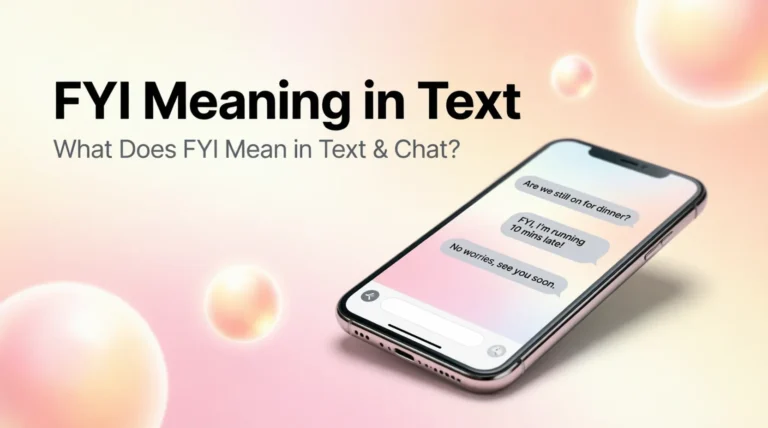
If you’ve received a message that starts with FYI, you may wonder what it means and whether you need to respond.
The most common FYI meaning in text is “For Your Information.” People use it to share information, updates, reminders, or useful details without necessarily expecting a reply.
You’ll commonly see FYI in text messages, emails, work chats, WhatsApp conversations, Instagram DMs, and other social media platforms.
Depending on the situation, it can sound helpful, neutral, friendly, or even slightly blunt if the message feels critical.
In this guide, you’ll learn exactly what FYI means, where it came from, how people use it in everyday conversations, how its tone changes with context, common mistakes to avoid, practical chat examples, and the best ways to reply.
| Term | Most Common Meaning | Full Form | Typical Tone | Common Usage |
|---|---|---|---|---|
| FYI | Sharing information | For Your Information | Usually neutral and helpful | Text messages, emails, work chats, social media |
Quick Answer:
FYI stands for “For Your Information.” It is used to give someone information, updates, reminders, or facts without necessarily asking them to take action.
What Does FYI Mean in Text & Chat?
In texting and online conversations, FYI simply means “For Your Information.” It tells the reader that the sender wants them to know something important or useful.
Most of the time, FYI is not a question or a request. Instead, it introduces information that may help the other person stay informed.
For example:
Person A: “FYI, the meeting has been moved to 3 PM.”
Here, the sender is simply sharing an update.
When People Use FYI
People commonly use FYI when they want to:
- Share news
- Give reminders
- Pass along useful information
- Clarify a situation
- Send updates
- Prevent confusion
The meaning usually stays the same regardless of whether the conversation is formal or casual.
Tone in Text Messages
The tone depends on the wording around it.
| Example | Tone |
|---|---|
| FYI, your package arrived. | Helpful |
| FYI 😊 We already booked the tickets. | Friendly |
| FYI… I already finished it. | Slightly defensive |
| FYI, that’s not what happened. | Can sound blunt or corrective |
Adding emojis, polite wording, or a friendly greeting often makes FYI sound warmer.
Full Form, Stands For & Short Meaning of FYI
The full form of FYI is:
For Your Information
It is one of the most widely recognized abbreviations in English communication.
Short Meaning
The short meaning is simple:
“I’m sharing this information so you know.”
Unlike many internet slang terms, FYI is used by people of all ages because it works well in both personal and professional communication.
What FYI Does Not Mean
FYI does not usually mean:
- An order
- A demand
- A request
- A warning by itself
However, the message following FYI may contain one of those depending on the context.
For example:
- “FYI, tomorrow’s office opens at 8.” → Information only.
- “FYI, you must complete the form today.” → Information plus instruction.
Origin, History & First Known Use of FYI
FYI did not begin with smartphones or social media.
The abbreviation has been used for many years in written communication, especially in offices and business correspondence. It became popular because it allowed people to quickly indicate that a message was being shared for informational purposes.
As email became common, FYI spread even further. Later, texting apps, workplace messaging platforms, and social media made it part of everyday digital communication.
Why It Became Popular
FYI is popular because it is:
- Short
- Easy to understand
- Professional
- Time-saving
- Suitable in many situations
There is no single confirmed date or person responsible for its first use. Its exact origin is not fully documented, so it is best not to attribute it to one specific event or year.
How People Use FYI in Daily Conversations
People use FYI whenever they want to keep someone informed without making the conversation complicated.
At Work
Examples include:
- Schedule changes
- Project updates
- Meeting reminders
- Shared documents
Example:
Person A: “FYI, the client approved the proposal.”
With Friends
Friends often use FYI casually.
Person A: “FYI, the café closes early today.”
With Family
Parents, siblings, and relatives often use FYI for reminders.
Person A: “FYI, dinner will be ready around 7.”
Tone Can Change
A simple FYI can feel different depending on punctuation.
| Style | Feeling |
|---|---|
| FYI 😊 | Friendly |
| FYI! | Energetic |
| FYI… | Hesitant or annoyed |
| FYI | Neutral |
Context matters much more than the abbreviation itself.
FYI Meaning Across WhatsApp, Instagram, TikTok & Snapchat
The meaning of FYI stays almost the same across major messaging and social platforms.
| Platform | Meaning Changes? | Typical Use |
|---|---|---|
| No | Updates, reminders | |
| No | DMs, story replies | |
| TikTok | No | Comments, captions |
| Snapchat | No | Casual chats |
People use FYI to notify friends or family.
Example:
“FYI, I’m running about 10 minutes late.”
It often appears in DMs or story replies.
Example:
“FYI, that restaurant finally reopened.”
TikTok
Creators may write:
“FYI, this trend started months ago.”
Snapchat
Friends often use it for quick updates.
Example:
“FYI 😂 Everyone’s already here.”
The platform rarely changes the meaning. Only the tone becomes more casual on social media.
Different Meanings of FYI in Other Fields
Although For Your Information is by far the most common meaning, the letters FYI can occasionally appear in specialized contexts.
Business
Almost always means:
“For Your Information.”
Education
Teachers may use FYI before announcements.
Example:
“FYI, tomorrow’s quiz has been postponed.”
Healthcare or Technical Documents
Some organizations may use FYI simply as an informational label to separate updates from instructions.
Rare Alternative Meanings
In niche industries or internal company documents, FYI may occasionally stand for something else. These meanings are uncommon and usually explained within that specific context.
Unless the conversation clearly suggests otherwise, readers should assume FYI means For Your Information.
Common Confusions, Mistakes & Wrong Interpretations
Many people misunderstand FYI because they focus only on the abbreviation instead of the entire message.
Mistake 1: Thinking FYI Is Always Rude
Not true.
FYI is usually neutral.
It may sound rude only if paired with harsh wording.
Example:
“FYI, you were completely wrong.”
The problem is the sentence—not the abbreviation.
Mistake 2: Assuming a Reply Is Required
Many FYI messages do not need a response.
Sometimes a simple:
- Thanks!
- Got it.
- Appreciate the update.
is enough.
Mistake 3: Believing It Is Only Business Language
FYI is common among friends and family too.
Similar Terms, Alternatives & Related Slang
Depending on the situation, people may use other expressions instead of FYI.
| Alternative | Best Used When |
|---|---|
| Just so you know | Casual conversations |
| Heads up | Giving advance notice |
| By the way | Adding related information |
| Keep in mind | Offering a reminder |
| Reminder | Highlighting something important |
| Note | Formal writing |
Each alternative has a slightly different tone.
For example:
- “Heads up” often prepares someone for something upcoming.
- “Just so you know” sounds friendly.
- “Reminder” suggests something previously mentioned.
Examples of FYI in Real Chat Situations
Friendly
Person A: “FYI 😊 I saved you a seat.”
Person B: “Awesome! Thanks so much.”
Meaning: Warm and thoughtful.
Serious
Person A: “FYI, tomorrow’s deadline hasn’t changed.”
Person B: “Thanks. I’ll finish everything tonight.”
Meaning: Informative and professional.
Playful
Person A: “FYI 😂 I already beat your high score.”
Person B: “Challenge accepted!”
Meaning: Light-hearted teasing.
Slightly Corrective
Person A: “FYI, that’s not what I said earlier.”
Person B: “You’re right. I misunderstood.”
Meaning: Can feel firm depending on the relationship.
Casual Reminder
Person A: “FYI, don’t forget your umbrella. 🌧️”
Person B: “Good catch! Thanks.”
Meaning: Helpful reminder.
How to Reply When Someone Says FYI
The best reply depends on why they shared the information.
| Situation | Good Reply |
|---|---|
| Helpful update | “Thanks!” |
| Work message | “Received, thank you.” |
| Reminder | “Got it!” |
| Funny message | “😂 Good to know!” |
| Corrective message | “Thanks for letting me know.” |
Serious Reply
“Thanks for the update.”
Friendly Reply
“Got it! Appreciate it 😊”
Playful Reply
“Noted 😂”
If You’re Confused
“What do you mean exactly?”
If It Sounds Slightly Rude
Remain polite.
Example:
“Thanks for clarifying.”
Keeping your response calm usually prevents unnecessary misunderstandings.
Is FYI Still Popular? Trends & Online Usage
Yes. FYI remains one of the most widely recognized abbreviations in digital communication.
It continues to appear in:
- Emails
- Workplace messaging apps
- Group chats
- Text messages
- Social media
- Online forums
Unlike many internet slang terms that become outdated quickly, FYI has stayed relevant because it is practical and easy to understand.
While younger users may sometimes choose phrases like “heads up” or “just so you know,” FYI remains common across different age groups and communication styles.
Its lasting popularity comes from its simplicity rather than from changing online trends.
Frequently Asked Questions
What does FYI mean in text messages?
FYI usually means “For Your Information.” It tells someone you’re sharing useful information, updates, or reminders.
Is FYI rude?
Not by itself. It is generally neutral. However, the wording around it can make the message sound friendly, formal, blunt, or sarcastic.
Do I have to reply to an FYI message?
Not always. If no response is needed, a simple “Thanks,” “Got it,” or “Noted” is usually enough.
Does FYI mean the same thing on WhatsApp, Instagram, TikTok, and Snapchat?
Yes. Across these platforms, FYI almost always means “For Your Information.” The tone may become more casual depending on the conversation.
Can FYI be used in professional emails?
Yes. It is widely accepted in business communication when sharing information or updates. Even so, using polite wording helps maintain a professional tone.
Is FYI only used in texting?
No. It is common in emails, office chats, documents, messaging apps, and everyday conversations.
Conclusion
The most common FYI meaning in text is “For Your Information.” It is a simple way to share updates, reminders, or useful details without necessarily expecting a reply.
Whether you’re chatting with friends, messaging family, or communicating at work, FYI usually has a neutral and helpful tone.
Even though the meaning stays consistent across platforms like WhatsApp, Instagram, TikTok, and Snapchat, the surrounding words, punctuation, emojis, and your relationship with the other person can affect how it feels.
Understanding that context helps you interpret messages more accurately and respond naturally.
If you’re exploring digital communication, learning common abbreviations like FYI can make online conversations clearer, faster, and more confident.

Alden Rowen is the author behind Meanings Path, sharing clear and reliable insights into the meanings, origins, and significance of words, names, and phrases. His goal is to make language simple, useful, and easy to understand.