
If you’ve seen DND in a text message, chat, or social media profile, you’re probably wondering what it means.
In most conversations, DND means “Do Not Disturb.” It tells others that someone does not want to be interrupted, usually because they are sleeping, working, studying, driving, or simply taking a break from notifications.
People commonly see DND on messaging apps, smartphones, gaming platforms, and social media.
While the meaning is usually straightforward, the context matters.
Sometimes it refers to a phone setting, while in other situations it politely explains why someone is slow to reply.
Less commonly, DND can represent other phrases in specific communities, such as gaming or entertainment.
This guide explains the meaning of DND in text, where it came from, how people use it, platform-specific usage, common mistakes, real chat examples, and the best ways to respond.
| Term | Most Common Meaning | Full Form | Typical Tone | Common Usage |
|---|---|---|---|---|
| DND | Do Not Disturb | Do Not Disturb | Neutral and polite | Text messages, chats, social media, smartphones, gaming |
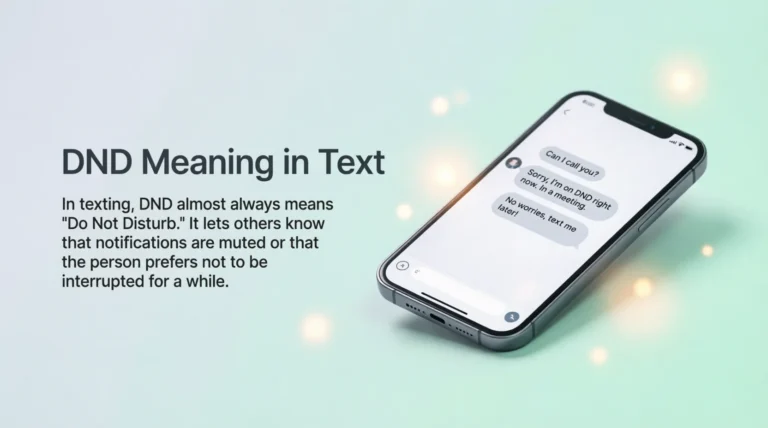
Quick Answer: In texting, DND almost always means “Do Not Disturb.” It lets others know that notifications are muted or that the person prefers not to be interrupted for a while.
What Does DND Mean in Text & Chat?
In text messages and online chats, DND is short for Do Not Disturb. It tells people that someone is unavailable or has silenced notifications.
The phrase does not usually mean the person is upset or ignoring others. Instead, it often signals that they are busy or temporarily offline.
For example, someone might write:
- “I’m on DND while studying.”
- “Sorry for the late reply. My phone was on DND.”
- “Putting my chats on DND tonight.”
Why People Use DND
People use DND because it is:
- Quick to type.
- Easy to understand.
- Polite without needing a long explanation.
- Recognized across many apps and devices.
The tone is usually neutral. However, the surrounding words can change how it feels.
| Message | Likely Tone |
|---|---|
| “Phone’s on DND.” | Neutral |
| “Need DND for a few hours.” | Polite |
| “Please respect my DND today.” | Firm but respectful |
| “LOL I’m permanently on DND 😂” | Playful joke |
Emojis, punctuation, and your relationship with the sender help reveal whether the message is serious or humorous.
Full Form, Stands For & Short Meaning of DND
The full form of DND is Do Not Disturb.
It is widely used as both:
- A smartphone notification mode.
- A short message telling others someone is unavailable.
Short Meaning
Simply put:
DND means “I’m not available right now, so don’t expect an immediate reply.”
The phrase can refer to:
- Muted calls.
- Silent notifications.
- Focus time.
- Sleep mode.
- Meetings.
- Personal time.
Although Do Not Disturb is by far the most common meaning in texting, DND can represent different phrases in specialized communities.
| Context | Meaning |
|---|---|
| Texting | Do Not Disturb |
| Smartphones | Notification-silencing mode |
| Gaming | Sometimes shorthand for Dungeons & Dragons (depends on context) |
| Business | Usually still means Do Not Disturb |
Always look at the conversation before assuming which meaning applies.
Origin, History & First Known Use of DND
The phrase “Do Not Disturb” has existed for many years, long before smartphones. Hotels famously placed Do Not Disturb signs on guest room doors to prevent interruptions.
As mobile phones evolved, manufacturers adopted Do Not Disturb as the name for a notification control that silences calls and alerts without turning the phone off. Messaging users naturally shortened the phrase to DND, making it easy to mention in chats.
There is no single confirmed person or exact date that introduced DND as texting slang. Instead, it became popular gradually as smartphones and messaging apps made the feature familiar to millions of users.
Today, the abbreviation is widely understood because the phone setting and the chat expression reinforce each other.
How People Use DND in Daily Conversations
People use DND in many everyday situations.
During Work or Study
Someone may want uninterrupted concentration.
Person A: “Can you call now?”
Person B: “I’m on DND until my exam ends. 😊”
Meaning: They are busy and will reply later.
Before Sleeping
Person A: “Why didn’t you answer?”
Person B: “Sorry! My phone was on DND all night.”
Meaning: Notifications were silenced while sleeping.
While Driving
Person A: “You missed my message.”
Person B: “I keep DND on when driving.”
Meaning: Safety comes first.
As a Joke
Person A: “Movie marathon tonight?”
Person B: “Already activated DND and hiding from the world 😂”
Meaning: A playful exaggeration rather than a serious statement.
The tone depends on context, but DND is rarely considered rude by itself.
DND Meaning Across WhatsApp, Instagram, TikTok & Snapchat
Across most social platforms, DND keeps the same basic meaning: Do Not Disturb.
| Platform | Common Meaning | Does It Change? |
|---|---|---|
| Notifications muted or unavailable | Usually no | |
| Busy or avoiding interruptions | Usually no | |
| TikTok | Mentioning phone settings or personal boundaries | Usually no |
| Snapchat | Busy or silent notifications | Usually no |
People often mention DND after replying late or when taking a break from constant messages.
Someone may write “DND” in a story or note to signal they are focusing on work or taking personal time.
TikTok
Creators sometimes mention DND while sharing productivity routines, study sessions, or digital wellness habits.
Snapchat
Friends may explain delayed replies by saying they had DND enabled.
The meaning stays remarkably consistent across platforms, making DND one of the easier internet abbreviations to understand.
Different Meanings of DND in Other Fields
Although Do Not Disturb dominates texting, other meanings exist.
| Field | Possible Meaning |
|---|---|
| Tabletop gaming | Dungeons & Dragons |
| Telecommunications | Do Not Disturb service |
| Hospitality | Do Not Disturb room notice |
These meanings are context-dependent.
For example:
- “We’re playing DND tonight.”
Here, the speaker almost certainly means Dungeons & Dragons, not phone notifications.
Likewise:
- “My phone is on DND.”
This clearly refers to Do Not Disturb.
Reading the surrounding conversation prevents confusion.
Common Confusions, Mistakes & Wrong Interpretations
One common mistake is assuming DND always refers to gaming.
In casual texting, Do Not Disturb is usually the intended meaning.
Another misunderstanding is believing DND means someone is angry or ignoring messages. Often, it simply indicates:
- They’re working.
- They’re sleeping.
- They’re in class.
- They’re driving.
- They’re taking a break.
Some people also think DND blocks messages completely. In reality, messages often still arrive—they are simply delivered without immediate notifications until the setting changes.
Checking the context almost always clears up the intended meaning.
Similar Terms, Alternatives & Related Slang
People use several expressions that communicate a similar idea.
| Term | Meaning |
|---|---|
| BRB | Be Right Back |
| AFK | Away From Keyboard |
| Busy | Currently occupied |
| Silent Mode | Notifications reduced |
| Focus Mode | Minimized distractions |
| Offline | Not currently active |
These phrases are related but not identical.
For example:
- AFK suggests someone has stepped away.
- BRB promises a quick return.
- DND emphasizes avoiding interruptions.
Choosing the right expression depends on the situation.
Examples of DND in Real Chat Situations
Study Session
Person A: “Can we play now?”
Person B: “Not yet. DND until I finish this assignment. 📚”
Tone: Serious and focused.
Work Meeting
Person A: “You free?”
Person B: “In a meeting. DND for the next hour.”
Tone: Professional.
Friendly Joke
Person A: “Where did everyone go?”
Person B: “Weekend DND activated 😎”
Tone: Playful.
Late Reply
Person A: “Thought you forgot me.”
Person B: “Sorry! My phone stayed on DND overnight.”
Tone: Polite explanation.
Family Time
Person A: “Want to chat?”
Person B: “Spending time with family. DND for a bit. ❤️”
Tone: Respectful and warm.
How to Reply When Someone Says DND
Your reply should match the situation.
| Situation | Good Reply |
|---|---|
| Serious | “No problem. Talk later.” |
| Busy | “Good luck! Message me when you’re free.” |
| Playful | “I’ll survive until DND ends 😂” |
| Confusing | “Do you mean Do Not Disturb?” |
| Sounds firm | “Understood. I’ll check back later.” |
A respectful response shows you understand their boundaries.
Avoid repeatedly messaging someone who has already said they are on DND, especially if they are working, driving, or sleeping.
Is DND Still Popular? Trends & Online Usage
Yes. DND remains widely used in 2026.
Its popularity comes from two main reasons:
- Most smartphones include a Do Not Disturb feature.
- People increasingly value uninterrupted focus and healthier notification habits.
Rather than disappearing, the abbreviation has become part of everyday digital communication. Because major messaging apps and operating systems support similar notification controls, users continue to recognize and use DND naturally.
The meaning has remained stable over time, making it one of the more consistent abbreviations in modern online conversations.
Frequently Asked Questions
What does DND mean in texting?
It usually means Do Not Disturb, indicating that someone has silenced notifications or prefers not to be interrupted.
Is DND considered rude?
No. It is generally a polite way to explain that someone is busy or unavailable. The wording around it determines whether it sounds friendly or firm.
Does DND have the same meaning on WhatsApp and Instagram?
Yes. On both platforms, DND almost always means Do Not Disturb, and the meaning rarely changes.
How should I respond when someone says DND?
A simple response such as “No worries, message me when you’re free” is polite and respectful.
Can DND mean something other than Do Not Disturb?
Yes. In some contexts, especially gaming, DND may refer to Dungeons & Dragons. The surrounding conversation usually makes the intended meaning clear.
Does DND mean someone is ignoring me?
Not necessarily. In most cases, it simply means they are busy, sleeping, working, driving, or limiting distractions.
Conclusion
The most common DND meaning in text is Do Not Disturb.
It is a simple, polite way to let others know that someone is unavailable or has muted notifications for a while.
Whether you see it in a text message, on WhatsApp, Instagram, TikTok, Snapchat, or as a phone setting, the core meaning usually stays the same.
As with many internet abbreviations, context matters.
In a gaming conversation, DND might refer to Dungeons & Dragons, but in everyday messaging, Do Not Disturb is almost always the correct interpretation.
Understanding the conversation, tone, emojis, and surrounding words helps you respond naturally.
If you’re exploring more text abbreviations and online slang, learning terms in context will make digital conversations much easier to understand.

Alden Rowen is the author behind Meanings Path, sharing clear and reliable insights into the meanings, origins, and significance of words, names, and phrases. His goal is to make language simple, useful, and easy to understand.