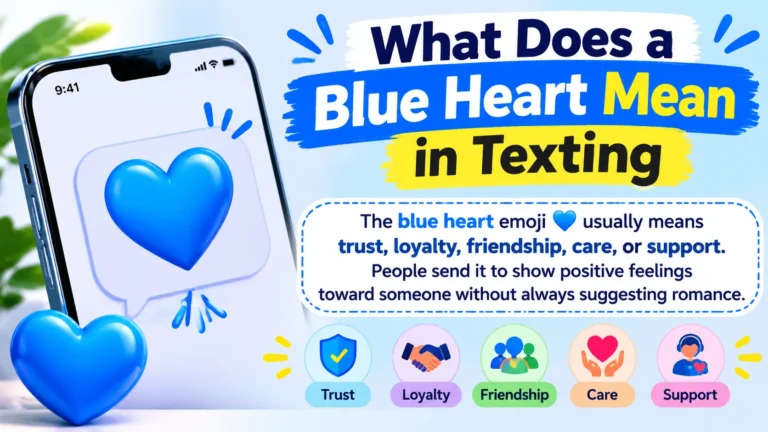
A blue heart 💙 in texting usually represents trust, loyalty, friendship, care, and emotional support. It is a way to show someone that you care about them without always expressing romantic love.
However, its meaning can change based on the conversation, the relationship, and the person who sends it.
You may see the blue heart emoji on WhatsApp, Instagram, TikTok, Snapchat, or in regular text messages.
Friends often use it to show support, while couples may use it to express affection. Some people also use it to show their love for the color blue or to support a favorite team.
So, what does a blue heart mean in texting? This guide explains its common meanings, emotional tone, use across social media platforms, and the best ways to reply when someone sends you this emoji.
| Category | Meaning |
|---|---|
| Term | Blue heart 💙 |
| Most common meaning | Trust, loyalty, friendship, and care |
| Full form | Not applicable; it is an emoji |
| Typical tone | Friendly, supportive, affectionate, or romantic |
| Common usage | Text messages, social media comments, and direct messages |
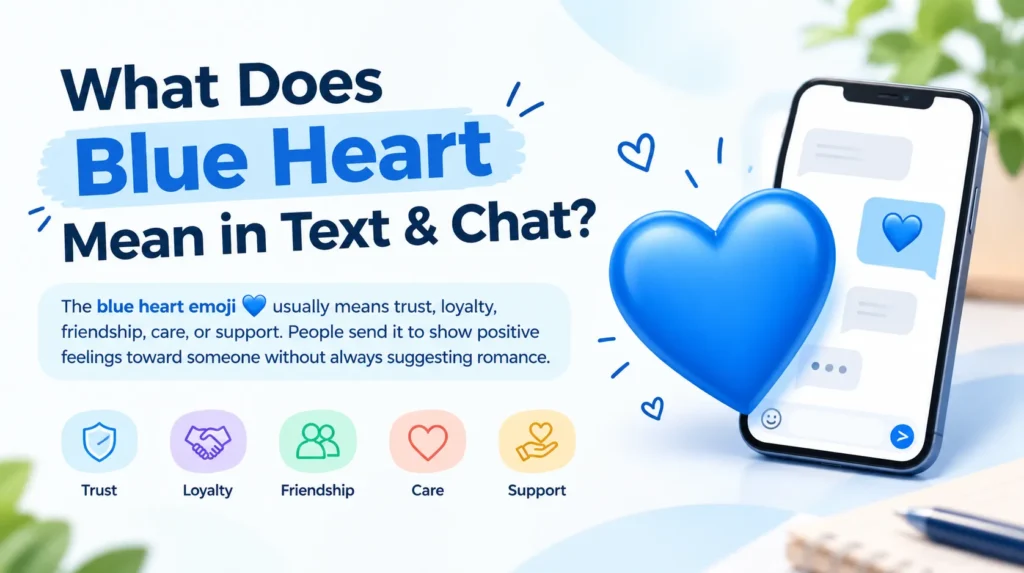
What Does Blue Heart Mean in Text & Chat?
The blue heart emoji 💙 usually means trust, loyalty, friendship, care, or support. People send it to show positive feelings toward someone without always suggesting romance.
For example, a friend might send you a blue heart after you help them through a hard day. It can mean, “I care about you,” “I’m here for you,” or “Thank you for being a good friend.”
The emoji can also express romantic feelings. Some couples use it to show love, commitment, or a calm and steady bond. However, a blue heart alone does not prove that someone has romantic feelings for you.
Common meanings of the blue heart emoji
- Trust: The sender values you and feels they can rely on you.
- Friendship: They care about you as a friend.
- Loyalty: They want to show support or commitment.
- Emotional support: They are thinking of you during a difficult time.
- Romantic affection: They may be showing love in a gentle way.
- Love for blue: They may simply like the color.
- Support for a team or cause: The blue heart may represent a shared interest or group.
The surrounding message helps you understand the intended meaning.
For example, “Thank you for always being there 💙” sounds caring and supportive. In contrast, “Blue looks so good on you 💙” may simply connect the heart to the color blue.
The most important point is that the blue heart usually carries a positive message, but its exact meaning depends on the sender and the situation.
Full Form, Stands For & Short Meaning of Blue Heart
The blue heart emoji has no official full form because it is a symbol, not an abbreviation or acronym. It does not stand for a set of words like many internet slang terms do.
Its meaning comes from how people use it in digital conversations. Most often, it represents trust, friendship, loyalty, care, or support.
Short meaning of 💙
If someone asks what the blue heart means in a text, a simple answer is:
Blue heart 💙 = trust, loyalty, friendship, care, or affection.
The exact meaning can change with the message. For example, a blue heart sent after “I’m always here for you” may show emotional support. One sent after “Love you, bestie” is more likely to express friendship.
Blue heart compared with other heart emojis
| Emoji | Common meaning | Typical tone |
|---|---|---|
| 💙 Blue heart | Trust, loyalty, friendship, support | Calm and caring |
| ❤️ Red heart | Love, romance, deep affection | Warm and loving |
| 💛 Yellow heart | Friendship, happiness, positivity | Cheerful and friendly |
| 💚 Green heart | Nature, care, growth, or support | Fresh and positive |
| 💜 Purple heart | Affection, admiration, or playful love | Sweet or expressive |
| 🖤 Black heart | Dark humor, sadness, style, or affection | Context-dependent |
| 🤍 White heart | Pure affection, peace, or gentle support | Soft and caring |
These meanings are common patterns, not strict rules. People may choose an emoji because they like its color, because it matches their mood, or simply because it looks good with their message.
Therefore, do not assume that a blue heart has a hidden full form or one fixed meaning. Read the words around it to understand what the sender likely wants to express.
Origin, History & First Known Use of Blue Heart
The blue heart emoji developed as part of the wider growth of digital emojis. People use emojis to add emotion, tone, and meaning to messages that might otherwise feel plain or unclear.
Heart symbols have long been used to express love and affection. As digital communication grew, colored heart emojis gave users more ways to express different feelings. The blue heart became one option for showing care, friendship, loyalty, and support.
Why does the blue heart have its own meaning?
Color can affect how people interpret a symbol. Blue is often associated with calmness, stability, trust, and reliability. These associations help explain why many people use a blue heart to express steady friendship or emotional support.
However, there is no single historical rule that says a blue heart must mean trust or loyalty. These meanings developed through common social use, and different people may interpret the emoji in different ways.
Does the blue heart have one official meaning?
No. The blue heart is a pictorial symbol, and its emotional meaning depends on how someone uses it.
Its digital appearance may also vary slightly between devices and platforms. The general symbol remains recognizable, but the color and visual style can differ.
It is best not to assign a precise first-use date or a single original meaning without reliable historical evidence. For everyday texting, what matters most is how the sender uses the emoji today.
In short, the blue heart is part of modern digital expression. Its common meanings come from social habits, color associations, and the context of online conversations rather than a fixed definition.
How People Use Blue Heart in Daily Conversations
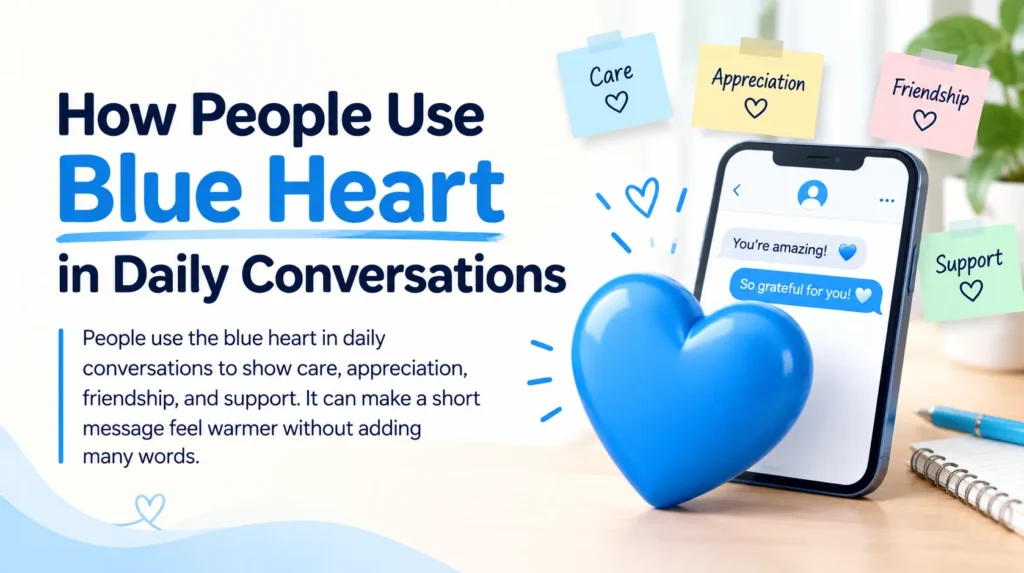
People use the blue heart in daily conversations to show care, appreciation, friendship, and support. It can make a short message feel warmer without adding many words.
For instance, someone may send “Good luck today 💙” before a job interview. A friend might reply with “You always support me, thank you 💙” after receiving helpful advice.
To show friendship
Friends often use the blue heart to express a close bond. It can feel caring without being as openly romantic as some people interpret a red heart.
Example:
Person A: “Thanks for listening to me yesterday.”
Person B: “Of course! I’m always here for you 💙”
This exchange shows friendship and emotional support.
To offer comfort
A blue heart can help someone feel supported when they are worried, upset, or going through a hard time.
Example:
Person A: “I’m nervous about my exam tomorrow.”
Person B: “You’ve prepared well. You’ve got this 💙”
The emoji adds warmth to the encouragement.
To express romantic affection
Some people use the blue heart with a partner because it represents trust, loyalty, or a steady relationship.
Example:
Person A: “I feel safe with you.”
Person B: “That means everything to me 💙”
In this context, the emoji supports an affectionate message. It does not have to mean that the relationship is less romantic than one represented by a red heart.
To show appreciation or shared interests
People also use blue hearts after compliments, thank-you messages, and posts about sports teams, school colors, or other shared interests.
The same emoji can therefore express different feelings. Look at the conversation, the sender’s usual habits, and your relationship before deciding what it means.
Blue Heart Meaning Across WhatsApp, Instagram, TikTok & Snapchat
The blue heart generally keeps the same core meanings across social media platforms: friendship, trust, care, loyalty, and support. The platform itself does not automatically give it a different meaning.
However, the type of conversation can influence how people understand it.
Blue heart meaning on WhatsApp
On WhatsApp, people often use 💙 in private messages with friends, family members, and partners.
For example, a family member may send it after asking whether you arrived home safely. A friend may use it to show appreciation after a helpful conversation.
Because WhatsApp often involves people who know each other personally, the relationship can provide useful clues about the emoji’s meaning.
Blue heart meaning on Instagram
On Instagram, the blue heart can appear in comments, direct messages, captions, and story replies.
Someone may use it to support a friend’s achievement, react to a blue outfit, or show appreciation for a photo. It may also appear in posts related to teams, communities, or shared interests.
A blue heart on a public post does not necessarily indicate romantic interest. It may simply be a friendly reaction.
Blue heart meaning on TikTok
On TikTok, people may use 💙 in comments, video captions, and replies to creators.
The emoji can express support for a video, appreciation for a creator, or agreement with a message. Its meaning may also depend on a trend or the subject of the video.
For example, a viewer commenting “This helped me so much 💙” is likely expressing gratitude or support.
Blue heart meaning on Snapchat
On Snapchat, the blue heart usually carries the same general emotional meanings as elsewhere. It can appear in chats or snaps between friends and partners.
Do not confuse the blue heart emoji with Snapchat’s separate friend-status symbols. Snapchat has its own interface indicators, and an emoji sent in a message does not automatically mean that someone has a particular friendship status.
| Platform | Common use |
|---|---|
| Personal care, friendship, and support | |
| Comments, reactions, appreciation, and shared interests | |
| TikTok | Supportive comments and reactions to content |
| Snapchat | Friendly or affectionate private messages |
| Regular SMS | General care, trust, and affection |
The main rule is simple: the blue heart’s basic meaning usually stays the same, while the conversation changes how you interpret it.
Different Meanings of Blue Heart in Other Fields
Although the blue heart often represents trust, loyalty, friendship, or affection in texting, it can have other meanings outside a personal conversation.
The subject of a post or message may matter more than the emoji’s general emotional meaning.
Love for the color blue
Someone may use 💙 simply because blue is their favorite color. They might add it to a photo of a blue dress, a blue car, or a blue-themed room.
Example:
Person A: “I finally painted my room blue!”
Person B: “It looks amazing 💙”
Here, the emoji may express appreciation for the color and the room’s appearance.
Sports teams and fan communities
Blue is an important color for many sports teams, schools, and fan groups. A blue heart may show support for a team or a sense of belonging.
For example, a person might add 💙 to a post celebrating a team’s win. The emoji is more about team spirit than personal affection.
Awareness and social causes
Some people use blue hearts in posts about causes, campaigns, or awareness topics. The intended message depends on the specific organization, campaign, or community.
Do not assume that every blue heart represents the same cause. Look for the accompanying words, hashtags, or other clear signs.
Emotional and creative expression
Writers, artists, and content creators may use blue hearts to create a calm, cool, or gentle mood. The emoji can also match a blue-themed design or brand identity.
Does a blue heart have a special technical meaning?
In ordinary texting, it is not a standard abbreviation, secret code, or universal relationship label. A person or group may assign it a private meaning, but that meaning is not automatically shared by everyone.
If the blue heart appears in a professional message, a fan post, or a discussion about a specific cause, consider the topic before interpreting it as a personal message.
The best approach is to separate the emoji’s common emotional meaning from any special meaning that the sender’s community or situation may give it.
Common Confusions, Mistakes & Wrong Interpretations
The blue heart is usually positive, but it is easy to read too much into a single emoji. A common mistake is to assume that it always means friendship or that it can never express romantic love.
Neither assumption is correct.
Mistake 1: Thinking it always means friendship
A blue heart often appears between friends, but couples can use it too. Some people prefer blue hearts because they associate the color with trust, loyalty, or calm affection.
The relationship and message provide better clues than the emoji alone.
Mistake 2: Assuming it proves romantic interest
If someone sends you 💙, it does not automatically mean they have a crush on you.
They might be showing kindness, appreciation, support, or friendship. If you want to understand their feelings, look at how they communicate with you over time rather than relying on one symbol.
Mistake 3: Thinking it means sadness
Blue is sometimes linked with sadness in phrases such as “feeling blue.” However, a blue heart does not automatically mean that someone is sad.
For example, “Proud of you 💙” is more likely to express support or affection than sadness.
Mistake 4: Believing every platform uses it differently
The blue heart’s general meaning does not change simply because it appears on WhatsApp instead of Instagram. Platform features and trends may affect how people use it, but context remains important.
Mistake 5: Treating it as a secret code
There is no universal rule that the blue heart means a hidden message, a specific relationship status, or a particular promise.
Some friends or couples may create their own meanings for emojis. Unless you know that personal meaning, do not assume it applies.
How can you avoid misunderstanding it?
Use these clues:
- The words: What did the person say before or after the emoji?
- The relationship: Are you friends, relatives, partners, or new contacts?
- The situation: Is the conversation serious, playful, supportive, or about a shared interest?
- Their usual style: Do they send heart emojis to many people?
- The overall pattern: Do their words and actions support the interpretation you have in mind?
If the message is unclear, you can ask a friendly question instead of guessing. A simple “What does the blue heart mean to you?” can clear things up without making the conversation awkward.
Similar Terms, Alternatives & Related Slang
The blue heart belongs to a larger group of emojis that people use to express feelings in digital conversations. Each heart has common associations, but none has a meaning that applies in every situation.
Blue heart vs. red heart
The red heart ❤️ is strongly associated with love, romance, and deep affection. The blue heart 💙 often feels more connected with trust, loyalty, friendship, and support.
However, either emoji can be used by friends, family members, or romantic partners.
Blue heart vs. yellow heart
The yellow heart 💛 often gives a cheerful, friendly feeling. People may use it to express happiness, positivity, or friendship.
The blue heart can also express friendship, but it may feel calmer or more connected with loyalty and trust.
Blue heart vs. white heart
The white heart 🤍 often suggests gentle affection, peace, or a soft emotional tone. The blue heart may suggest trust, steady support, or a connection to the color blue.
These are common associations rather than strict definitions.
Related emojis and expressions
| Term or emoji | Common meaning |
|---|---|
| 🫶 | Love, appreciation, or support |
| 🥰 | Warm affection or feeling loved |
| 😊 | Happiness, kindness, or friendliness |
| 🤝 | Agreement, teamwork, or trust |
| ❤️ | Love or deep affection |
| 💛 | Friendship or cheerful feelings |
| 💜 | Affection, admiration, or playful love |
| 💙 | Trust, loyalty, care, or support |
You can also express the same feelings with words. For example, “I’ve got your back,” “I appreciate you,” “You’re a great friend,” and “I’m here for you” can communicate support without using an emoji.
The best alternative depends on the message you want to send. Use words when clarity matters, and use emojis when they fit the tone of your conversation.
Examples of Blue Heart in Real Chat Situations
The meaning of a blue heart becomes easier to understand when you see it in real chat situations. Below are examples of how people may use it with friends, family members, partners, and other contacts.
Example 1: Showing friendship
Person A: “Thanks for being my friend through everything.”
Person B: “Always! You mean a lot to me 💙”
Meaning: The blue heart shows friendship, loyalty, and appreciation.
Example 2: Offering support
Person A: “I’ve had a really difficult week.”
Person B: “I’m sorry. I’m here if you need to talk 💙”
Meaning: The emoji adds warmth and shows emotional support.
Example 3: Expressing romantic affection
Person A: “I love how I can always count on you.”
Person B: “I’ll always do my best to be there for you 💙”
Meaning: In this context, the blue heart may express trust and romantic affection. The words and relationship help explain the feeling.
Example 4: Reacting to good news
Person A: “I finally got the job!”
Person B: “That’s amazing! I’m so happy for you 💙”
Meaning: The emoji expresses happiness, encouragement, and care.
Example 5: Showing love for blue
Person A: “I bought the blue version instead.”
Person B: “Good choice! Blue is such a beautiful color 💙”
Meaning: The heart connects to the color rather than a personal or romantic message.
Example 6: Sending a simple thank-you
Person A: “I sent you the notes from class.”
Person B: “Thank you so much 💙”
Meaning: The blue heart adds appreciation and friendliness to a short reply.
Example 7: Using it in a playful conversation
Person A: “You owe me coffee after all that help!”
Person B: “Fine, but only because you’re my favorite person 💙😂”
Meaning: The blue heart shows affection or friendship, while the laughing emoji makes the message playful.
Example 8: Responding to a compliment
Person A: “You looked great in that picture.”
Person B: “Aww, thank you 💙😊”
Meaning: The emojis show warmth and appreciation. The message could be friendly or flirtatious depending on the relationship.
Example 9: Showing team support
Person A: “Our team finally won the final!”
Person B: “Let’s gooo! 💙”
Meaning: The blue heart may represent team colors, excitement, and shared support.
Example 10: A message with unclear intent
Person A: “Good night 💙”
Person B: “Good night! Sleep well 😊”
Meaning: The blue heart adds warmth, but it does not reveal whether the sender has romantic feelings. Their normal communication style matters.
These examples show that the blue heart can communicate different emotions without changing its basic form. Always consider the words, situation, and relationship before deciding what it means.
How to Reply When Someone Sends a Blue Heart
The best reply depends on what the person said, how well you know them, and how you feel about the message. You do not need to give every blue heart a special response.
A simple, natural reply is often enough.
If a friend sends you a blue heart
You can respond warmly without making the conversation romantic.
Examples:
- “Thanks for always being there for me! 💙”
- “You’re such a good friend 😊”
- “Appreciate you!”
- “Right back at you 💙”
These replies work well when the message expresses friendship, care, or support.
If someone you like sends you a blue heart
If you are interested in the person, you can reply with warmth or gentle flirtation.
Examples:
- “Aww, that’s sweet of you 💙”
- “You always know how to make me smile 😊”
- “Sending one right back 💙”
- “You’re pretty special to me too.”
Choose a reply that matches your real feelings. You do not need to make the conversation romantic if you are unsure about the sender’s intentions.
If a partner sends you a blue heart
You can respond with affection in a way that feels natural to your relationship.
Examples:
- “Love you always 💙”
- “You’re my favorite person.”
- “I’m so lucky to have you ❤️”
- “Always here for you too.”
The right reply depends on how you and your partner usually communicate.
If you do not understand why they sent it
There is nothing wrong with asking for clarification, especially if the message feels important.
Examples:
- “Aww, what does the blue heart mean to you?”
- “Is that your favorite heart emoji? 😊”
- “That’s sweet of you. What made you send it?”
These questions keep the conversation friendly without making assumptions.
If the message feels rude or sarcastic
A blue heart is not usually rude by itself, but it can appear in a sarcastic or dismissive message.
For example:
Person A: “You forgot to tell me about the plan again 💙”
Person B: “I’m sorry. I should have told you earlier.”
Meaning: Depending on the relationship and tone, the heart might be sincere or sarcastic. The words suggest that the sender may feel upset, so a calm reply is more useful than focusing only on the emoji.
If you feel uncomfortable, you can ask what they mean or respond to the actual words in the message.
Ultimately, choose a reply that fits the conversation. You can send another emoji, write a few words, or simply acknowledge the message.
Is Blue Heart Still Popular? Trends & Online Usage
The blue heart remains a familiar emoji in everyday digital communication. People can use it in private messages, social media comments, captions, and reactions to express care, friendship, support, or affection.
However, it would be misleading to claim that it is currently more popular than other heart emojis without reliable, up-to-date usage data. Emoji preferences can vary by age group, community, platform, and personal style.
Why do people keep using the blue heart?
One reason is its flexibility. It can express warmth without always sounding romantic, making it useful for friendships, family conversations, supportive messages, and shared interests.
Another reason is that people often choose emojis to match a color, a personal preference, or the mood of a message. Someone who likes blue may use the blue heart often, even when no special emotional meaning is intended.
Does its meaning change with online trends?
It can. A creator, fan community, or group of friends may use 💙 in a specific way for a period of time. People may also use it alongside certain hashtags, team names, or campaign messages.
These local meanings should not be treated as universal. An emoji used in one online community may carry a different association in another.
How should you understand it today?
Focus on the actual conversation rather than trying to follow every online trend. If a friend sends you a blue heart after a kind message, it likely expresses care or appreciation. If it appears in a sports post, it may represent team support.
The blue heart’s meaning is flexible, and there is no need to search for a hidden message every time you see it. A little context is usually more helpful than assumptions about popularity or trends.
Frequently Asked Questions
What does a blue heart mean from a girl?
A blue heart from a girl can mean friendship, trust, care, support, or affection. It may be romantic, but the emoji alone does not prove that she likes you romantically. Consider her message, your relationship, and how she normally communicates.
What does a blue heart mean from a boy?
A boy may use a blue heart to show friendship, loyalty, appreciation, emotional support, or romantic interest. The intended meaning depends on the conversation and the relationship. Do not assume that it automatically signals a crush.
Does a blue heart mean love?
Yes, it can express love or affection, but it does not always mean romantic love. Friends and family members may use it to show care, while partners may use it to express trust and commitment.
Is a blue heart friendly or flirty?
It can be either. A blue heart is often friendly and supportive, but it may feel flirty when paired with personal compliments, romantic messages, or other signs of interest. The surrounding words provide important clues.
What does a blue heart mean on WhatsApp?
On WhatsApp, the blue heart usually represents trust, friendship, loyalty, care, or affection. Its general meaning is similar to its meaning on other platforms. The specific message and relationship help you interpret it.
What does a blue heart mean on Instagram?
On Instagram, a blue heart may express appreciation, friendship, support, affection, or love for something blue. In comments and story replies, it can simply be a positive reaction rather than a sign of romantic interest.
What does a blue heart mean on Snapchat?
On Snapchat, the blue heart can show care, friendship, or affection in a chat. However, the standard blue heart emoji should not be confused with Snapchat’s separate friend-status indicators.
What is the difference between a blue heart and a red heart?
A red heart ❤️ is commonly associated with love and romance, while a blue heart 💙 often suggests trust, loyalty, friendship, or support. Both can express affection, and neither has one fixed meaning.
What should I reply when someone sends me a blue heart?
You can reply with a blue heart, a smiley face, or a short message such as “Thank you 💙” or “Right back at you!” If you are unsure what the sender means, ask a friendly question.
Does a blue heart mean sadness?
Not necessarily. Although blue can be associated with sadness in some expressions, the blue heart emoji more often communicates trust, friendship, care, or support in everyday texting. The message may change its meaning.
Does the blue heart have a secret meaning?
There is no single universal secret meaning for the blue heart. Friends, couples, or online groups may give it a personal meaning, but you should not assume that everyone uses it as a code.
Can I send a blue heart to someone I do not know well?
Yes. A blue heart can be a friendly way to show appreciation or support, especially in response to a kind message or positive post. If you are unsure how it may be received, a simple thank-you or smiley face may be clearer.
Conclusion
The blue heart 💙 in texting most commonly represents trust, loyalty, friendship, care, and emotional support.
It can also express romantic affection, appreciation, love for the color blue, or support for a team or shared cause.
Its meaning is not fixed. A blue heart from a close friend may show loyalty, while one from a partner may express love and trust.
On WhatsApp, Instagram, TikTok, Snapchat, and regular text messages, the general meaning usually remains similar.
To understand what someone really means, pay attention to their words, your relationship, and the situation. Do not assume that one emoji proves romantic interest or carries a hidden message.
When you receive a blue heart, respond in a way that feels natural to you. If the meaning is unclear, asking politely is often the easiest solution. Understanding emojis becomes much easier when you look at the full conversation rather than one symbol alone.

Alden Rowen is the author behind Meanings Path, sharing clear and reliable insights into the meanings, origins, and significance of words, names, and phrases. His goal is to make language simple, useful, and easy to understand.