If you’ve ever received a message ending with “XD”, you may have wondered what it means.
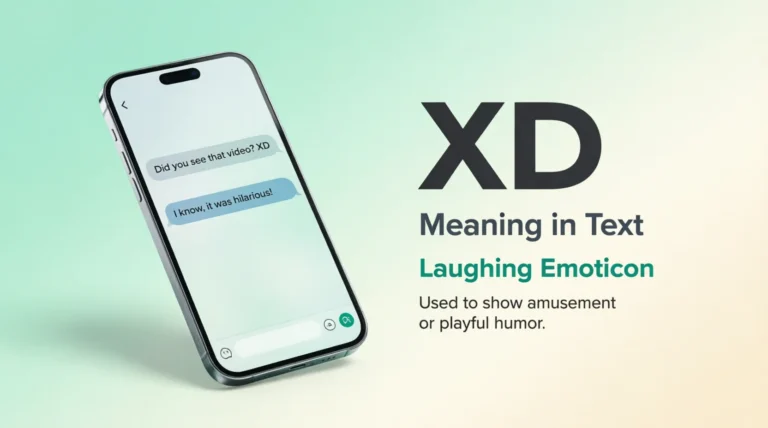
The most common meaning of XD in text is a laughing face. The letters are not an abbreviation but an emoticon.
When viewed sideways, the X represents tightly closed eyes, while the D forms a wide-open mouth, showing someone laughing hard.
People often search for this term because they see it in text messages, online games, social media comments, or group chats.
While newer emojis like 😂 and 🤣 have become more common, XD still appears in many online communities and casual conversations.
In this guide, you’ll learn what XD means, whether it has a full form, where it came from, how people use it today, and how its tone can change depending on the conversation.
| Term | Most Common Meaning | Full Form | Typical Tone | Common Usage |
|---|---|---|---|---|
| XD | A laughing face (emoticon) | No official full form | Playful, happy, joking | Text messages, gaming, social media, chats |
Quick Answer:
XD is a text emoticon that represents someone laughing with their eyes squeezed shut and mouth wide open. It is commonly used to show amusement, excitement, or playful humor.
What Does XD Mean in Text & Chat?
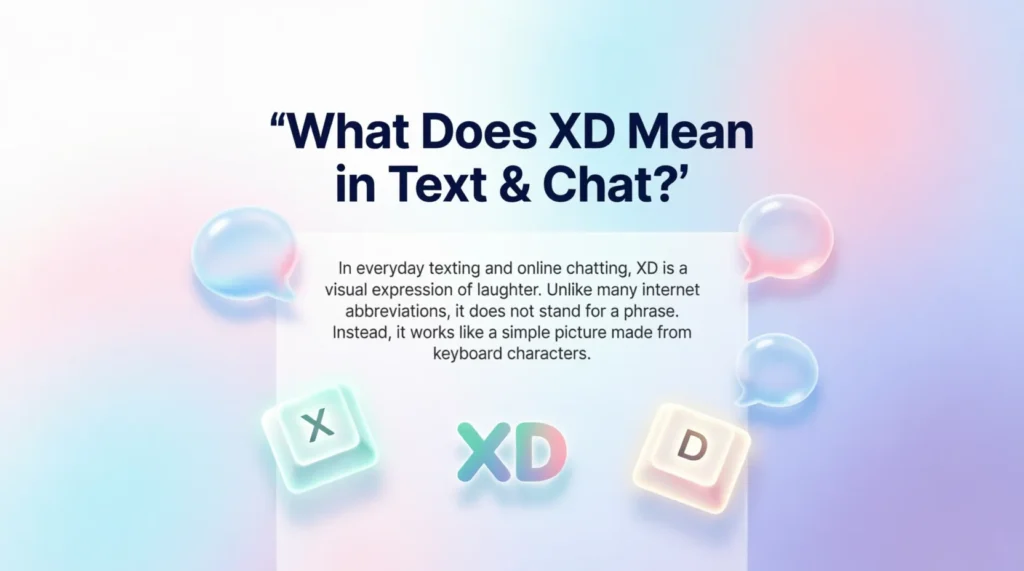
In everyday texting and online chatting, XD is a visual expression of laughter. Unlike many internet abbreviations, it does not stand for a phrase. Instead, it works like a simple picture made from keyboard characters.
Imagine turning your head slightly to the left. The X becomes tightly closed eyes, while the D looks like a big smiling mouth. Together, they create the image of someone laughing very hard.
People usually use XD after a funny joke, a playful comment, or an embarrassing moment. It helps show emotion when plain text might otherwise seem flat or serious.
The Most Common Meaning
Most of the time, XD simply means:
- “That’s really funny.”
- “I’m laughing.”
- “That made me smile.”
- “I’m joking.”
Unlike “LOL,” which has become a general reaction word, XD often feels more expressive because it visually represents laughter.
How Tone Changes
The meaning stays mostly the same, but the tone depends on context.
| Style | Possible Meaning |
|---|---|
| XD | Friendly laughter |
| XD! | Excited laughter |
| xD | Casual or softer laugh |
| XDDD | Extremely amused |
| XD 😂 | Extra emphasis on laughing |
Emojis, punctuation, and the relationship between the people chatting all influence how warm or playful XD feels.
For example, a close friend sending “You’re impossible XD” usually sounds affectionate, while the same message from someone you barely know might simply be playful.
Full Form, Stands For & Short Meaning of XD
One of the biggest misconceptions about XD is that it is an acronym with hidden words behind it. In reality, XD has no official full form.
It belongs to a group of internet emoticons created from keyboard characters. Before smartphones made emojis widely available, people commonly used symbols like 🙂
😀
🙁
😉
and XD to express emotions.
Does XD Stand for Anything?
No.
There is no universally accepted expansion such as:
- “Extreme Delight”
- “Extra Happy”
- “Excited Day”
These are creative guesses rather than real definitions.
The accepted meaning is simply the emoticon itself.
Short Meaning
You can think of XD as meaning:
- Big laugh
- Laughing hard
- That’s hilarious
- Funny reaction
- Playful amusement
Why People Mistake It for an Acronym
Many internet terms are abbreviations, including:
- LOL
- BRB
- OMG
- IMO
Since XD uses two capital letters, people naturally assume it follows the same pattern.
However, its purpose is different. It represents facial expression rather than shortened words.
Remember this simple rule:
XD is an emoticon, not an acronym.
That distinction helps avoid confusion when explaining the term to others.
Origin, History & First Known Use of XD
The exact first appearance of XD is difficult to verify because internet slang often spreads across many websites at once rather than beginning in one documented place.
However, XD became widely recognized during the early years of online chat rooms, forums, and instant messaging services, when people relied on keyboard characters to express emotions.
Why It Became Popular
Before colorful emojis existed, people used simple text combinations to show feelings.
Examples included:
- 🙂
- 😀
- 😉
- 😛
- XD
These emoticons made conversations feel warmer and more expressive without requiring images.
As online gaming communities, discussion boards, and messaging platforms grew, XD spread naturally between users.
Why It Has Lasted
Many internet expressions disappear after a few years, but XD has remained recognizable because it is easy to type and instantly understood by many long-time internet users.
That said, younger users today often choose emojis such as 😂 or 🤣 instead. Even so, XD still appears in gaming chats, online communities, and conversations among people who enjoy classic internet culture.
Rather than replacing emojis, XD now exists alongside them as a familiar and nostalgic way to express laughter.
How People Use XD in Daily Conversations
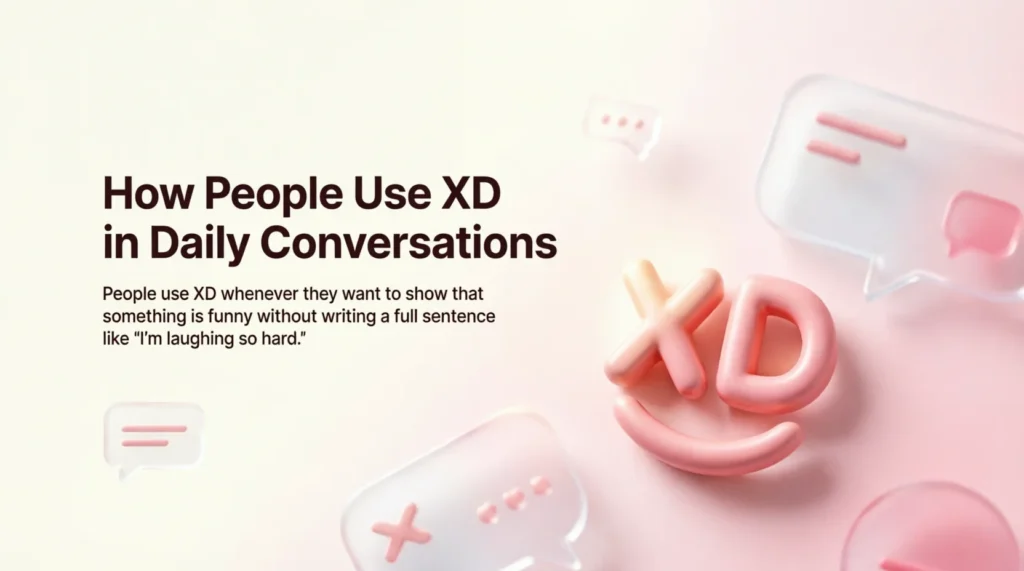
People use XD whenever they want to show that something is funny without writing a full sentence like “I’m laughing so hard.”
Its biggest strength is that it quickly adds emotion to a message.
Common Situations
People often use XD when:
- Someone tells a joke.
- A friend shares a funny photo.
- An embarrassing mistake becomes amusing.
- They tease someone in a friendly way.
- They react to a funny story.
Everyday Chat Examples
Example 1
Person A: “I walked into the wrong classroom today.”
Person B: “No way! XD”
Meaning: Person B finds the story funny and is laughing with the speaker rather than making fun of them.
Example 2
Person A: “I forgot my own birthday password.”
Person B: “Only you could do that XD 😂”
Meaning: Adding the emoji makes the laughter feel even stronger and more lighthearted.
Example 3
Person A: “You’re going to lose this game.”
Person B: “We’ll see about that XD”
Meaning: Here, XD softens the competitive comment and makes it sound playful instead of aggressive.
Why Context Matters
Although XD usually signals laughter, surrounding words change its emotional tone.
| Message | Likely Tone |
|---|---|
| “That’s amazing XD” | Happy |
| “You actually did that? XD” | Playfully surprised |
| “Nice one… XD” | Could be joking or mildly sarcastic |
| “Seriously? XD” | Depends on friendship and context |
When chatting with close friends, XD often creates a relaxed and humorous atmosphere. In more formal conversations, however, it may seem too casual or out of place.
XD Meaning Across WhatsApp, Instagram, TikTok & Snapchat
The meaning of XD remains largely the same across today’s major messaging and social media platforms. Whether you see it in a private chat, a comment section, or a gaming conversation, it almost always expresses laughter or playful amusement.
What changes is how often people use it, not what it means.
On WhatsApp, XD usually appears in conversations between friends, classmates, or family members. It often replaces laughing emojis when someone prefers typing with a keyboard.
Example:
Person A: “I accidentally called my teacher ‘Mom.'”
Person B: “XD That must have been awkward!”
Here, XD makes the reply sound supportive and amused rather than judgmental.
On Instagram, you’ll occasionally see XD in comments, captions, or direct messages. However, many users now prefer emojis like 😂, 🤣, or 😭 to express laughter.
When someone comments, “This video is hilarious XD,” the meaning is still clear: they found the content genuinely funny.
TikTok
TikTok users tend to rely more on emojis, trending phrases, and reaction slang. Even so, XD still appears in comments, especially among users who have been active online for many years or who enjoy older internet culture.
Snapchat
Snapchat conversations are fast and casual, making XD a natural fit. Friends may use it to react to funny selfies, voice notes, or everyday moments.
| Platform | Meaning | Usage Today |
|---|---|---|
| Laughing or amused | Fairly common | |
| Funny reaction | Less common than emojis | |
| TikTok | Laughing | Occasional, often nostalgic |
| Snapchat | Playful laughter | Still seen in casual chats |
Overall, XD carries the same core meaning across platforms. The biggest difference is that modern emojis have become the more common way to express laughter, while XD remains a familiar choice for many internet users.
Different Meanings of XD in Other Fields
Although XD is best known as a laughing emoticon, it can have different meanings in specific industries, products, or technical contexts. The correct interpretation depends entirely on where you see it.
Most people searching for “XD meaning in text” are looking for the chat meaning, not these alternative uses.
In Digital Communication
This is the most common meaning.
- XD = A laughing face emoticon.
- Expresses amusement, joy, or playful laughter.
- Used in text messages, online chats, gaming, and social media.
In Product Names
Some companies use XD as part of a product or model name. In these cases, it is not related to the laughing emoticon.
Examples include:
- Cameras
- Cars
- Electronic devices
- Software products
Here, XD functions as branding rather than internet slang.
In Gaming Communities
Gamers often use XD exactly as they do in regular chats.
For example:
Person A: “I missed the easiest shot.”
Person B: “XD That happens to everyone.”
The meaning remains “I’m laughing” or “That’s funny.”
Quick Summary
| Context | Meaning |
|---|---|
| Text messages | Laughing face |
| Social media | Playful laughter |
| Gaming | Funny reaction |
| Product names | Part of a brand or model |
| Technical documents | Depends on the specific subject |
The safest approach is to look at the surrounding conversation. If people are chatting casually, XD almost always represents laughter.
Common Confusions, Mistakes & Wrong Interpretations
Because XD is made of two capital letters, many people assume it is an abbreviation. That leads to several common misunderstandings.
Mistake 1: Thinking XD Has a Full Form
This is the biggest misconception.
Many websites or social posts invent phrases like:
- Extreme Delight
- Extra Happy
- Excited Day
These are not official meanings.
XD is an emoticon, not an acronym.
Mistake 2: Reading It Without Turning It Sideways
Someone seeing XD for the first time may read it as two separate letters.
Its meaning becomes obvious only when viewed as a sideways face:
- X = Closed laughing eyes
- D = Wide open smiling mouth
Mistake 3: Assuming It Is Always Sarcastic
Most uses are friendly.
However, tone depends on context.
For example:
“Nice job XD”
This could mean:
- Genuine playful teasing
- Friendly joking
- Light sarcasm
The words before and after XD usually reveal the intended tone.
Mistake 4: Using It in Formal Conversations
While XD works well in casual chats, it generally doesn’t fit professional emails, business messages, or academic writing.
Instead, choose clear language without internet slang when communicating formally.
Quick Guide
| Assumption | Correct? |
|---|---|
| XD has a full form | ❌ No |
| XD shows laughter | ✅ Yes |
| XD is always sarcastic | ❌ No |
| XD works in formal writing | ❌ Usually not |
| Context affects meaning | ✅ Yes |
Similar Terms, Alternatives & Related Slang
Over the years, many internet expressions have been used to show laughter. Some are words, while others are emoticons or emojis.
Each one carries a slightly different feeling.
| Expression | Typical Meaning | Tone |
|---|---|---|
| LOL | Laughing out loud | Casual |
| LMAO | Laughing very hard | Informal |
| ROFL | Rolling with laughter | Exaggerated |
| 😂 | Laughing with tears | Friendly |
| 🤣 | Laughing extremely hard | Strong reaction |
| 😀 | Big smile | Happy |
| XD | Laughing face | Playful |
When People Choose XD
Someone may prefer XD because it:
- Feels nostalgic.
- Is easy to type.
- Matches older internet culture.
- Looks expressive without using emojis.
XD vs LOL
Although both suggest laughter, they are slightly different.
| XD | LOL |
|---|---|
| Visual emoticon | Text abbreviation |
| Looks like a laughing face | Means “laughing out loud” |
| Often feels playful | Often used as a quick reaction |
Neither is more “correct.” People simply choose the style they like.
Examples of XD in Real Chat Situations
Seeing XD in real conversations makes its meaning much easier to understand.
Example 1: Funny Story
Person A: “I waved at someone who wasn’t waving at me.”
Person B: “XD I’ve done that before.”
Meaning: Shared laughter and empathy.
Example 2: Friendly Teasing
Person A: “You’re always five minutes late.”
Person B: “Only five? XD”
Meaning: Playful teasing between friends.
Example 3: Gaming Chat
Person A: “I fell off the map again.”
Person B: “XD That was impressive.”
Meaning: Laughing about a funny mistake.
Example 4: Mild Sarcasm
Person A: “I totally studied…”
Person B: “Sure… XD”
Meaning: The speaker probably doesn’t believe the statement but keeps the conversation light.
Example 5: Excitement
Person A: “We got concert tickets!”
Person B: “XD That’s awesome!”
Meaning: Happy excitement rather than laughter alone.
How Emojis Change the Tone
| Message | Feeling |
|---|---|
| XD | Playful laugh |
| XD 😂 | Strong laughter |
| XD ❤️ | Affectionate and warm |
| XD 😅 | Laughing with slight embarrassment |
| XD!!! | Extra excitement |
Small additions like emojis and punctuation often make the emotional meaning clearer.
How to Reply When Someone Says XD
There isn’t one perfect response to XD. Your reply should match the mood of the conversation.
If They’re Laughing at Something Funny
You can continue the joke.
Example
Person A: “XD”
Person B: “I knew you’d find that funny. 😂”
If They’re Being Playful
Keep the playful energy going.
Example
Person A: “You’re impossible XD”
Person B: “That’s part of my charm.”
If You’re Confused
It’s perfectly fine to ask.
Example
Person A: “XD”
Person B: “Haha, what’s so funny?”
or
Person B: “Did I miss something?”
If It Feels Slightly Sarcastic
Stay calm and ask for clarification if needed.
Example
Person A: “Nice one XD”
Person B: “Are you joking, or do you mean it?”
This avoids misunderstandings without creating unnecessary conflict.
Quick Reply Ideas
| Situation | Good Reply |
|---|---|
| Funny joke | “😂 Right?” |
| Friendly teasing | “You got me!” |
| Exciting news | “I can’t wait!” |
| Unsure what they mean | “What made you laugh?” |
| Mild sarcasm | “Haha, just checking!” |
Matching the other person’s tone usually leads to the smoothest conversation.
Is XD Still Popular? Trends & Online Usage
XD is still recognized across the internet, but it is no longer as common as it was during the early days of online messaging.
Today’s users have many more ways to express emotion, especially through emojis, GIFs, stickers, and animated reactions.
Who Still Uses XD?
You are more likely to see XD among:
- Long-time internet users.
- Gaming communities.
- Online forums.
- Friends who enjoy classic internet slang.
- People typing quickly on a keyboard.
Younger users often choose emojis instead, but many still understand what XD means when they see it.
Is XD Outdated?
Not exactly.
It is better described as less common than before rather than obsolete.
Using XD won’t usually confuse people, although some may see it as a nostalgic internet expression.
Should You Still Use It?
Yes—if it fits the conversation.
Use XD when:
- Chatting with friends.
- Sending casual messages.
- Joining gaming conversations.
- Sharing jokes.
Avoid it in:
- Business emails.
- Professional communication.
- Academic assignments.
- Formal customer support messages.
Quick Summary
| Question | Answer |
|---|---|
| Is XD still understood? | Yes |
| Is it as popular as before? | No |
| Do emojis replace it sometimes? | Yes |
| Is it okay in casual chats? | Absolutely |
| Should it be used professionally? | Usually no |
While online language continues to evolve, XD remains a familiar symbol of laughter and playful conversation. Its meaning has stayed remarkably consistent, even as the ways people communicate have changed.
Frequently Asked Questions
What does XD mean in text messages?
The most common meaning of XD in text messages is a laughing face emoticon. When viewed sideways, the X represents tightly closed eyes and the D represents a wide-open smiling mouth. People use it to show they find something funny or amusing.
Does XD have a full form?
No. XD does not have an official full form. It is not an acronym like LOL or BRB. Instead, it is an emoticon created from keyboard characters to represent laughter.
Is XD the same as LOL?
Not exactly. Both express laughter, but they work differently.
- XD is a visual emoticon that looks like a laughing face.
- LOL is an abbreviation for “laughing out loud.”
Many people use them interchangeably, but XD often feels more playful because it visually represents someone’s expression.
Is XD rude or sarcastic?
Usually, no. Most of the time, XD sounds friendly, playful, or cheerful.
However, context matters. In a message like “Nice job XD,” it could be light-hearted teasing or mild sarcasm depending on the relationship between the people, the surrounding words, and any accompanying emojis or punctuation.
Is XD still popular in 2026?
Yes, but it is less common than it once was. Many people now use emojis such as 😂 or 🤣 instead. Even so, XD remains widely understood and is still used in gaming communities, online forums, and casual conversations.
Does XD mean the same thing on WhatsApp, Instagram, TikTok, and Snapchat?
In most cases, yes. Across these platforms, XD almost always means laughter or playful amusement. The biggest difference is frequency of use—some platforms favor emojis more heavily, but the meaning of XD remains consistent.
How should I reply to XD?
A good reply depends on the conversation. Here are a few natural responses:
- If someone is laughing: “😂 I knew you’d find that funny!”
- If they’re teasing you: “Haha, fair enough!”
- If you’re confused: “What made you laugh?”
- If they’re celebrating something: “That’s awesome! 🎉”
Matching the other person’s tone usually makes the conversation feel more natural.
Is XD appropriate for professional communication?
Generally, no. XD is considered casual internet slang and is best suited for conversations with friends, family, classmates, or gaming communities. For professional emails, work chats, or formal communication, it’s better to use clear language without slang or emoticons.
Conclusion
XD is one of the internet’s classic emoticons, and its meaning has stayed remarkably consistent over the years.
In text messages and online chats, it most commonly represents a laughing face with closed eyes and a wide smile, making it a simple way to show amusement, excitement, or playful humor.
Although modern emojis have become the preferred way for many people to express laughter, XD remains familiar and widely understood across messaging apps, gaming communities, and social media platforms.
Remember that the surrounding words, emojis, punctuation, and your relationship with the other person can subtly change its tone—from friendly and affectionate to lightly sarcastic or teasing.
If you’re curious about other internet slang, text abbreviations, or chat expressions, exploring their meanings can help you communicate more confidently and avoid misunderstandings in online conversations.

Alden Rowen is the author behind Meanings Path, sharing clear and reliable insights into the meanings, origins, and significance of words, names, and phrases. His goal is to make language simple, useful, and easy to understand.