“I get it” is a common English phrase that means “I understand.” People use it when they understand an idea, explanation, feeling, or situation.
It is simple and natural, but using the same phrase again and again can make your English sound repetitive.
Learning other ways to say I get it can help you sound more fluent, confident, and natural.
The best alternative depends on the situation.
For example, “I understand” works well in professional settings, while “Got it” sounds more casual. “That makes sense” is useful when someone explains a reason or idea.
Choosing the right phrase also changes your tone.
Some expressions sound friendly, while others sound more formal or emphatic.
This guide covers 20 alternatives to I get it, with meanings, examples, tones, and practical advice for English learners and professionals.
What Does “I Get It” Mean?
“I get it” means “I understand” or “I understand what you mean.”
It is an informal expression. Here, “get” does not mean physically receiving or obtaining something. It means to understand something.
For example:
- I get it now. = I understand it now.
- I get what you mean. = I understand your point.
- Okay, I get it. = Okay, I understand.
The phrase can be used in both spoken and written communication. However, it is more common in everyday conversation, text messages, chats, and informal communication.
The tone can also change with context. A friendly “I get it” can show understanding. But a short “I get it” said with an annoyed tone may mean, “You do not need to explain it again.”
When to Use “I Get It”
“I get it” is best when you are having a casual or friendly conversation.
You might use it when a friend explains a problem:
“You are upset because you thought they would support you. I get it.”
You can also use it when someone explains how something works:
“Oh, I get it now. The first button starts the process.”
In text messages, “I get it” is also very common:
“I get it. Don’t worry about explaining.”
However, you may want a more professional alternative at work. In an email to a manager or client, “I understand” or “That makes sense” can sound more polished.
So, use “I get it” when you want a natural, relaxed expression. Choose a more formal phrase when the situation calls for professional language.
Is It Professional or Polite to Say “I Get It”?
Yes, “I get it” is polite in many everyday situations. However, it is informal.
With close friends, classmates, family members, or people you know well, it usually sounds natural.
At work, the phrase is not necessarily rude or wrong. Still, it can sound too casual in formal emails, presentations, business meetings, or communication with senior clients.
For example:
Casual:
“I get it. Thanks for explaining.”
Professional:
“I understand. Thank you for explaining.”
The second sentence sounds more polished.
There is another point to remember. “I get it” can sometimes sound impatient. If someone is repeating an explanation and you say, “I get it,” they may think you are annoyed.
If you want to sound warm and respectful, try:
- I understand what you mean.
- That makes sense.
- I see your point.
- Thanks, I understand now.
These alternatives help you show understanding without sounding dismissive.
Pros and Cons of Using “I Get It”
Pros
- It is simple: English learners can use it easily.
- It sounds natural: Native speakers often use it in casual conversation.
- It is short: You can quickly show that you understand.
- It works in conversations: It fits many everyday situations.
- It can show empathy: “I get it” can mean you understand someone’s feelings.
Cons
- It is informal: It may not be ideal for formal business writing.
- It can sound impatient: Your tone can change its meaning.
- It may become repetitive: Frequent use can make your speech less varied.
- It may be too general: Sometimes you need to explain exactly what you understand.
- It can sound abrupt: A short “I get it” may feel cold in some situations.
20 Other Ways to Say “I Get It”
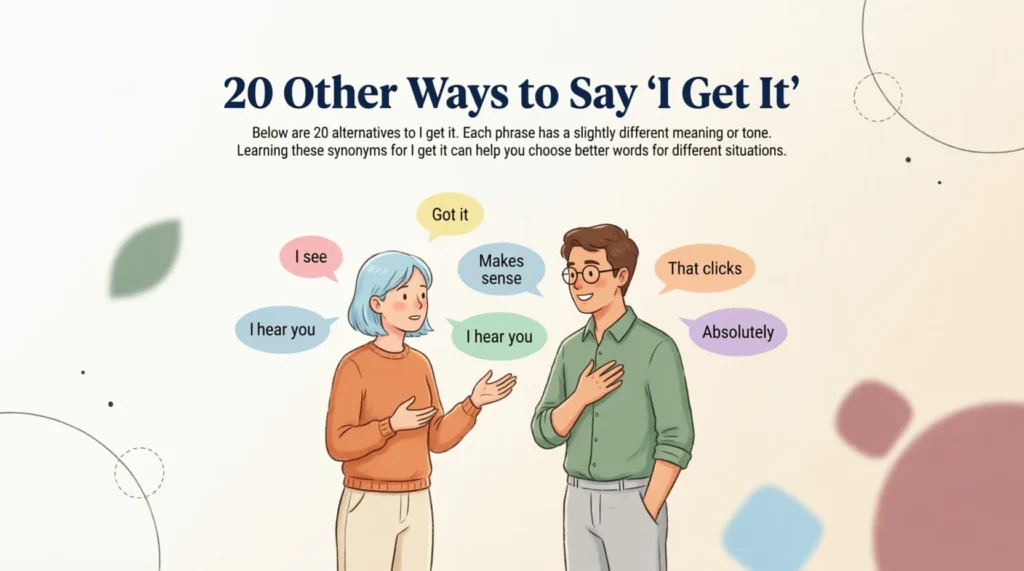
Below are 20 alternatives to I get it. Each phrase has a slightly different meaning or tone. Learning these synonyms for I get it can help you choose better words for different situations.
1. I Understand
Meaning: You understand the information, idea, or situation.
Explanation: “I understand” is one of the safest and most useful alternatives. It works in both everyday and professional English. It sounds more formal than “I get it.”
Example Sentence: “I understand what you are asking me to do.”
Best Use: Formal, Business, Professional
Worst Use: Very relaxed conversations where a more friendly phrase would sound better.
Tone: Neutral
2. Got It
Meaning: You understand or have received the information.
Explanation: “Got it” is short and common. It is especially useful after someone gives you instructions.
Example Sentence: “Send the report before noon.” “Got it.”
Best Use: Informal, Casual, Workplace conversations
Worst Use: Very formal letters or highly formal presentations.
Tone: Friendly
3. I See
Meaning: You now understand an idea or situation.
Explanation: “I see” is useful when someone has just explained something to you. It can also show that you are following their explanation.
Example Sentence: “I see why you chose that option.”
Best Use: Spoken English, Business, Everyday conversation
Worst Use: When you need to clearly confirm that you will complete a task.
Tone: Neutral
4. That Makes Sense
Meaning: The explanation or idea seems logical.
Explanation: Use this phrase when something becomes clear after someone explains it. It does more than simply say you understand. It shows that the reasoning is logical to you.
Example Sentence: “That makes sense. Now I understand why the meeting was moved.”
Best Use: Business, Friendly, Casual
Worst Use: When you do not actually agree with the idea.
Tone: Friendly
5. I Know What You Mean
Meaning: You understand what another person is trying to say.
Explanation: This is especially useful when someone is explaining a feeling, opinion, or personal experience.
Example Sentence: “I know what you mean. It can be hard to stay focused after a long day.”
Best Use: Casual, Friendly, Personal conversations
Worst Use: Formal reports or highly formal emails.
Tone: Friendly
6. I See What You Mean
Meaning: You understand someone’s point or idea.
Explanation: This phrase is slightly more specific than “I see.” It tells the other person that their point is clear to you.
Example Sentence: “I see what you mean about making the design simpler.”
Best Use: Business, Discussion, Everyday English
Worst Use: Situations where you need to confirm agreement rather than understanding.
Tone: Neutral
7. I Follow You
Meaning: You understand what someone is explaining.
Explanation: “I follow you” is often used during conversations or explanations. It tells the speaker that you are keeping up with their ideas.
Example Sentence: “I follow you. First, we collect the data, and then we review it.”
Best Use: Business, Spoken English, Discussions
Worst Use: Very basic conversations where “I understand” would be clearer for a learner.
Tone: Neutral
8. Understood
Meaning: The information is clear to you.
Explanation: “Understood” is concise and professional. It is often used when someone gives instructions or explains a requirement.
Example Sentence: “Understood. I’ll update the document today.”
Best Use: Business, Workplace, Professional communication
Worst Use: Warm personal conversations where it may sound too serious.
Tone: Formal
9. I’m With You
Meaning: You understand and are following someone’s point.
Explanation: This phrase can show that you understand an argument or explanation. Depending on context, it can also suggest agreement.
Example Sentence: “I’m with you. We need to improve the customer experience.”
Best Use: Discussions, Friendly, Business
Worst Use: When you want to show understanding without suggesting agreement.
Tone: Friendly
10. I’m Following
Meaning: You understand what someone is explaining.
Explanation: “I’m following” tells someone that their explanation is clear and you are keeping up with it.
Example Sentence: “I’m following so far. Please continue.”
Best Use: Meetings, Classes, Discussions
Worst Use: Very formal written documents.
Tone: Neutral
11. I Appreciate What You Mean
Meaning: You understand the point someone is making.
Explanation: This phrase can sound respectful and thoughtful. It is useful when you want to acknowledge someone’s perspective.
Example Sentence: “I appreciate what you mean, and I understand why you are concerned.”
Best Use: Professional, Polite discussions
Worst Use: Very quick casual replies.
Tone: Formal
12. I Understand Your Point
Meaning: You understand another person’s argument or opinion.
Explanation: This is a strong choice for discussions where people have different views. It shows that you understand their argument without necessarily saying you agree.
Example Sentence: “I understand your point, but I have a different suggestion.”
Best Use: Business, Meetings, Debates
Worst Use: Simple instructions where “Got it” would be more natural.
Tone: Neutral
13. I See Your Point
Meaning: You understand why someone thinks or feels a certain way.
Explanation: This phrase is useful when discussing opinions. It can acknowledge someone’s reasoning without showing complete agreement.
Example Sentence: “I see your point, and I think we should consider both options.”
Best Use: Business, Discussions, Polite disagreement
Worst Use: When you simply need to confirm that you received an instruction.
Tone: Neutral
14. That’s Clear
Meaning: The information is easy to understand.
Explanation: “That’s clear” tells someone that their explanation has removed confusion.
Example Sentence: “Thanks for explaining the process. That’s clear now.”
Best Use: Workplace, Education, Professional communication
Worst Use: When you need to express empathy about someone’s feelings.
Tone: Neutral
15. Crystal Clear
Meaning: Completely clear and easy to understand.
Explanation: “Crystal clear” is an emphatic expression. It means there is no confusion at all.
Example Sentence: “Your instructions are crystal clear.”
Best Use: Informal, Friendly, Workplace conversations
Worst Use: Very formal writing where a simpler phrase may be better.
Tone: Emphatic
16. I’m Clear on That
Meaning: You understand a specific point, task, or requirement.
Explanation: This phrase is useful when confirming that you understand what needs to be done.
Example Sentence: “I’m clear on that. I’ll send the final version this afternoon.”
Best Use: Business, Workplace
Worst Use: Casual conversations about emotions or personal experiences.
Tone: Professional
17. Thanks, That Clarifies It
Meaning: The explanation helped remove your confusion.
Explanation: This is a polite alternative when someone has explained something that was unclear. It also shows appreciation.
Example Sentence: “Thanks, that clarifies it. I now know which form to use.”
Best Use: Business, Email, Professional communication
Worst Use: Quick conversations with close friends.
Tone: Formal
18. I Have a Clear Picture Now
Meaning: You now understand the whole situation.
Explanation: This phrase suggests that you understand the larger idea, not just one small detail.
Example Sentence: “After reviewing the report, I have a clear picture now.”
Best Use: Business, Meetings, Professional discussions
Worst Use: Very short casual replies.
Tone: Neutral
19. Now I Understand
Meaning: You did not understand before, but you understand now.
Explanation: This phrase is useful after someone gives you new information or explains something differently.
Example Sentence: “Oh, now I understand why the numbers changed.”
Best Use: Formal, Informal, Educational
Worst Use: When you want to sound extremely casual.
Tone: Neutral
20. I’ve Got You
Meaning: I understand what you are saying or asking.
Explanation: “I’ve got you” is a casual and friendly expression. It can also mean that you understand what someone needs and are ready to help.
Example Sentence: “You need the file before the meeting? I’ve got you.”
Best Use: Casual, Friendly, Informal workplace conversations
Worst Use: Formal business emails, academic writing, or serious professional documents.
Tone: Friendly
Quick Comparison of the Best Alternatives
| Alternative | Tone | Best Setting |
|---|---|---|
| I understand | Formal | Business and professional |
| Got it | Friendly | Casual and workplace |
| That makes sense | Friendly | Explanations and discussions |
| I see your point | Neutral | Meetings and debates |
| Understood | Formal | Instructions and business |
| I know what you mean | Friendly | Personal conversations |
| Thanks, that clarifies it | Formal | Emails and workplace |
The key is not to choose the “best” phrase every time. Instead, choose the phrase that matches your situation.
For example, a manager may prefer:
“Understood. I’ll take care of it.”
A friend may prefer:
“Got it!”
During a discussion, you could say:
“I see your point.”
This small change in wording can make your English sound more natural and flexible.
Frequently Asked Questions
What is the best formal way to say “I get it”?
“I understand” is usually the safest formal alternative. You can also say “Understood” or “I understand your point” depending on the situation.
What is a casual way to say “I get it”?
“Got it” is one of the most common casual alternatives. “I see” and “I know what you mean” are also natural.
Is “I get it” rude?
Not usually. However, your tone matters. A short or sharp “I get it” can sound impatient, especially if someone is repeating an explanation.
What can I say instead of “I get it” at work?
Try “I understand,” “Understood,” “That makes sense,” or “I’m clear on that.” These options sound professional and respectful.
What is another way to say “I get what you mean”?
You can say “I understand what you mean,” “I see what you mean,” “I know what you mean,” or “I see your point.”
Conclusion
Knowing other ways to say I get it gives you more control over your English.
The right phrase can make you sound more professional, friendly, polite, or confident.
Use “I understand” in formal situations, “Got it” in casual conversations, and “That makes sense” when an explanation becomes clear.
If you want to acknowledge someone’s opinion, “I see your point” is a useful choice.
You do not need to replace “I get it” every time. Instead, learn how each alternative sounds and use it when the situation fits.
With practice, these small changes will help you communicate more naturally and confidently in 2026.

Alden Rowen is the author behind Meanings Path, sharing clear and reliable insights into the meanings, origins, and significance of words, names, and phrases. His goal is to make language simple, useful, and easy to understand.