
“Fine by me” means that you agree with an idea, plan, choice, or suggestion.
It is a simple way to say, “I am okay with that.” You may hear it in daily conversations, emails, meetings, text messages, and workplace chats.
However, using the same phrase again and again can make your English sound repetitive.
Learning other ways to say fine by me helps you sound more natural and confident.
The right phrase can also change your tone. Some alternatives sound warm and friendly, while others sound more professional or formal.
In this guide, you will learn 20 alternatives to “fine by me.” Each one includes its meaning, usage, example, tone, and best context.
These synonyms for fine by me can help you choose the right words for friends, coworkers, clients, and professional situations.
What Does “Fine by Me” Mean?
“Fine by me” means “I agree,” “I am okay with that,” or “That is acceptable to me.”
It is an informal expression of agreement. The word “fine” means acceptable or satisfactory, while “by me” shows that the speaker personally accepts the idea.
For example:
“We can meet at 3 p.m. instead.”
“Fine by me.”
Here, the speaker agrees with the new meeting time.
The phrase is usually used after someone makes a suggestion or proposes a change. It can also be used when someone asks for permission.
“Is it okay if I take Friday off?”
“Fine by me.”
The phrase is grammatically natural in spoken English. It is often shorter and more conversational than saying, “That is acceptable to me.”
However, tone matters. Depending on your voice, “fine by me” can sound friendly, neutral, relaxed, or slightly indifferent.
When to Use “Fine by Me”
“Fine by me” works best in casual and everyday communication.
You can use it when:
- Agreeing with a friend’s suggestion
- Accepting a change of plans
- Choosing a restaurant or meeting place
- Responding to a coworker’s simple suggestion
- Agreeing to a time or date
- Giving informal permission
- Replying to a text message
- Talking with people you know well
For example:
“Let’s order pizza tonight.”
“Fine by me.”
It is also possible to use the phrase at work, especially when speaking with coworkers you know well.
“Would 2 p.m. work for our meeting?”
“Fine by me.”
However, “fine by me” may not be the best choice for formal emails, client communication, business proposals, or important professional decisions. In these situations, phrases such as “That works for me,” “I agree,” or “That is acceptable to me” may sound more polished.
The key is to match the phrase to your audience and situation.
Is It Professional or Polite to Say “Fine by Me”?
Yes, “fine by me” is generally polite. It clearly shows agreement without sounding rude.
But it is informal rather than highly professional.
In a friendly workplace conversation, it can sound perfectly natural:
“Can we move the meeting to Thursday?”
“Fine by me.”
In a formal email to a client, however, you may want a more professional option:
“Thursday works well for me.”
There is another point to remember. The word “fine” can sometimes sound less enthusiastic than “great” or “sounds good.” If someone suggests an exciting plan and you answer only, “Fine by me,” they might think you are simply accepting it rather than feeling enthusiastic.
So, “fine by me” is polite, but context and tone matter.
For professional communication, choose a phrase that shows the exact level of agreement you want to express.
Pros and Cons of Using “Fine by Me”
Pros
- Simple: It is short and easy to understand.
- Natural: Native speakers commonly use it in casual conversations.
- Flexible: It works with plans, choices, times, and suggestions.
- Polite: It normally shows acceptance without sounding demanding.
- Easy to remember: English learners can use it in many everyday situations.
Cons
- Informal: It may not be ideal for highly formal communication.
- Can sound indifferent: “Fine” does not always show strong enthusiasm.
- Can become repetitive: Using it too often can make your English sound limited.
- Tone can change: A flat or sarcastic voice can make the phrase sound negative.
- Not always precise: Sometimes you need to show strong agreement instead of simple acceptance.
Learning different alternatives to fine by me gives you more control over your tone.
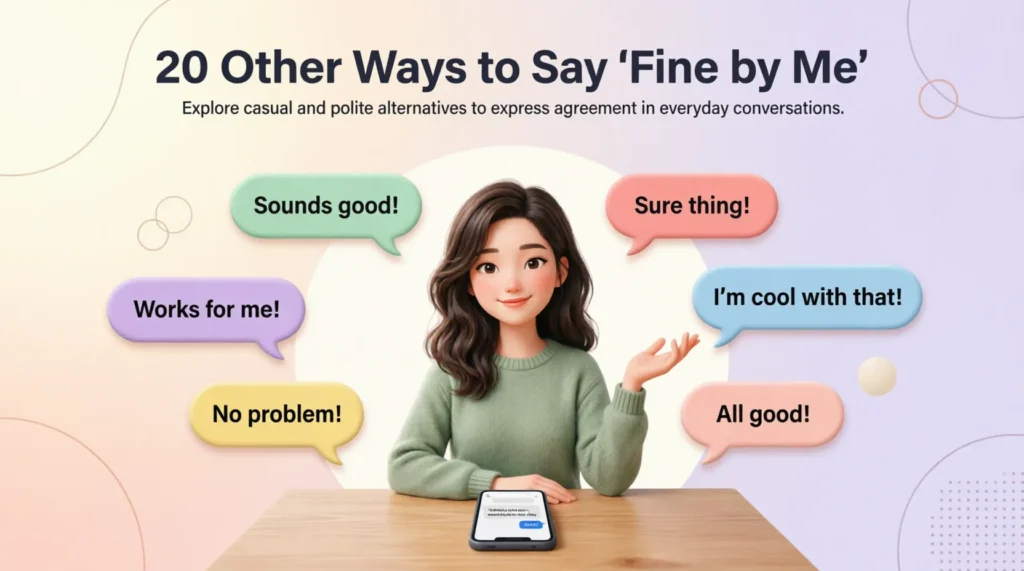
20 Other Ways to Say “Fine by Me”
1. That Works for Me
Meaning: This means that a plan or suggestion is suitable or acceptable to you.
Explanation: This is one of the most useful formal ways to say fine by me. It sounds natural in both professional and personal conversations. It often focuses on whether a time, plan, or arrangement is convenient.
Example Sentence: “We can have the meeting at 10 a.m. That works for me.”
Best Use: Business, Professional, Informal
Worst Use: Very formal legal or academic writing where more precise wording is needed.
Tone: Friendly / Neutral
2. Sounds Good to Me
Meaning: You like or accept someone’s suggestion.
Explanation: This phrase often shows a little more enthusiasm than “fine by me.” It is very common in spoken English and online conversations.
Example Sentence: “Let’s meet at the coffee shop after work.” “Sounds good to me.”
Best Use: Casual, Informal, Workplace
Worst Use: Highly formal business documents.
Tone: Friendly
3. I’m Okay With That
Meaning: You have no problem with an idea or decision.
Explanation: This is a clear and simple alternative. It is useful when someone asks whether you accept a particular choice.
Example Sentence: “Would you like to sit outside?” “I’m okay with that.”
Best Use: Casual, Informal, Spoken English
Worst Use: Formal client correspondence.
Tone: Neutral
4. I’m Happy With That
Meaning: You are satisfied with a decision or arrangement.
Explanation: This phrase can show stronger positive feelings than “fine by me.” It tells the listener that you are not simply accepting the plan; you are satisfied with it.
Example Sentence: “We can use the new design for the website.” “I’m happy with that.”
Best Use: Business, Professional, Informal
Worst Use: Situations where you need to express strong excitement rather than simple satisfaction.
Tone: Friendly / Positive
5. Works for Me
Meaning: The plan is suitable or convenient for you.
Explanation: This is a shorter version of “That works for me.” It is extremely useful for talking about times, dates, plans, and arrangements.
Example Sentence: “Can we talk after lunch?” “Works for me.”
Best Use: Casual, Workplace, Texting
Worst Use: Very formal letters or official documents.
Tone: Neutral / Friendly
6. I’m Fine With That
Meaning: You accept or do not object to something.
Explanation: This phrase is very close in meaning to “fine by me.” It can be used when you want to make it clear that a choice does not cause a problem for you.
Example Sentence: “You can send the report tomorrow.” “I’m fine with that.”
Best Use: Informal, Casual, Workplace
Worst Use: Formal business proposals.
Tone: Neutral
7. I Agree
Meaning: You share the same opinion or accept a proposal.
Explanation: “I agree” is direct and professional. It is especially useful when responding to an opinion, decision, or recommendation rather than simply choosing a time or place.
Example Sentence: “I think we should focus on customer service first.” “I agree.”
Best Use: Business, Professional, Formal
Worst Use: Very casual situations where a warmer phrase would sound more natural.
Tone: Neutral / Formal
8. Absolutely
Meaning: You strongly agree.
Explanation: This is a strong form of agreement. Unlike “fine by me,” it can show enthusiasm and confidence.
Example Sentence: “Should we invite the whole team?” “Absolutely.”
Best Use: Informal, Professional, Business
Worst Use: Situations where you only want to give weak or neutral approval.
Tone: Emphatic
9. Go Ahead
Meaning: You give someone permission to continue or do something.
Explanation: This phrase is useful when someone is waiting for your approval. It does not simply mean “I agree”; it can mean “You have my permission.”
Example Sentence: “Can I send the email now?” “Go ahead.”
Best Use: Informal, Workplace, Spoken English
Worst Use: Formal written approval when official authorization is required.
Tone: Friendly / Neutral
10. Why Not?
Meaning: You see no reason to refuse a suggestion.
Explanation: “Why not?” is a casual way to accept an idea. It can sound relaxed and open-minded.
Example Sentence: “Want to try the new restaurant tonight?” “Why not?”
Best Use: Casual, Informal
Worst Use: Formal meetings, official emails, or serious decisions.
Tone: Friendly / Casual
11. I Don’t Mind
Meaning: You have no strong preference or objection.
Explanation: This phrase is useful when you are happy to let another person choose. It can be slightly less positive than “sounds good to me.”
Example Sentence: “Do you want tea or coffee?” “I don’t mind. You choose.”
Best Use: Casual, Informal
Worst Use: Situations where you want to show enthusiasm.
Tone: Neutral
12. That’s Acceptable to Me
Meaning: You consider something satisfactory or suitable.
Explanation: This is a more formal alternative to “fine by me.” It is useful when discussing agreements, conditions, schedules, or business decisions.
Example Sentence: “The revised payment schedule is acceptable to me.”
Best Use: Formal, Business, Professional
Worst Use: Friendly conversations with close friends.
Tone: Formal / Neutral
13. I’m on Board
Meaning: You support or agree with an idea or plan.
Explanation: “I’m on board” is common in workplace English. It often suggests more than simple acceptance. It can show that you are willing to support the plan.
Example Sentence: “We’re planning to launch the campaign next month.” “I’m on board.”
Best Use: Business, Workplace, Professional
Worst Use: Highly formal legal writing.
Tone: Friendly / Positive
14. Count Me In
Meaning: Include me because I want to participate.
Explanation: This is stronger than “fine by me.” It shows that you actively want to join an activity or plan.
Example Sentence: “We’re going hiking this weekend.” “Count me in!”
Best Use: Casual, Informal, Friendly
Worst Use: Formal business decisions where participation needs official wording.
Tone: Friendly / Emphatic
15. I’m Good With That
Meaning: You accept or support the suggested option.
Explanation: This is a common conversational phrase. It sounds relaxed and natural, especially in American English.
Example Sentence: “Let’s take the train instead.” “I’m good with that.”
Best Use: Casual, Informal, Workplace
Worst Use: Formal emails or academic writing.
Tone: Friendly / Neutral
16. That Is Fine With Me
Meaning: You accept the suggested idea or arrangement.
Explanation: This is slightly more complete than “fine by me,” but it has almost the same meaning. It can work in everyday speech and some workplace situations.
Example Sentence: “If you prefer to start at noon, that is fine with me.”
Best Use: Informal, Workplace, Spoken English
Worst Use: Highly formal corporate documents.
Tone: Neutral
17. I Have No Objection
Meaning: You do not oppose a proposal or action.
Explanation: This is a formal expression. It is useful when someone asks for your approval or wants to know whether you oppose a decision.
Example Sentence: “I have no objection to the proposed schedule.”
Best Use: Formal, Business, Professional
Worst Use: Casual conversations with friends.
Tone: Formal / Neutral
18. That Seems Fine
Meaning: Something appears acceptable to you.
Explanation: This phrase is useful when you have reviewed a suggestion and see no obvious problem. “Seems” makes the statement slightly less absolute.
Example Sentence: “I’ve attached the updated schedule. Does it work?” “Yes, that seems fine.”
Best Use: Workplace, Professional, Informal
Worst Use: When you need to express strong enthusiasm or definite approval.
Tone: Neutral
19. I’m All for It
Meaning: You strongly support an idea or activity.
Explanation: This phrase shows clear enthusiasm. It is stronger than simply saying “fine by me.”
Example Sentence: “I think we should organize a team lunch.” “I’m all for it.”
Best Use: Informal, Friendly, Workplace
Worst Use: Formal legal or official documents.
Tone: Emphatic / Friendly
20. That Gets My Approval
Meaning: You approve of an idea, plan, or decision.
Explanation: This phrase clearly communicates approval. It can sound confident and slightly more formal than casual alternatives.
Example Sentence: “We’ve chosen the final design.” “That gets my approval.”
Best Use: Business, Professional, Informal
Worst Use: Very casual conversations where it may sound overly serious.
Tone: Formal / Emphatic
Quick Comparison of the Best Alternatives
| Alternative | Tone | Best Context |
|---|---|---|
| That works for me | Neutral | Business and everyday use |
| Sounds good to me | Friendly | Casual and workplace conversations |
| I agree | Formal / Neutral | Professional discussions |
| I’m on board | Positive | Team and business settings |
| I’m all for it | Emphatic | Friendly and informal settings |
| I have no objection | Formal | Official or professional situations |
| Count me in | Friendly | Social plans and activities |
The best choice depends on what you want to communicate. If you simply accept a plan, “That works for me” is a safe option. If you want to sound enthusiastic, “Sounds good to me” or “I’m all for it” works better.
For formal situations, “I agree,” “That’s acceptable to me,” or “I have no objection” can sound more appropriate.
How to Choose the Right Alternative
Choosing the right synonym is not only about grammar. It is also about tone, relationship, and purpose.
For casual conversations
Use:
- Sounds good to me.
- Why not?
- I’m good with that.
- Count me in.
- Works for me.
These phrases sound natural with friends, family, and people you know well.
For workplace conversations
Use:
- That works for me.
- I’m happy with that.
- I’m on board.
- I agree.
- That seems fine.
These options are useful in meetings, team chats, and everyday professional conversations.
For formal communication
Use:
- I agree.
- That’s acceptable to me.
- I have no objection.
- That is acceptable.
These phrases are better when communicating with clients, senior professionals, or people you do not know well.
When you want to sound enthusiastic
Use:
- Absolutely.
- I’m all for it.
- Count me in.
- Sounds good to me.
These phrases show more energy than “fine by me.”
Common Mistakes When Using Alternatives to “Fine by Me”
One common mistake is choosing a phrase that is too casual for the situation.
For example:
“Why not?”
This may sound friendly when talking to a coworker. But in a formal client email, it can sound too relaxed.
Another mistake is using “I don’t mind” when you actually want to show strong approval.
Compare:
“I don’t mind the new plan.”
This means you have no objection.
Now compare:
“I’m all for the new plan.”
This means you strongly support it.
The two sentences are not equal in tone.
English learners should also remember that “fine” can sometimes sound negative depending on voice and context.
“Fine.”
This can sound annoyed or unwilling.
But:
“Fine by me!”
usually sounds more positive and accepting.
So, do not learn these phrases as exact replacements in every situation. Learn the meaning and tone behind each one.
Examples in Real Conversations
Example 1: Choosing a Meeting Time
Sarah: “Can we move our meeting to Friday?”
David: “That works for me.”
Meaning: David accepts the new meeting time.
Example 2: Making Weekend Plans
Ali: “Let’s watch a movie tonight.”
Sam: “Sounds good to me.”
Meaning: Sam likes the suggestion and agrees.
Example 3: Giving Permission
Manager: “Can you send the report tomorrow morning?”
Employee: “Absolutely.”
Meaning: The employee strongly agrees.
Example 4: Joining an Activity
Friend: “We’re going hiking on Saturday.”
You: “Count me in!”
Meaning: You want to participate.
Example 5: Formal Agreement
Client: “Would you accept the revised delivery date?”
Manager: “That is acceptable to me.”
Meaning: The manager formally accepts the proposed date.
Frequently Asked Questions
What is the best formal way to say “fine by me”?
“That is acceptable to me” is a strong formal option. “I agree” and “I have no objection” can also work depending on the context.
What is a friendly way to say “fine by me”?
“Sounds good to me” is one of the most natural friendly alternatives. “Works for me” is another common choice.
Is “fine by me” rude?
No. “Fine by me” is normally polite. However, your tone of voice can make it sound indifferent or annoyed.
Can I use “fine by me” in a business email?
Yes, but it is somewhat informal. For a formal business email, “That works for me” or “That is acceptable to me” may sound more professional.
What is the difference between “fine by me” and “I’m all for it”?
“Fine by me” means you accept something. “I’m all for it” means you strongly support it. The second phrase shows more enthusiasm.
Conclusion
Learning other ways to say fine by me gives you more control over your English.
Instead of using one phrase for every situation, you can choose words that match your tone and audience.
Use “Sounds good to me” with friends, “That works for me” at work, and “That is acceptable to me” in formal settings.
Remember that small changes in wording can make your English sound more natural, polite, and confident.
Try these alternatives to fine by me in real conversations, emails, and meetings.
The more phrases you use, the easier it becomes to express agreement naturally.

Alden Rowen is the author behind Meanings Path, sharing clear and reliable insights into the meanings, origins, and significance of words, names, and phrases. His goal is to make language simple, useful, and easy to understand.