

Knowing other ways to say agree can make your English sound more natural, clear, and confident.
The word agree is common and correct, but using the same word again and again can make your speaking and writing feel repetitive.
Different alternatives can also change the tone of your message.
For example, “I agree” sounds neutral, while “I completely agree” sounds stronger. In a business email, “I support your proposal” may sound more professional.
In a friendly chat, “Exactly!” feels more relaxed.
Learning synonyms for agree is useful for students, professionals, English learners, and anyone who wants better communication skills.
In this guide, you will learn 20 alternatives to agree, when to use them, what they mean, and which situations they fit best.
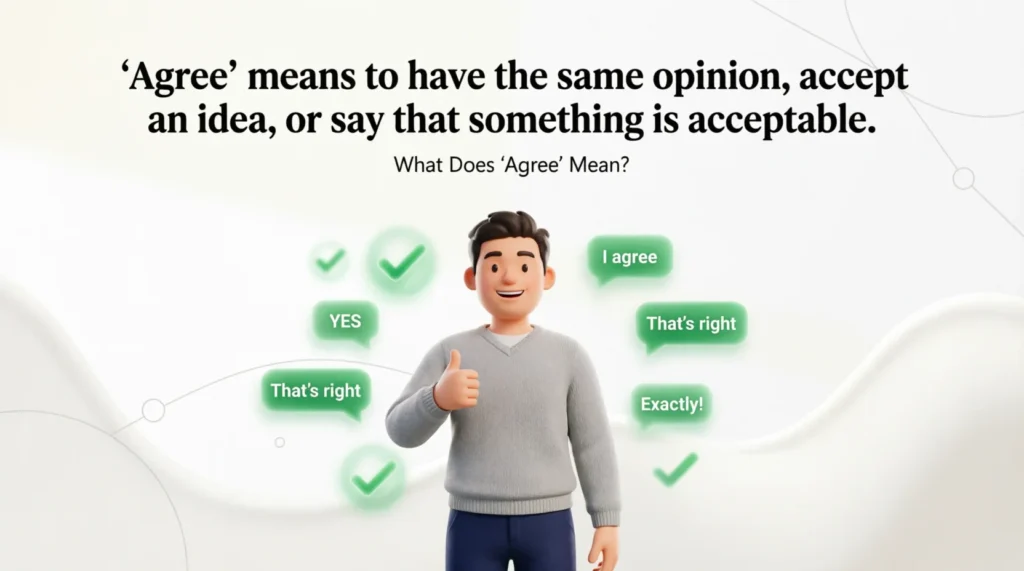
What Does “Agree” Mean?
Agree means to have the same opinion, accept an idea, or say that something is acceptable.
The word is usually used as a verb.
For example:
- I agree with you.
- She agrees with the plan.
- We agreed to meet at 10 a.m.
- They agreed that the idea was useful.
There are several common grammar patterns with agree.
Agree with + person or opinion
Use agree with when you have the same opinion as someone.
Example:
“I agree with your point.”
Agree with + statement
You can also use it when accepting or supporting an idea.
Example:
“I agree with this approach.”
Agree to + plan or proposal
Use agree to when you accept a suggestion, request, condition, or arrangement.
Example:
“They agreed to the new terms.”
Agree on + topic or decision
Use agree on when two or more people reach the same decision.
Example:
“We agreed on a meeting time.”
So, when looking for formal ways to say agree, remember that the best alternative depends on both meaning and context.
When to Use “Agree”
Agree works in almost every type of English communication. It is simple, natural, and easy to understand.
Formal situations
You can use agree in:
- Business emails
- Reports
- Meetings
- Academic writing
- Presentations
- Professional discussions
Example:
“I agree with your recommendation and believe it is the best option.”
Informal situations
The word also works well in everyday conversations.
Example:
“I totally agree with you!”
Written English
Agree is useful in emails, essays, articles, and messages.
Example:
“I agree that customer feedback should be our main priority.”
Spoken English
It is one of the easiest ways to show that you share someone’s opinion.
Example:
“Yes, I agree. That makes sense.”
However, using different alternatives can make your English more expressive. Instead of always saying “I agree,” you can say “Exactly,” “That’s a good point,” “I feel the same way,” or “I support that idea.”
Is It Professional or Polite to Say “Agree”?
Yes. Agree is both professional and polite when used correctly.
It is a neutral word, so it normally does not sound too casual or too formal. That makes it a safe choice for most situations.
For example:
Professional:
“I agree with your assessment.”
Polite:
“I agree with your suggestion.”
Casual:
“Yeah, I agree!”
The tone can change depending on the words around it. “I completely agree” is stronger than “I agree.” Saying “I agree, but…” can introduce a different opinion without directly rejecting someone.
In a workplace, you may sometimes want a more precise phrase. For example, “I support the proposal” shows active approval, while “That’s a good point” shows that you recognize the value of someone’s argument.
When speaking with clients, managers, teachers, or colleagues, choose an alternative that clearly matches your meaning.
Pros and Cons of Using “Agree”
Pros
- Simple: Almost every English learner understands it.
- Clear: It directly shows that you share an opinion.
- Professional: It works well in workplace communication.
- Flexible: You can use it in speech and writing.
- Natural: Native speakers use it very often.
Cons
- Repetitive: Using it too often can make your English sound less varied.
- Limited emotion: It does not always show how strongly you agree.
- Less expressive: It may not show support, enthusiasm, or understanding.
- Context matters: “Agree with,” “agree to,” and “agree on” have different meanings.
Learning alternatives gives you more control over your tone and helps you express agreement more precisely.
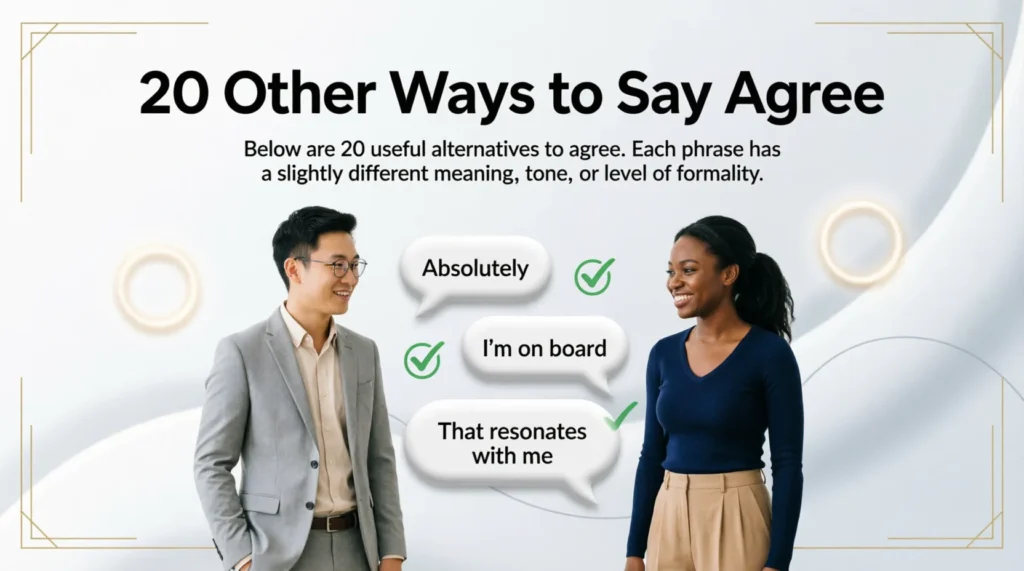
20 Other Ways to Say Agree
Below are 20 useful alternatives to agree. Each phrase has a slightly different meaning, tone, or level of formality.
1. I Completely Agree
Meaning: You strongly share the same opinion.
Explanation:
Use “I completely agree” when you want to show strong agreement. It is stronger than simply saying “I agree.” It works well in conversations, meetings, and professional discussions.
Example Sentence:
“I completely agree that customer service should be our top priority.”
Best Use: Formal, Business, Informal
Worst Use: When you only partly agree
Tone: Emphatic
2. I Totally Agree
Meaning: You strongly agree with someone.
Explanation:
“I totally agree” is common in spoken English and casual communication. It sounds friendly and natural but is usually less formal than “I completely agree.”
Example Sentence:
“I totally agree! That movie was much better than I expected.”
Best Use: Casual, Informal
Worst Use: Very formal reports or highly formal business writing
Tone: Friendly, Emphatic
3. I Absolutely Agree
Meaning: You agree very strongly.
Explanation:
This phrase adds strong emphasis. It can show confidence and enthusiasm. It is useful when someone’s idea matches your opinion exactly.
Example Sentence:
“I absolutely agree that clear communication is essential.”
Best Use: Business, Formal, Spoken
Worst Use: Situations where you have doubts
Tone: Emphatic
4. I Feel the Same Way
Meaning: You have the same opinion or feeling.
Explanation:
“I feel the same way” sounds natural and personal. It is especially useful when someone shares a feeling, preference, or personal opinion rather than a technical fact.
Example Sentence:
“I feel the same way about working from home.”
Best Use: Informal, Casual, Personal conversations
Worst Use: Highly technical or legal statements
Tone: Friendly, Neutral
5. Exactly
Meaning: You think someone has said something correct or accurate.
Explanation:
“Exactly” is a short and natural way to show agreement. It often means, “That is exactly what I think.” It is very common in spoken English and online conversations.
Example Sentence:
“Exactly! That’s why we need a better plan.”
Best Use: Informal, Casual, Spoken
Worst Use: Formal documents where a complete sentence is expected
Tone: Friendly, Emphatic
6. That’s a Good Point
Meaning: You recognize that someone’s idea or argument is valid.
Explanation:
This phrase is useful when you want to agree politely without simply saying “I agree.” It is especially helpful during meetings or discussions.
Example Sentence:
“That’s a good point. We should consider the cost before making a decision.”
Best Use: Business, Formal, Meetings
Worst Use: When you strongly disagree with the person’s main idea
Tone: Polite, Neutral
7. You’re Right
Meaning: You accept that another person is correct.
Explanation:
“You’re right” is direct and natural. It can also show that you have changed your mind after hearing someone’s explanation.
Example Sentence:
“You’re right. We should check the figures again before sending the report.”
Best Use: Informal, Business, Spoken
Worst Use: When you do not actually believe the person is correct
Tone: Neutral, Friendly
8. I Support That
Meaning: You approve of an idea, plan, or decision.
Explanation:
“I support that” is stronger and more active than simply saying “I agree.” It suggests that you are willing to stand behind an idea.
Example Sentence:
“I support that proposal because it could improve customer satisfaction.”
Best Use: Business, Formal, Meetings
Worst Use: Casual conversations where the phrase may sound too serious
Tone: Professional, Emphatic
9. I’m in Agreement
Meaning: You have the same opinion.
Explanation:
“I’m in agreement” is a formal expression. It is more common in professional or official communication than in everyday conversation.
Example Sentence:
“I’m in agreement with the recommendations presented in the report.”
Best Use: Formal, Business, Written English
Worst Use: Casual chats with friends
Tone: Formal, Neutral
10. I Share Your View
Meaning: You have the same opinion as another person.
Explanation:
This is a polished alternative for professional English. It works especially well when discussing ideas, strategies, or business decisions.
Example Sentence:
“I share your view that employee training should be improved.”
Best Use: Business, Formal
Worst Use: Very casual conversations
Tone: Professional, Neutral
11. I’m of the Same Opinion
Meaning: You have the same opinion as someone else.
Explanation:
This phrase clearly communicates agreement. It has a formal tone and is more common in writing or serious discussions than in everyday speech.
Example Sentence:
“I’m of the same opinion regarding the proposed changes.”
Best Use: Formal, Academic, Business
Worst Use: Casual text messages
Tone: Formal
12. I See It the Same Way
Meaning: You understand and view an issue in the same way.
Explanation:
This phrase is useful when discussing opinions or interpretations. It sounds natural without being too formal.
Example Sentence:
“I see it the same way. We need to focus on quality before speed.”
Best Use: Informal, Business, Spoken English
Worst Use: Highly formal documents
Tone: Neutral, Friendly
13. That Makes Sense
Meaning: You think someone’s explanation or idea is logical.
Explanation:
“That makes sense” is not always a direct synonym for “I agree.” It often means that you understand why something is reasonable. It is a useful and polite response in conversations.
Example Sentence:
“That makes sense. Starting earlier should help us avoid traffic.”
Best Use: Informal, Business, Spoken
Worst Use: When you want to express strong support for a controversial opinion
Tone: Friendly, Neutral
14. I’m with You on That
Meaning: You agree with someone about a particular issue.
Explanation:
This phrase is friendly and conversational. It is useful when you want to show that you and another person have the same position.
Example Sentence:
“I’m with you on that. We need more time to test the product.”
Best Use: Informal, Casual, Spoken
Worst Use: Formal reports or legal documents
Tone: Friendly
15. I Couldn’t Agree More
Meaning: You strongly agree.
Explanation:
“I couldn’t agree more” is a powerful idiom. It means that you agree as much as possible. It is natural in both professional and everyday English.
Example Sentence:
“I couldn’t agree more. Good communication makes teamwork much easier.”
Best Use: Business, Informal, Formal, Spoken
Worst Use: When you only partly agree
Tone: Emphatic
16. Absolutely
Meaning: You strongly agree or confirm something.
Explanation:
“Absolutely” is a short but powerful response. It can replace “I agree” in many spoken situations. It is also useful when answering a question.
Example Sentence:
“Would you recommend improving the website?”
“Absolutely.”
Best Use: Informal, Business, Spoken
Worst Use: Detailed academic writing without additional explanation
Tone: Emphatic, Positive
17. I’m on the Same Page
Meaning: You and another person have the same understanding or opinion.
Explanation:
This is a common business idiom. It is especially useful when talking about teamwork, goals, plans, or expectations.
Example Sentence:
“Before we begin the project, I want to make sure we’re all on the same page.”
Best Use: Business, Workplace, Informal
Worst Use: Very formal academic writing
Tone: Friendly, Professional
18. I Endorse That
Meaning: You publicly or officially support an idea, decision, or recommendation.
Explanation:
“Endorse” is stronger and more formal than “agree.” It suggests active approval or support. It is often used in professional, public, or official contexts.
Example Sentence:
“I fully endorse the committee’s recommendation.”
Best Use: Formal, Business, Official
Worst Use: Simple casual conversations
Tone: Formal, Emphatic
19. I Concur
Meaning: You agree with an opinion, decision, or statement.
Explanation:
“I concur” is a formal synonym for “I agree.” It is grammatically correct but can sound very formal in everyday conversation.
Example Sentence:
“I concur with your assessment of the situation.”
Best Use: Formal, Business, Official Writing
Worst Use: Casual text messages
Tone: Formal
20. I’m on Board
Meaning: You agree with or support a plan or idea.
Explanation:
“I’m on board” is an informal but common expression, especially in workplaces. It usually means that you accept a plan and are willing to support it.
Example Sentence:
“I’m on board with the new marketing strategy.”
Best Use: Business, Informal, Workplace
Worst Use: Very formal academic or legal writing
Tone: Friendly, Positive
Quick Comparison of the Best Alternatives
| Alternative | Tone | Best Context |
|---|---|---|
| I completely agree | Emphatic | Professional or general |
| That’s a good point | Neutral | Meetings and discussions |
| I support that | Professional | Business |
| Exactly | Friendly | Casual conversation |
| I concur | Formal | Official or formal writing |
| I’m on the same page | Friendly | Workplace |
| I couldn’t agree more | Emphatic | Strong agreement |
The best choice depends on what you want to communicate. If you want a safe professional phrase, “I completely agree” works well. If you want to sound friendly, try “Exactly” or “I feel the same way.” For business discussions, “I support that” and “I’m on the same page” can sound natural.
How to Choose the Right Alternative
Choosing the right synonym is not only about knowing more vocabulary. It is about matching your words to the situation.
For formal writing
Try:
- I concur
- I’m in agreement
- I’m of the same opinion
- I share your view
These phrases are useful for reports, formal emails, academic discussions, and official communication.
For business communication
Try:
- I support that
- That’s a good point
- I’m on the same page
- I share your view
These phrases can make workplace communication clear without sounding overly complicated.
For casual conversation
Try:
- Exactly
- Absolutely
- I totally agree
- I’m with you on that
- I feel the same way
These options sound relaxed and natural with friends, classmates, and people you know well.
For strong agreement
Try:
- I completely agree
- I absolutely agree
- I couldn’t agree more
- Absolutely
These phrases make your agreement stronger.
Common Mistakes When Using Alternatives to “Agree”
One common mistake is treating every synonym as a perfect replacement. Many expressions show agreement, but they do not all have exactly the same meaning.
For example, “That makes sense” means that something seems logical. It does not always mean that you completely share the person’s opinion.
Similarly, “That’s a good point” recognizes a strong argument, but you can say it even when you have not fully made up your mind.
Another mistake is using very formal expressions in casual situations. Saying “I concur” to a close friend may sound unnatural or overly serious.
The opposite can also happen. Using “I’m totally with you” in a formal report may not fit the style.
The goal is not to avoid the word agree. Instead, learn several expressions and choose the one that best matches your meaning, audience, and tone.
Frequently Asked Questions
What is the best formal way to say “I agree”?
“I concur,” “I share your view,” and “I’m in agreement” are formal alternatives. In many professional situations, “I completely agree” is also natural and clear.
What is a casual way to say “I agree”?
You can say “Exactly,” “Absolutely,” “I totally agree,” or “I’m with you on that.” These expressions are common in everyday conversations.
What is a professional way to say “I agree”?
Try “I support that,” “I share your view,” “That’s a good point,” or “I’m on the same page.” Choose one based on whether you mean agreement, support, or shared understanding.
Is “I couldn’t agree more” polite?
Yes. “I couldn’t agree more” is polite and strongly emphasizes agreement. It works well in both professional and casual conversations.
Is “I concur” too formal?
It can be. “I concur” is correct English, but it sounds formal. In everyday conversation, “I agree” or “I completely agree” usually sounds more natural.
Conclusion
Learning other ways to say agree helps you communicate with more variety and confidence.
The best alternative depends on your audience, situation, and intended tone.
Use “Exactly” or “I totally agree” for casual conversations.
Try “I support that” or “I share your view” in professional settings.
For strong agreement, “I couldn’t agree more” is a useful choice. You do not need to stop using agree.
Instead, build a wider vocabulary so you can choose the phrase that fits each situation.
As you practice these synonyms for agree, your English can become more natural, flexible, and expressive.

Alden Rowen is the author behind Meanings Path, sharing clear and reliable insights into the meanings, origins, and significance of words, names, and phrases. His goal is to make language simple, useful, and easy to understand.