
The phrase “over the years” means during a long period of time, usually from the past until now.
It is common in everyday English, business writing, essays, emails, and conversations.
For example, you can say, “Our company has grown over the years.” The phrase is correct and natural, but using the same expression again and again can make your English sound repetitive.
Learning other ways to say over the years helps you sound more fluent and flexible.
It also lets you choose words that match your tone.
Some alternatives sound formal, while others feel friendly or conversational.
In this guide, you will learn 21 alternatives to “over the years”, with meanings, examples, tones, and best uses.
These phrases can help English learners, students, writers, and professionals communicate with greater confidence.
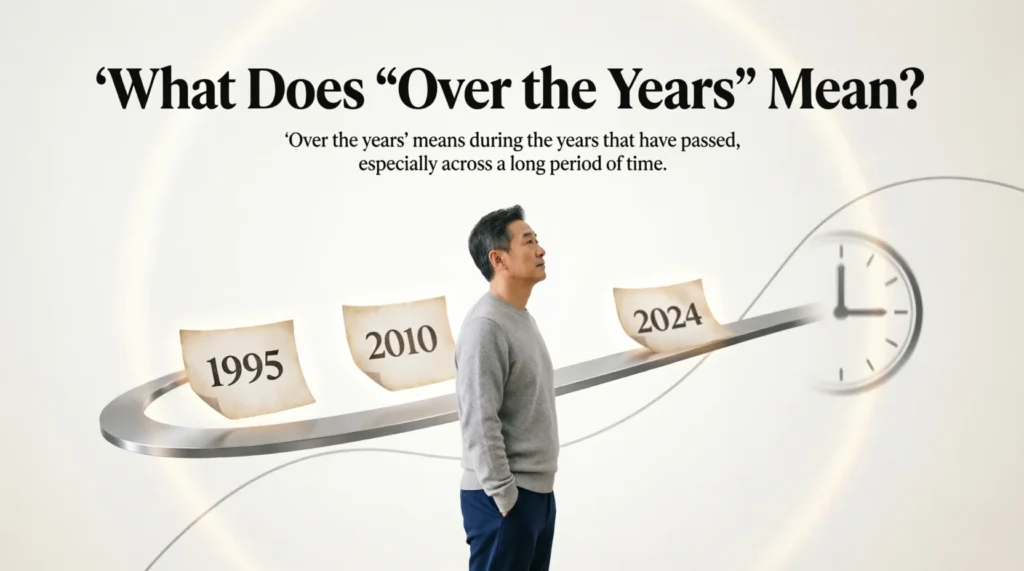
What Does “Over the Years” Mean?
“Over the years” means during the years that have passed, especially across a long period of time.
It often describes a gradual change, development, experience, or trend.
For example:
- She has become more confident over the years.
- The business has changed over the years.
- We have learned many lessons over the years.
Grammatically, “over the years” is a time expression. It tells the reader or listener when something happened or developed.
The phrase normally works well with the present perfect tense when talking about change from the past until now:
Our team has improved over the years.
It can also appear with other tenses when the context is clear:
Over the years, the town became a popular tourist destination.
Because it is broad, the phrase does not usually identify a specific number of years.
When to Use “Over the Years”
You can use “over the years” in many situations.
Formal Writing
It works well in reports, essays, academic writing, and professional documents.
The organization has expanded its services over the years.
Business Communication
It is useful when discussing company growth, customer relationships, employee experience, or changes in a market.
We have built strong relationships with our clients over the years.
Everyday Conversation
The phrase also sounds natural in casual speech.
I’ve learned a lot about cooking over the years.
Personal Stories
Use it when describing how people, places, relationships, or skills have changed.
We’ve stayed close over the years.
Essays and Presentations
It can introduce a long-term trend or development.
Technology has changed the way we communicate over the years.
If you use the phrase many times in the same article, however, alternatives can make your writing smoother and more interesting.
Is It Professional or Polite to Say “Over the Years”?
Yes. “Over the years” is professional, polite, and grammatically correct.
It does not sound rude or too casual. In fact, it is suitable for:
- Business emails
- Reports
- Presentations
- Academic essays
- Professional conversations
- Customer communication
- Personal writing
For example:
We appreciate the trust you have placed in us over the years.
This sounds warm and professional.
However, the best alternative depends on your purpose. “Throughout the years” can sound slightly more formal. “With time” can focus more on gradual change. “Over time” is often better when you are describing a process rather than a long period of personal history.
So, the phrase itself is professional. The key is choosing an alternative that fits the context.
Pros and Cons of Using “Over the Years”
Pros
- Simple: Most English speakers understand it immediately.
- Natural: It is common in both speech and writing.
- Flexible: It works in personal, academic, and professional contexts.
- Neutral: It does not strongly suggest a formal or casual tone.
- Useful for long-term changes: It clearly shows that something happened gradually.
Cons
- Can become repetitive: Using it several times may make writing feel dull.
- Not very specific: It does not tell readers exactly how many years passed.
- Sometimes too general: Another phrase may explain the time period more clearly.
- Limited emotional effect: A more specific phrase may sound warmer or more reflective.
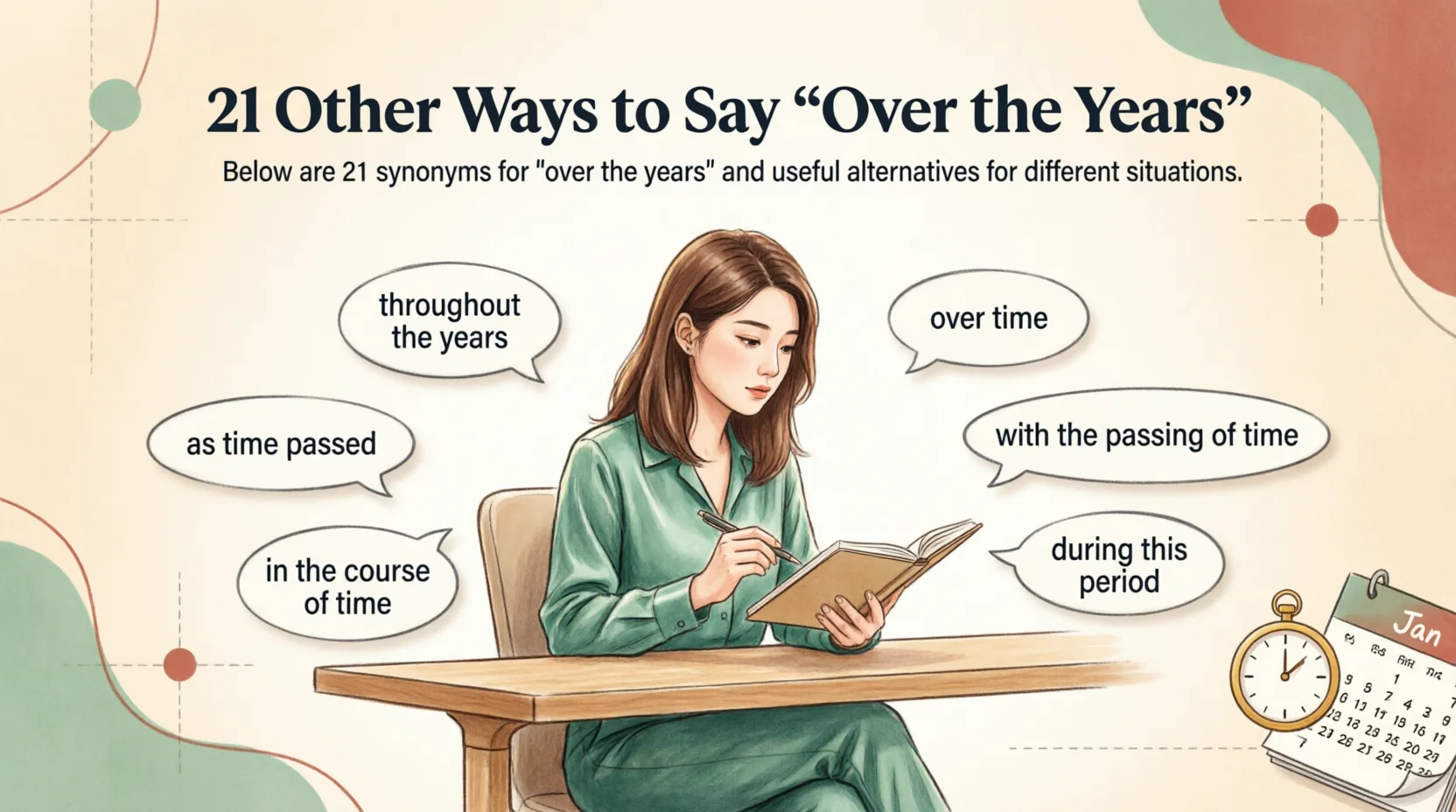
21 Other Ways to Say “Over the Years”
Below are 21 synonyms for “over the years” and useful alternatives for different situations.
1. Throughout the Years
Phrase: Throughout the years
Meaning: During all or most of the years in a particular period.
Explanation: This is very close in meaning to “over the years.” It can place slightly more focus on the entire period.
Example Sentence:
Throughout the years, she has remained committed to helping her community.
Best Use: Formal, Written, Business
Worst Use: Very short casual conversations where a simpler phrase is better.
Tone: Formal
2. Over Time
Phrase: Over time
Meaning: Gradually as time passes.
Explanation: This is one of the most useful alternatives to “over the years.” It focuses more on gradual change than on the number of years.
Example Sentence:
Over time, the team developed a more efficient way to work.
Best Use: Formal, Business, Academic, Casual
Worst Use: When you specifically need to emphasize many years.
Tone: Neutral
3. Throughout the Years That Followed
Phrase: Throughout the years that followed
Meaning: During the period after a particular event.
Explanation: This phrase is useful when your sentence already has a clear starting point.
Example Sentence:
Throughout the years that followed, the company continued to expand.
Best Use: Formal, Academic, Historical Writing
Worst Use: Quick everyday conversation.
Tone: Formal
4. As the Years Went By
Phrase: As the years went by
Meaning: As time passed through several years.
Explanation: This sounds natural and slightly reflective. It is often used when describing personal change, memories, or life experiences.
Example Sentence:
As the years went by, we became closer friends.
Best Use: Informal, Personal, Storytelling
Worst Use: Highly technical reports.
Tone: Friendly
5. As Time Passed
Phrase: As time passed
Meaning: Gradually while time moved forward.
Explanation: This phrase works well when one event or situation changed gradually.
Example Sentence:
As time passed, his confidence continued to grow.
Best Use: Formal, Informal, Storytelling
Worst Use: When you need to emphasize a specific number of years.
Tone: Neutral
6. With the Passage of Time
Phrase: With the passage of time
Meaning: As more time passes.
Explanation: This is a more formal expression. It often appears in essays, reports, literature, and thoughtful discussions.
Example Sentence:
With the passage of time, public attitudes toward the issue changed.
Best Use: Formal, Academic, Written
Worst Use: Casual text messages.
Tone: Formal
7. In the Course of the Years
Phrase: In the course of the years
Meaning: During the period of several years.
Explanation: This is less common than “over the years,” but it can be useful in formal or literary writing.
Example Sentence:
In the course of the years, the project became much more successful.
Best Use: Formal, Literary
Worst Use: Everyday conversation.
Tone: Formal
8. Across the Years
Phrase: Across the years
Meaning: During a long period of years.
Explanation: This expression highlights a connection or pattern that continues through different years.
Example Sentence:
Their friendship has remained strong across the years.
Best Use: Written, Personal, Reflective
Worst Use: Technical business documents when a clearer phrase is available.
Tone: Friendly
9. Through the Years
Phrase: Through the years
Meaning: During the years that have passed.
Explanation: This is a natural alternative, especially when talking about memories, relationships, experiences, or changes.
Example Sentence:
He has supported me through the years.
Best Use: Informal, Personal, Friendly
Worst Use: Very formal academic writing.
Tone: Friendly
10. Year After Year
Phrase: Year after year
Meaning: Repeatedly or continuously every year.
Explanation: Unlike “over the years,” this phrase emphasizes repetition or consistency from one year to another.
Example Sentence:
Year after year, the festival attracts thousands of visitors.
Best Use: Business, News, Informal, Emphatic
Worst Use: When something happened only once during a long period.
Tone: Emphatic
11. From Year to Year
Phrase: From year to year
Meaning: When comparing one year with another.
Explanation: This phrase is especially useful when discussing changes, differences, or trends between years.
Example Sentence:
The company’s sales have increased from year to year.
Best Use: Business, Formal, Academic
Worst Use: Personal conversations where it may sound too analytical.
Tone: Neutral
12. Over the Course of the Years
Phrase: Over the course of the years
Meaning: During a long period of years.
Explanation: This is a longer version of “over the years.” It can add emphasis to the length or progression of a period.
Example Sentence:
Over the course of the years, the organization has introduced several new programs.
Best Use: Formal, Business, Academic
Worst Use: Short casual sentences where it sounds unnecessarily long.
Tone: Formal
13. In Recent Years
Phrase: In recent years
Meaning: During the years shortly before the present.
Explanation: This is not an exact synonym in every situation. Use it when you mean a relatively recent period, not the entire past.
Example Sentence:
In recent years, online learning has become more common.
Best Use: Business, Academic, News, Formal
Worst Use: When talking about a very long period of history.
Tone: Neutral
14. In the Past Few Years
Phrase: In the past few years
Meaning: During the last several years.
Explanation: This phrase gives a clearer sense that the period is relatively short and close to the present.
Example Sentence:
In the past few years, she has gained valuable professional experience.
Best Use: Professional, Academic, Casual
Worst Use: When discussing decades of change.
Tone: Neutral
15. In the Years Since
Phrase: In the years since
Meaning: During the years following a specific event.
Explanation: This phrase needs a clear event or point in time.
Example Sentence:
In the years since graduation, he has started his own business.
Best Use: Formal, Personal, Storytelling
Worst Use: When there is no clear starting event.
Tone: Neutral
16. As the Years Have Passed
Phrase: As the years have passed
Meaning: Gradually as several years have gone by.
Explanation: This phrase is useful when reflecting on personal development or long-term change.
Example Sentence:
As the years have passed, I have learned to value my time more.
Best Use: Personal, Reflective, Written
Worst Use: Short business emails.
Tone: Friendly
17. As Time Has Gone By
Phrase: As time has gone by
Meaning: Gradually as time has passed.
Explanation: This is conversational and often appears in personal stories or emotional writing.
Example Sentence:
As time has gone by, we have learned to understand each other better.
Best Use: Informal, Personal, Storytelling
Worst Use: Formal reports.
Tone: Friendly
18. Over the Course of Time
Phrase: Over the course of time
Meaning: Gradually during a period of time.
Explanation: This is broader than “over the years.” It can describe weeks, months, years, or an unspecified period.
Example Sentence:
Over the course of time, the new system became easier to use.
Best Use: Formal, Business, Academic
Worst Use: When you specifically want to say something happened across many years.
Tone: Formal
19. Throughout This Period
Phrase: Throughout this period
Meaning: During the whole period being discussed.
Explanation: This is useful when the time period has already been mentioned.
Example Sentence:
Throughout this period, the company maintained strong customer satisfaction.
Best Use: Business, Academic, Formal
Worst Use: Casual conversation without a clearly defined period.
Tone: Formal
20. During the Years
Phrase: During the years
Meaning: At different points within a period of years.
Explanation: This expression can work when the surrounding sentence makes the time period clear.
Example Sentence:
During the years, the village changed from a small community into a busy town.
Best Use: Written, Historical
Worst Use: When “over the years” or “over time” would sound more natural.
Tone: Neutral
21. In the Long Run
Phrase: In the long run
Meaning: Over a long period, especially when discussing the final result.
Explanation: This is not a direct synonym for “over the years.” It focuses on the eventual result or effect of something rather than simply the passing of time.
Example Sentence:
In the long run, investing in employee training can benefit the company.
Best Use: Business, Advice, Professional, Casual
Worst Use: When you simply want to describe something that happened across several years.
Tone: Emphatic
Quick Comparison of the Best Alternatives
| Alternative | Tone | Best Use |
|---|---|---|
| Over time | Neutral | General use |
| Throughout the years | Formal | Business and writing |
| As the years went by | Friendly | Personal stories |
| Year after year | Emphatic | Repeated events |
| In recent years | Neutral | Recent trends |
| With the passage of time | Formal | Academic writing |
| In the long run | Emphatic | Results and future effects |
How to Choose the Right Alternative
The best synonym depends on what you want to say.
If you want a simple replacement, choose “over time.”
Over time, the process became easier.
If you want a formal expression, use “throughout the years” or “with the passage of time.”
With the passage of time, the policy became more effective.
If you are telling a personal story, “as the years went by” sounds warmer.
As the years went by, we became good friends.
If something happens repeatedly every year, use “year after year.”
Year after year, the team improves its performance.
If you are discussing a recent trend, “in recent years” is more precise.
In recent years, remote work has become more common.
This distinction matters because not every phrase listed above has exactly the same meaning. Good English is not only about finding a synonym. It is about choosing the phrase that matches your intended meaning.
Common Mistakes to Avoid
One common mistake is assuming that every alternative can replace “over the years” in every sentence.
For example:
Over the years, the company has grown.
You can naturally change this to:
Over time, the company has grown.
But:
Year after year, the company has grown.
has a slightly different meaning. It suggests repeated yearly growth.
Another mistake is using a formal phrase in a very casual situation.
For example, “with the passage of time” is grammatically correct, but it may sound too serious in a simple text message.
Instead, say:
As time goes by, things change.
Also remember that “in recent years” means a relatively recent period. It should not replace “over the years” when you are talking about a long historical period.
Frequently Asked Questions
1. What is another way to say “over the years”?
Some common alternatives are “over time,” “throughout the years,” “through the years,” and “as the years went by.” The best choice depends on the context and tone.
2. What is a formal way to say “over the years”?
“Throughout the years,” “with the passage of time,” and “over the course of the years” can work well in formal writing.
3. What is a casual way to say “over the years”?
For casual English, try “through the years,” “as the years went by,” or “as time went by.”
4. Is “over time” the same as “over the years”?
They are similar, but not always identical. “Over time” focuses on gradual change, while “over the years” usually suggests a longer period measured in years.
5. Can I use “over the years” in professional writing?
Yes. “Over the years” is completely professional and polite. It is common in reports, emails, presentations, and business communication.
Conclusion
Learning other ways to say “over the years” can make your English more natural, flexible, and interesting.
The original phrase is already correct and professional, but alternatives help you express small differences in meaning and tone.
Use “over time” for gradual change, “throughout the years” for a formal style, and “as the years went by” for personal or friendly writing.
For repeated yearly events, “year after year” is a stronger choice.
The goal is not to avoid “over the years.” Instead, learn how to choose the phrase that best matches your message, audience, and situation.
Try using these alternatives in your conversations, emails, essays, and presentations to build stronger English skills.

Alden Rowen is the author behind Meanings Path, sharing clear and reliable insights into the meanings, origins, and significance of words, names, and phrases. His goal is to make language simple, useful, and easy to understand.