
Saying “nicely done” is a simple way to praise someone for doing something well.
You can use it after a person completes a task, gives a good presentation, solves a problem, or achieves a goal.
It is friendly, positive, and easy to understand.
However, using the same phrase again and again can make your English sound repetitive.
Learning other ways to say nicely done can help you sound more natural and confident.
It also lets you match your words to the situation.
For example, “Excellent work” can sound professional, while “You nailed it!” feels more casual and energetic.
This guide explains 24 alternatives to nicely done.
You will learn their meanings, tone, examples, and best uses.
These phrases can help English learners, students, coworkers, managers, and professionals give better praise in both spoken and written English.
What Does “Nicely Done” Mean?
“Nicely done” means that someone has completed something successfully or performed well.
The word “nicely” is an adverb. It describes how something was done. “Done” is the past participle of the verb “do.”
For example:
“You finished the report early. Nicely done!”
The speaker is praising the person because the report was completed well and on time.
“Nicely done” can describe many types of success. It can praise work, effort, skills, decisions, performances, or results.
Some common situations include:
- Completing a difficult task
- Giving a strong presentation
- Solving a problem
- Winning a competition
- Finishing a project
- Helping someone successfully
- Producing high-quality work
The phrase is usually positive and friendly. However, the exact tone depends on the situation and your relationship with the person.
When to Use “Nicely Done”
You can use “nicely done” in both spoken and written English.
Formal Use
In professional situations, “nicely done” is acceptable, but it can sound slightly casual. For important business communication, phrases such as “Excellent work” or “Outstanding job” may sound more polished.
Informal Use
Among friends, classmates, or coworkers, “nicely done” works very well. It is short, warm, and natural.
Written Use
You can use it in:
- Emails
- Team chats
- Social media comments
- Messages
- Feedback
- Workplace communication
Spoken Use
It is especially common in conversation. You can say it immediately after someone does something successfully.
For example:
“You solved that problem in five minutes. Nicely done!”
Is It Professional or Polite to Say “Nicely Done”?
Yes, “nicely done” is polite and positive. It shows appreciation without being too strong.
However, its level of professionalism depends on the context.
In a relaxed workplace, saying “Nicely done!” to a coworker can sound friendly and encouraging. In a formal performance review or official business email, a more specific phrase may be better.
For example:
- Casual workplace: “Nicely done on the presentation!”
- Professional email: “Excellent work on the presentation.”
- Formal feedback: “Your presentation was well organized and highly effective.”
The key is to choose praise that fits the person, situation, and relationship.
Pros and Cons of Using “Nicely Done”
Pros
- Simple: It is easy to understand.
- Positive: It clearly shows approval.
- Friendly: It creates a warm tone.
- Flexible: It works in many everyday situations.
- Short: It is useful for quick messages.
- Natural: Native speakers commonly understand the phrase.
Cons
- Can become repetitive: Using it too often may sound predictable.
- Not very specific: It does not explain what was done well.
- Slightly casual: It may not be ideal for highly formal communication.
- Less expressive: It may not show strong excitement or admiration.
- Can sound generic: More specific praise can have a stronger impact.
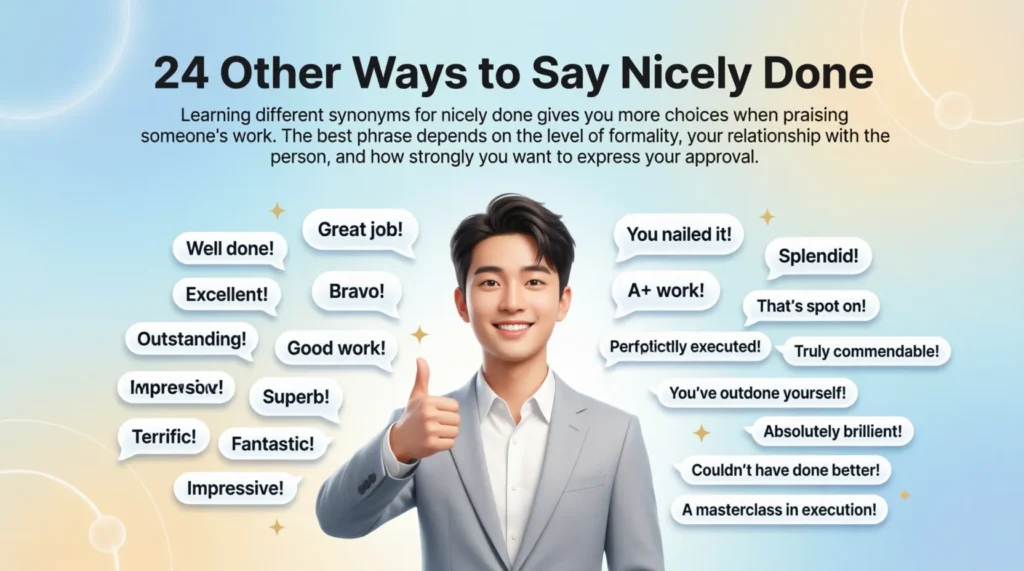
24 Other Ways to Say Nicely Done
Learning different synonyms for nicely done gives you more choices when praising someone’s work. The best phrase depends on the level of formality, your relationship with the person, and how strongly you want to express your approval.
1. Excellent Work
Meaning: The work was done very well and reached a high standard.
Explanation: “Excellent work” is one of the best formal alternatives to nicely done. It is clear, professional, and suitable for workplace feedback.
Example Sentence: “Excellent work on the quarterly report. The information was clear and well organized.”
Best Use: Formal, Business, Professional
Worst Use: Very casual situations where a playful phrase would be more natural
Tone: Formal
2. Great Job
Meaning: Someone completed a task successfully.
Explanation: “Great job” is one of the most common alternatives to nicely done. It works in professional and personal situations.
Example Sentence: “Great job on completing the project before the deadline.”
Best Use: Friendly, Business, Everyday
Worst Use: Highly formal documents
Tone: Friendly
3. Well Done
Meaning: Something was completed successfully or performed well.
Explanation: “Well done” is a classic expression of praise. It is slightly more direct than “nicely done” and works in many settings.
Example Sentence: “Well done on getting such a strong result.”
Best Use: Formal, Informal, Business
Worst Use: Situations where detailed feedback is required
Tone: Neutral
4. Outstanding Work
Meaning: Work that is exceptionally good.
Explanation: Use “outstanding work” when you want to give stronger praise. It is especially useful in professional settings.
Example Sentence: “Your team produced outstanding work during this project.”
Best Use: Formal, Business
Worst Use: Minor tasks where very strong praise may seem excessive
Tone: Emphatic
5. Fantastic Job
Meaning: A job that was done extremely well.
Explanation: “Fantastic job” adds more enthusiasm than “great job.” It is friendly and energetic.
Example Sentence: “You did a fantastic job explaining the new process.”
Best Use: Informal, Friendly, Workplace
Worst Use: Very formal reports
Tone: Friendly
6. Great Work
Meaning: Work that has been completed successfully and effectively.
Explanation: “Great work” is short and flexible. It is useful in emails, team chats, and face-to-face conversations.
Example Sentence: “Great work, everyone. We completed the project on time.”
Best Use: Business, Friendly, Informal
Worst Use: Highly formal written evaluations
Tone: Friendly
7. Impressive Work
Meaning: Work that creates a strong positive impression.
Explanation: Use “impressive work” when someone has shown skill, creativity, or strong results.
Example Sentence: “This is impressive work. Your analysis is very detailed.”
Best Use: Business, Professional, Academic
Worst Use: When you want to give very casual praise
Tone: Neutral
8. Superb Job
Meaning: An exceptionally good job.
Explanation: “Superb job” gives strong praise. It can be used when someone’s performance clearly stands out.
Example Sentence: “You did a superb job managing the event.”
Best Use: Formal, Professional
Worst Use: Serious situations where simple, neutral feedback is preferred
Tone: Emphatic
9. You Did a Great Job
Meaning: You performed a task successfully.
Explanation: This phrase directly addresses the person. It sounds personal and encouraging.
Example Sentence: “You did a great job handling the client meeting.”
Best Use: Friendly, Business, Everyday
Worst Use: Formal documents that require concise wording
Tone: Friendly
10. You Nailed It!
Meaning: You did something extremely well.
Explanation: “You nailed it!” is an informal idiom. It suggests that someone achieved exactly what they wanted.
Example Sentence: “That presentation was excellent. You nailed it!”
Best Use: Casual, Friendly
Worst Use: Formal business emails or official reports
Tone: Emphatic
11. That Was Excellent
Meaning: Something was performed at a very high level.
Explanation: This phrase focuses on the specific performance. It is useful after a presentation, speech, performance, or demonstration.
Example Sentence: “That was excellent. Your explanation was easy to follow.”
Best Use: Professional, Friendly, Spoken
Worst Use: Very casual situations where stronger excitement is expected
Tone: Neutral
12. Fantastic Work
Meaning: Work of very high quality.
Explanation: “Fantastic work” combines strong praise with a friendly tone. It works well when recognizing effort and results.
Example Sentence: “Fantastic work on the new website design.”
Best Use: Business, Friendly, Informal
Worst Use: Very formal legal or official writing
Tone: Emphatic
13. You Did It!
Meaning: You successfully achieved the goal.
Explanation: This phrase celebrates success. It is especially useful when someone has worked hard toward a difficult goal.
Example Sentence: “You passed the exam after all that studying. You did it!”
Best Use: Casual, Friendly
Worst Use: Formal workplace evaluations
Tone: Emphatic
14. That’s the Way to Do It
Meaning: You performed the task correctly.
Explanation: This phrase encourages someone by showing that their method or result was good.
Example Sentence: “You handled the customer complaint calmly. That’s the way to do it.”
Best Use: Friendly, Informal, Coaching
Worst Use: Formal corporate emails
Tone: Friendly
15. Keep Up the Good Work
Meaning: Continue doing good work.
Explanation: This phrase praises current performance while encouraging future success. It is common in workplaces, schools, and team settings.
Example Sentence: “Your writing has improved a lot. Keep up the good work.”
Best Use: Business, Academic, Friendly
Worst Use: When the person has already finished and no future work is expected
Tone: Friendly
16. Impressive Job
Meaning: A job completed in a way that deserves admiration.
Explanation: “Impressive job” highlights the quality or skill behind the result.
Example Sentence: “That was an impressive job. You solved the issue very quickly.”
Best Use: Business, Professional, Friendly
Worst Use: Highly formal reports
Tone: Neutral
17. Wonderful Work
Meaning: Very good work that deserves praise.
Explanation: This phrase sounds warm and positive. It can be useful when giving personal encouragement.
Example Sentence: “Wonderful work on organizing the charity event.”
Best Use: Friendly, Academic, Workplace
Worst Use: Very technical or highly formal documents
Tone: Friendly
18. You’re Doing Great
Meaning: You are performing very well.
Explanation: Unlike “nicely done,” this phrase focuses on ongoing performance. It is useful when someone is still working toward a goal.
Example Sentence: “You’re doing great with the new training program.”
Best Use: Friendly, Casual, Coaching
Worst Use: Formal performance reports
Tone: Friendly
19. That’s Excellent
Meaning: Something is very good or successful.
Explanation: “That’s excellent” is short but professional. It can respond to an idea, result, decision, or piece of work.
Example Sentence: “You found a way to reduce the costs. That’s excellent.”
Best Use: Business, Formal, Spoken
Worst Use: Situations where detailed praise is needed
Tone: Neutral
20. Terrific Job
Meaning: A very good job.
Explanation: “Terrific job” is an upbeat expression. It is slightly more enthusiastic than “good job.”
Example Sentence: “Terrific job on the final presentation.”
Best Use: Friendly, Workplace, Casual
Worst Use: Formal legal or academic writing
Tone: Friendly
21. Remarkable Work
Meaning: Work that is unusually good or impressive.
Explanation: “Remarkable work” is a stronger and more polished expression. It is useful when someone’s achievement is clearly special.
Example Sentence: “The research team has produced remarkable work this year.”
Best Use: Formal, Professional, Academic
Worst Use: Small everyday tasks where it may sound exaggerated
Tone: Emphatic
22. Nicely Executed
Meaning: A task or plan was carried out effectively.
Explanation: “Nicely executed” is useful when talking about how someone performed a particular action or strategy. It sounds more polished than the basic phrase.
Example Sentence: “That was a nicely executed presentation.”
Best Use: Professional, Business, Written
Worst Use: Very casual conversations with friends
Tone: Neutral
23. A Job Well Done
Meaning: A task was completed successfully and to a good standard.
Explanation: “A job well done” is a classic expression. It sounds slightly formal and is useful for recognizing completed work.
Example Sentence: “The team deserves recognition for a job well done.”
Best Use: Formal, Business, Professional
Worst Use: Extremely casual conversations where a shorter phrase would feel more natural
Tone: Formal
24. Congratulations on a Great Job
Meaning: Praise combined with congratulations for successful work.
Explanation: This phrase is useful when someone has achieved an important result. It gives more recognition than simply saying “nicely done.”
Example Sentence: “Congratulations on a great job with the product launch.”
Best Use: Business, Professional, Formal
Worst Use: Tiny tasks that do not require special recognition
Tone: Emphatic
Quick Comparison of Top Alternatives
| Alternative | Tone | Formality | Best Situation |
|---|---|---|---|
| Excellent Work | Professional | High | Workplace |
| Great Job | Friendly | Medium | Everyday praise |
| Well Done | Neutral | Medium | General use |
| Outstanding Work | Strong | High | Major achievements |
| You Nailed It! | Excited | Low | Casual situations |
| Keep Up the Good Work | Encouraging | Medium | Ongoing work |
| A Job Well Done | Professional | High | Completed projects |
How to Choose the Right Alternative
Choosing the right alternative depends on the situation.
If you are writing to a manager, client, or senior colleague, choose a professional phrase such as “Excellent work,” “Outstanding work,” or “Remarkable work.”
If you are speaking with a coworker, “Great job,” “Great work,” or “Fantastic job” may sound more natural.
For friends and family, casual expressions such as “You nailed it!” and “You did it!” can sound warmer.
You should also think about how strong your praise should be. A small successful task may only need “Well done.” A major achievement may deserve “Outstanding work” or “Remarkable work.”
Specific praise is often even better. Instead of only saying “Nicely done,” you can mention what impressed you:
“Excellent work on the report. Your data analysis was clear and easy to understand.”
This makes your praise more meaningful.
FAQs
1. What is another way to say “nicely done”?
Some common alternatives include “Well done,” “Great job,” “Excellent work,” “Great work,” and “Outstanding work.” The best choice depends on the situation and level of formality.
2. What is a formal way to say “nicely done”?
“Excellent work,” “Outstanding work,” “Remarkable work,” and “A job well done” are good formal alternatives. They work well in professional and academic settings.
3. What is a casual way to say “nicely done”?
For casual situations, you can say “Great job,” “You nailed it!” “You did it!” or “Fantastic job!”
4. Can I say “nicely done” at work?
Yes. “Nicely done” is polite and positive. It works well in friendly workplace conversations. For formal emails or official feedback, “Excellent work” may sound more professional.
5. How can I praise someone’s work without sounding repetitive?
Use different expressions based on the situation. Try “Excellent work,” “Impressive job,” “Fantastic work,” “Well done,” or “A job well done.” You can also mention the exact thing the person did well.
Conclusion
Learning other ways to say nicely done can make your English more natural, flexible, and expressive.
While “nicely done” is friendly and useful, using different phrases helps you match your words to each situation.
Choose professional expressions such as “Excellent work” for business settings and friendly phrases such as “Great job” for everyday conversations.
For casual situations, “You nailed it!” can add energy and excitement.
Try these 24 alternatives to nicely done in your conversations, emails, and workplace messages to communicate praise with greater confidence.

Alden Rowen is the author behind Meanings Path, sharing clear and reliable insights into the meanings, origins, and significance of words, names, and phrases. His goal is to make language simple, useful, and easy to understand.