

“Thank you for letting me know” is a polite way to show that you appreciate someone sharing information with you.
It is common in emails, work chats, conversations, and everyday English.
However, using the same phrase again and again can make your English sound repetitive.
Learning other ways to say thank you for letting me know can help you sound more natural, confident, and professional.
The best alternative depends on the situation.
You may want a formal phrase for your manager, a friendly phrase for a coworker, or a simple response for a friend.
Small changes in wording can also change the tone. Some phrases sound warm, while others sound more professional or direct.
In this guide, you will learn 17 alternatives to “thank you for letting me know,” when to use them, and examples that you can use in real conversations.
What Does “Thank You for Letting Me Know” Mean?
“Thank you for letting me know” means “I appreciate you giving me this information.”
It is usually said after someone tells you something that you did not know before.
For example:
Sarah: The meeting has been moved to Friday.
Mike: Thank you for letting me know.
The phrase has two main parts:
- Thank you — expresses appreciation.
- For letting me know — explains what you appreciate.
The grammar uses “for” + gerund (-ing form):
thank you + for + verb-ing
Examples include:
- Thank you for helping me.
- Thank you for calling.
- Thank you for checking.
- Thank you for letting me know.
The phrase is neutral and polite. It works well in both spoken and written English.
When to Use “Thank You for Letting Me Know”
You can use this phrase in many situations.
Formal situations
It works well when replying to a professional email or receiving important information from a manager, client, teacher, or official contact.
Example:
Thank you for letting me know about the schedule change. I will adjust my plans accordingly.
Informal situations
You can also use it with friends, family members, and classmates.
Example:
Thanks for letting me know! I’ll be there at 7.
Workplace communication
The phrase is especially useful in business English. It acknowledges information without sounding too emotional or overly formal.
Example:
Thank you for letting me know about the updated deadline.
Written communication
It is common in:
- Emails
- Work chats
- Messages
- Customer service replies
- School communication
- Business letters
Spoken English
You can say it naturally when someone gives you useful information.
Example:
“The store closes at six.”
“Oh, thank you for letting me know.”
If you want more variety, you can use one of the alternatives below.
Is “Thank You for Letting Me Know” Professional and Polite?
Yes. “Thank you for letting me know” is professional, polite, and safe to use in most workplace situations.
It does not sound too formal or too casual. This makes it a useful phrase for English learners.
You can use it with:
- Your boss
- A coworker
- A customer
- A client
- A teacher
- A business partner
- Someone you do not know well
However, context still matters.
For example, “Thanks for the update” may sound more natural in a quick workplace chat. On the other hand, “I appreciate you keeping me informed” sounds more formal and deliberate.
In a very casual conversation, simply saying “Thanks for the heads-up” may sound friendlier.
The important point is that there is no single perfect alternative. Your relationship with the other person and the type of information both affect your choice.
Pros and Cons of Using “Thank You for Letting Me Know”
Pros
- Polite: It clearly shows appreciation.
- Professional: It works well in business communication.
- Simple: English learners can use it easily.
- Neutral: It does not create a strong emotional tone.
- Flexible: It works in emails, chats, and conversations.
Cons
- Repetitive: Using it too often can make your writing sound predictable.
- Less personal: It may feel slightly routine in some situations.
- Not always the best fit: A more specific phrase may better match the situation.
- Limited emotional range: It does not strongly show excitement, concern, or warmth.
Learning synonyms for “thank you for letting me know” gives you more control over your tone.
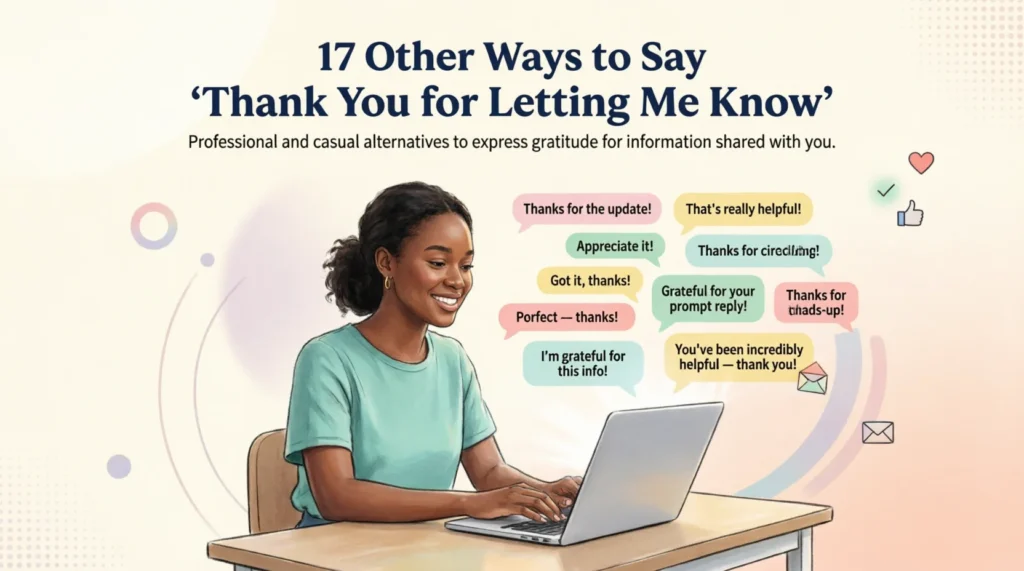
17 Other Ways to Say “Thank You for Letting Me Know”
1. Thanks for the Update
Meaning: You appreciate someone giving you new information.
Explanation: This is one of the most useful alternatives in professional English. It works especially well when someone gives you new information about a project, schedule, task, or situation.
Example Sentence:
Thanks for the update. I’ll review the changes this afternoon.
Best Use: Business, workplace, written communication
Worst Use: Very formal situations where a more respectful phrase is expected
Tone: Friendly / Neutral
2. I Appreciate the Update
Meaning: You are expressing genuine appreciation for the new information.
Explanation: This sounds slightly more polished than “Thanks for the update.” It is a strong choice for emails and professional conversations.
Example Sentence:
I appreciate the update on the project timeline.
Best Use: Business, formal emails, professional communication
Worst Use: Very casual conversations with close friends
Tone: Professional / Neutral
3. Thanks for Keeping Me Informed
Meaning: You appreciate someone continuing to give you important information.
Explanation: This phrase is useful when the person has been providing updates over time. It suggests that staying informed is helpful to you.
Example Sentence:
Thanks for keeping me informed about the changes.
Best Use: Business, workplace, formal communication
Worst Use: A situation where the person only gave you one very small piece of information
Tone: Professional / Friendly
4. I Appreciate You Letting Me Know
Meaning: You appreciate the person’s effort to tell you something.
Explanation: This is very close to the original phrase but sounds slightly more personal. It is useful when you want to recognize the person’s action directly.
Example Sentence:
I appreciate you letting me know about the issue.
Best Use: Business, professional, polite conversations
Worst Use: Extremely casual conversations where a shorter phrase would sound more natural
Tone: Friendly / Professional
5. Thanks for the Heads-Up
Meaning: You thank someone for giving you an early warning or useful notice.
Explanation: “Heads-up” is informal. It is common in everyday American English and workplace chats. It is useful when someone warns you about something before it happens.
Example Sentence:
Thanks for the heads-up about the traffic.
Best Use: Casual, friendly, informal workplace chats
Worst Use: Highly formal letters or official business documents
Tone: Friendly / Casual
6. I Appreciate the Information
Meaning: You are thankful for the information someone provided.
Explanation: This phrase is clear and professional. It focuses on the information rather than the act of telling you.
Example Sentence:
I appreciate the information regarding the new policy.
Best Use: Formal, business, customer service
Worst Use: Very casual conversations with close friends
Tone: Formal / Neutral
7. Thanks for Sharing That
Meaning: You appreciate someone sharing information, an idea, or an experience.
Explanation: This phrase is broader than “thank you for letting me know.” It can be used when someone shares an opinion, personal experience, helpful detail, or piece of news.
Example Sentence:
Thanks for sharing that. It gives me a better idea of what happened.
Best Use: Friendly, casual, conversational
Worst Use: Highly formal business writing when a more precise phrase is needed
Tone: Friendly / Warm
8. Thank You for the Information
Meaning: You are politely thanking someone for providing information.
Explanation: This is a direct and professional alternative. It is particularly useful in emails, customer service, and formal communication.
Example Sentence:
Thank you for the information. We will take it into consideration.
Best Use: Formal, business, professional emails
Worst Use: Very casual conversations where it may sound slightly stiff
Tone: Formal / Neutral
9. Thanks for Informing Me
Meaning: You appreciate someone telling you about something.
Explanation: This phrase has almost the same meaning as the original. It is grammatically correct, but it can sound more formal or businesslike.
Example Sentence:
Thanks for informing me about the revised deadline.
Best Use: Business, formal communication
Worst Use: Casual conversations with close friends
Tone: Formal / Neutral
10. I’m Glad You Told Me
Meaning: You are happy that someone gave you the information.
Explanation: This phrase adds a stronger personal feeling. It often suggests that the information was useful, important, or necessary.
Example Sentence:
I’m glad you told me about the change before I left.
Best Use: Casual, friendly, spoken English
Worst Use: Formal business emails where a neutral tone is better
Tone: Friendly / Warm
11. I’m Grateful for the Information
Meaning: You feel thankful for receiving the information.
Explanation: “Grateful” is stronger than ordinary “thanks.” It can be useful when the information is especially helpful or important.
Example Sentence:
I’m grateful for the information. It helped me make a better decision.
Best Use: Formal, sincere, professional
Worst Use: Tiny everyday updates where the wording may sound too strong
Tone: Formal / Warm
12. Thanks for Bringing This to My Attention
Meaning: You thank someone for pointing out something important.
Explanation: This phrase is common in professional communication. It works particularly well when someone identifies a problem, mistake, concern, or issue that you had not noticed.
Example Sentence:
Thanks for bringing this to my attention. I’ll look into it today.
Best Use: Business, workplace, customer service
Worst Use: Simple social updates where the phrase may sound too formal
Tone: Professional / Neutral
13. I Appreciate the Notice
Meaning: You appreciate being warned or informed about something in advance.
Explanation: This phrase is useful when someone gives you notice about a change, cancellation, deadline, or upcoming event.
Example Sentence:
I appreciate the notice about the schedule change.
Best Use: Business, formal, professional
Worst Use: Casual conversations where “Thanks for the heads-up” sounds more natural
Tone: Formal / Neutral
14. Thanks for Giving Me a Heads-Up
Meaning: You thank someone for warning you or informing you before something happens.
Explanation: This is a friendly variation of “thanks for the heads-up.” It is common in casual speech and informal workplace communication.
Example Sentence:
Thanks for giving me a heads-up about the meeting time.
Best Use: Casual, friendly, informal workplace
Worst Use: Formal reports, official letters, and highly formal emails
Tone: Friendly / Casual
15. Thanks for Keeping Me in the Loop
Meaning: You appreciate being included in ongoing information or updates.
Explanation: “Keep me in the loop” is a common business expression. It means to continue sharing relevant information with you.
Example Sentence:
Thanks for keeping me in the loop as the project develops.
Best Use: Business, workplace, team communication
Worst Use: Formal academic writing or situations where the reader may not know the idiom
Tone: Friendly / Professional
16. I Appreciate You Keeping Me Updated
Meaning: You appreciate someone continuing to provide updates.
Explanation: This is useful when communication happens more than once. It recognizes the person’s ongoing effort to keep you informed.
Example Sentence:
I appreciate you keeping me updated on the delivery.
Best Use: Business, professional emails, customer communication
Worst Use: A single casual message from a close friend
Tone: Professional / Friendly
17. Thank You for Keeping Me Informed
Meaning: You thank someone for making sure you have the information you need.
Explanation: This is a polished and professional alternative. It is especially suitable when someone regularly provides important updates.
Example Sentence:
Thank you for keeping me informed about the progress of the application.
Best Use: Formal, business, professional emails
Worst Use: Very casual conversations where it may sound overly formal
Tone: Formal / Professional
Quick Comparison of the Best Alternatives
| Alternative | Tone | Best Setting | Formality |
|---|---|---|---|
| Thanks for the update | Neutral | Workplace | Medium |
| I appreciate the update | Professional | Business email | High |
| Thanks for the heads-up | Friendly | Casual/work chat | Low |
| Thank you for the information | Neutral | Formal email | High |
| Thanks for keeping me in the loop | Friendly | Workplace | Medium |
| I’m glad you told me | Warm | Personal conversation | Low |
| Thank you for keeping me informed | Professional | Business | High |
The best choice depends on what you want to communicate. If you need a safe professional option, “Thank you for the information” is a strong choice. For a quick work message, “Thanks for the update” sounds natural. For a friend, “Thanks for the heads-up” may be better.
How to Choose the Right Alternative
Think about three things before choosing a phrase: who you are talking to, what information they shared, and how formal you want to sound.
For professional emails
Choose phrases such as:
- Thank you for the information.
- I appreciate the update.
- Thank you for keeping me informed.
- I appreciate you keeping me updated.
These phrases sound respectful and clear.
For coworkers
You have more flexibility.
Thanks for the update.
or
Thanks for keeping me in the loop.
Both can work well in a workplace chat.
For friends
Use warmer and more relaxed expressions.
Thanks for the heads-up!
or
I’m glad you told me.
These sound natural in everyday English.
For important information
If the information helped you avoid a problem, make a decision, or prepare for something, you can make your appreciation stronger.
I really appreciate you letting me know.
This sounds more personal than a routine “thank you.”
Common Mistakes to Avoid
English learners sometimes choose an alternative based only on its dictionary meaning. However, tone matters just as much as meaning.
For example, “Thanks for the heads-up” and “Thank you for the information” can communicate similar ideas. They do not sound the same.
The first is relaxed and conversational. The second is more formal.
Another common mistake is using “I’m grateful” for every small update. “Grateful” can sound stronger than necessary.
Also, remember that “keeping me informed” often suggests ongoing communication. If someone simply tells you one small detail, “Thanks for the update” may be more natural.
The goal is not to replace the original phrase every time. The goal is to have enough options to choose the phrase that fits the situation.
Frequently Asked Questions
1. What is another way to say “thank you for letting me know”?
Common alternatives include “Thanks for the update,” “I appreciate the information,” “Thank you for the information,” and “Thanks for keeping me informed.”
2. What is a professional way to say “thank you for letting me know”?
“Thank you for the information” and “I appreciate the update” are professional choices. “Thank you for keeping me informed” is also suitable for formal business communication.
3. What is a casual way to say “thank you for letting me know”?
You can say “Thanks for the heads-up,” “Thanks for the update,” or “I’m glad you told me.”
4. Can I say “thanks for keeping me in the loop” at work?
Yes. It is common in workplace English and means that you appreciate being included in ongoing updates.
5. Is “thank you for informing me” correct English?
Yes. It is grammatically correct, but “thank you for the information” or “thank you for letting me know” may sound more natural in many situations.
Conclusion
Learning other ways to say thank you for letting me know gives you more flexibility in English.
You do not need to use the same phrase every time someone shares information.
Choose “Thanks for the update” for a simple workplace response, “Thank you for the information” for formal communication, or “Thanks for the heads-up” for a casual conversation.
Small changes can make your English sound more natural and confident. The key is to match your words with the person, situation, and tone.
Try these 17 alternatives to “thank you for letting me know” in real conversations and emails, and you will quickly build a more natural English vocabulary.

Alden Rowen is the author behind Meanings Path, sharing clear and reliable insights into the meanings, origins, and significance of words, names, and phrases. His goal is to make language simple, useful, and easy to understand.