
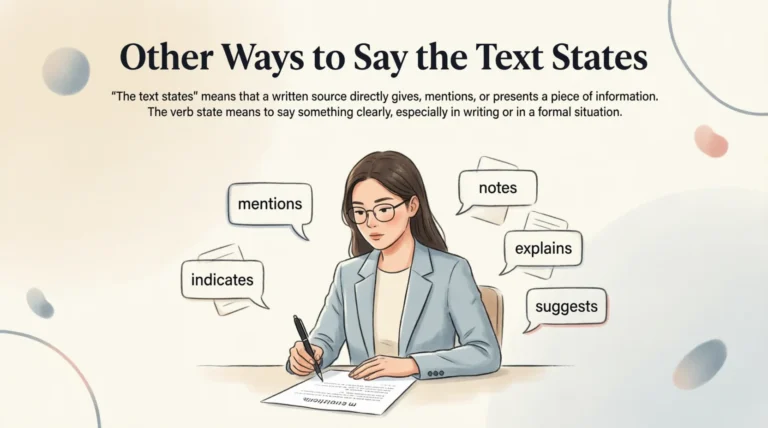
The phrase “the text states” means that written information clearly says or explains something.
You may see it in essays, reports, research papers, emails, contracts, and business documents.
While it is correct English, using the same phrase again and again can make your writing sound repetitive.
Learning other ways to say the text states can help you sound more fluent, precise, and professional.
The right alternative also depends on your purpose.
For example, “the text explains” sounds natural when discussing an idea, while “the document specifies” is stronger for rules or requirements.
In this guide, you will learn 17 useful alternatives to “the text states”, including formal, business, academic, and everyday options.
What Does “The Text States” Mean?
“The text states” means that a written source directly gives, mentions, or presents a piece of information.
The verb state means to say something clearly, especially in writing or in a formal situation.
For example:
The text states that all employees must complete the training.
This means that the written material clearly says employees must complete the training.
Grammar Explanation
“The text states” follows a simple subject + verb structure:
- The text = subject
- states = verb
- that all employees must complete the training = information being stated
You can also use the phrase with a noun:
The text states the main purpose of the project.
Or with a that-clause:
The text states that the project will begin in June.
The phrase is grammatically correct, but choosing different verbs can make your writing more varied and accurate.
When to Use “The Text States”
“The text states” works best when you want to point directly to information found in a written source.
It is especially useful in academic writing. Students can use it when discussing a textbook, article, passage, or research source.
The text states that regular exercise can improve overall well-being.
It is also common in professional writing. A manager may write:
The policy text states that employees must submit requests in advance.
In formal documents, the phrase sounds clear and objective. It focuses on what the source says rather than on the writer’s personal opinion.
In spoken English, however, people often use simpler phrases such as “the text says” or “the article explains.”
For example:
The article says that the new system will save time.
This sounds more natural in everyday conversation.
So, while “the text states” is useful, you should choose an alternative when another verb describes the source more accurately.
Is It Professional or Polite to Say “The Text States”?
Yes. “The text states” is professional, neutral, and polite.
The word “states” has a formal tone. It is common in academic papers, reports, legal documents, business communication, and official writing.
For example:
The report states that the company exceeded its annual target.
This sounds professional and objective.
However, it may sound slightly formal in casual conversation. If you are talking with a friend, “the text says” is usually more natural.
The key is to match the phrase with your audience.
Use “the text states” when you want to sound:
- Clear
- Objective
- Formal
- Professional
- Academic
Use simpler alternatives when you want to sound:
- Friendly
- Conversational
- Natural
- Less formal
In business writing, alternatives such as “the report indicates,” “the document specifies,” and “the policy explains” can sometimes be even more precise.
Pros and Cons of Using “The Text States”
Pros
- It is clear: Readers understand that you are referring to written information.
- It is professional: The phrase fits academic and business writing.
- It is objective: It does not make the statement sound like your personal opinion.
- It is grammatically correct: The structure is simple and reliable.
- It works in many contexts: You can use it with articles, reports, policies, and other texts.
Cons
- It can become repetitive: Using it many times makes writing less interesting.
- It may sound formal: It is not always the best choice for casual conversation.
- It can be vague: Sometimes a more specific verb explains the source better.
- It may not show nuance: A text can explain, suggest, emphasize, confirm, or report something.
- It can weaken your writing: Choosing a stronger verb may make your meaning more precise.
17 Other Ways to Say “The Text States”
Below are 17 useful synonyms for “the text states”. Each option has a slightly different meaning, tone, or best use.
1. Phrase: The Text Says
Meaning: The written material gives or mentions information.
Explanation: This is the simplest alternative to “the text states.” It is easy to understand and sounds natural. It works well in everyday English and less formal writing.
Example Sentence:
The text says that the meeting will start at nine.
Best Use: Informal, Casual, General
Worst Use: Highly formal legal or academic writing when a more precise verb is needed
Tone: Neutral
2. Phrase: The Text Explains
Meaning: The written material makes an idea or topic clear.
Explanation: Use this when the source does more than simply give information. It is useful when the text provides reasons, details, or background.
Example Sentence:
The text explains how the new system works.
Best Use: Academic, Educational, Business
Worst Use: When the source only mentions a fact without explaining it
Tone: Neutral
3. Phrase: The Text Indicates
Meaning: The written material shows or suggests something.
Explanation: “Indicates” is useful when the information points toward a conclusion. It can sound more analytical than “states.”
Example Sentence:
The text indicates that customer demand is increasing.
Best Use: Academic, Business, Analytical
Worst Use: Casual conversations where simpler language would be better
Tone: Formal
4. Phrase: The Text Mentions
Meaning: The written material refers to something briefly.
Explanation: Use “mentions” when the information is included but is not necessarily a major focus of the text.
Example Sentence:
The text mentions several benefits of remote work.
Best Use: Academic, General, Informal
Worst Use: When the source gives a detailed explanation of the subject
Tone: Neutral
5. Phrase: The Text Notes
Meaning: The written material points out or records a particular fact.
Explanation: “Notes” is common in reports and academic writing. It can suggest that the writer wants readers to pay attention to a specific detail.
Example Sentence:
The text notes that the results changed after the second test.
Best Use: Academic, Business, Reports
Worst Use: Very casual conversation
Tone: Formal
6. Phrase: The Text Describes
Meaning: The written material gives details about something.
Explanation: Use this when the source provides characteristics, details, or information about a person, object, process, or event.
Example Sentence:
The text describes the challenges faced by small businesses.
Best Use: Academic, Educational, Professional
Worst Use: When the text simply gives a single fact
Tone: Neutral
7. Phrase: The Text Reports
Meaning: The written source provides information about an event, result, or finding.
Explanation: This phrase works especially well with news articles, research, surveys, and business reports.
Example Sentence:
The text reports a significant increase in online sales.
Best Use: News, Research, Business
Worst Use: Casual messages or personal conversations
Tone: Formal
8. Phrase: The Text Reveals
Meaning: The written material makes previously unknown information known.
Explanation: “Reveals” is stronger than “states.” It works when the information is interesting, important, or previously hidden.
Example Sentence:
The text reveals new details about the company’s expansion plans.
Best Use: Journalism, Articles, Analytical Writing
Worst Use: When the information is already obvious or widely known
Tone: Emphatic
9. Phrase: The Text Highlights
Meaning: The written material gives special attention to something important.
Explanation: Use “highlights” when a source emphasizes a particular fact, issue, or idea.
Example Sentence:
The text highlights the importance of clear communication.
Best Use: Academic, Business, Presentations
Worst Use: When the source only briefly mentions the point
Tone: Emphatic
10. Phrase: The Text Emphasizes
Meaning: The written material strongly focuses attention on an idea.
Explanation: This is a strong alternative when the author clearly wants readers to notice or understand an important point.
Example Sentence:
The text emphasizes the need for better workplace communication.
Best Use: Academic, Professional, Persuasive
Worst Use: When the source does not give the idea special importance
Tone: Emphatic
11. Phrase: The Document Specifies
Meaning: The document gives an exact requirement, detail, or condition.
Explanation: “Specifies” is more precise than “states.” It is excellent for contracts, policies, instructions, rules, and official documents.
Example Sentence:
The document specifies that applications must be submitted by Friday.
Best Use: Business, Legal, Formal
Worst Use: Casual writing
Tone: Formal
12. Phrase: The Report Indicates
Meaning: The report provides information that points to a particular result or conclusion.
Explanation: This is a strong choice for business reports, research papers, and data-based writing.
Example Sentence:
The report indicates that employee satisfaction has improved.
Best Use: Business, Academic, Analytical
Worst Use: Casual conversations
Tone: Formal
13. Phrase: The Author States
Meaning: The writer directly expresses a particular idea or fact.
Explanation: Use this when you want to identify the person responsible for the statement. It is often more precise than saying “the text states.”
Example Sentence:
The author states that education plays an important role in economic growth.
Best Use: Academic, Literary, Analytical
Worst Use: When the writer is unknown or not relevant
Tone: Formal
14. Phrase: The Author Argues
Meaning: The writer presents and supports a particular opinion or position.
Explanation: This is not simply another word for “states.” Use it when the author is making a claim or trying to persuade readers.
Example Sentence:
The author argues that companies should invest more in employee training.
Best Use: Academic, Essays, Critical Analysis
Worst Use: When the author only gives a neutral fact
Tone: Formal
15. Phrase: The Source Points Out
Meaning: The source draws attention to a particular fact or detail.
Explanation: “Points out” sounds more natural and conversational than many formal alternatives. It can still work in professional writing.
Example Sentence:
The source points out several problems with the current process.
Best Use: General, Business, Informal
Worst Use: Very formal legal documents
Tone: Neutral
16. Phrase: The Document Confirms
Meaning: The document verifies or supports information that is already suspected or known.
Explanation: Use “confirms” only when the source provides evidence or information that supports something. It is stronger than simply saying “states.”
Example Sentence:
The document confirms that the payment was received.
Best Use: Business, Legal, Professional
Worst Use: When the document is introducing new information without verification
Tone: Formal
17. Phrase: The Source Suggests
Meaning: The source gives an idea or evidence that points toward a possible conclusion.
Explanation: “Suggests” is useful when the source does not make a direct or certain statement. It is softer than “states” or “confirms.”
Example Sentence:
The source suggests that consumers are becoming more interested in sustainable products.
Best Use: Academic, Research, Analytical
Worst Use: When the source clearly gives a definite fact
Tone: Neutral
Quick Comparison of the Top Alternatives
| Alternative | Tone | Best Use |
|---|---|---|
| The text says | Neutral | Everyday English |
| The text explains | Neutral | Education and general writing |
| The text indicates | Formal | Research and business |
| The document specifies | Formal | Rules and requirements |
| The author argues | Formal | Essays and critical analysis |
| The document confirms | Formal | Business and official records |
| The source suggests | Neutral | Research and analysis |
The best choice depends on what the source actually does. Do not replace “states” with a stronger verb unless the meaning is accurate.
For example, “confirms” means verification. “Suggests” means the information is less certain. “Emphasizes” means the writer gives special importance to an idea.
How to Choose the Right Alternative
The easiest way to choose an alternative is to ask what the source is doing.
If it simply gives information, use “says,” “states,” or “mentions.”
If it makes an idea clear, use “explains.”
If it gives evidence for a possible conclusion, use “indicates” or “suggests.”
If it gives an exact rule or requirement, use “specifies.”
If it gives special attention to an idea, use “highlights” or “emphasizes.”
If it verifies existing information, use “confirms.”
If the writer presents a position and supports it, use “argues.”
This approach is better than simply searching for synonyms for “the text states.” Good writing is not only about changing words. It is about choosing the word that gives the exact meaning you need.
Formal Ways to Say “The Text States”
For professional or academic writing, these options are especially useful:
- The text indicates
- The text explains
- The text notes
- The document specifies
- The report indicates
- The author states
- The author argues
- The source confirms
- The document outlines
- The source suggests
For example, instead of writing:
The text states that employees need better training.
You could write:
The report indicates that employees need better training.
The second sentence sounds more analytical because “indicates” suggests that the report provides evidence for the conclusion.
Informal Alternatives to “The Text States”
In everyday English, simple language is often better.
You can say:
- The text says
- The article says
- The source mentions
- The writer says
- The article points out
- The document says
For example:
The article says that the new app is easier to use.
This sounds natural in a conversation.
You do not always need a formal word such as “indicates.” Clear English is often more effective than complicated English.
Common Mistakes When Replacing “The Text States”
One common mistake is using every alternative as if it had exactly the same meaning.
They do not.
For example:
States = directly gives information.
Suggests = gives an idea without complete certainty.
Confirms = verifies information.
Argues = presents a position or claim.
Highlights = gives special attention.
Mentions = refers to something, often briefly.
Another mistake is using formal words in every sentence. A sentence does not become better just because it contains a sophisticated verb.
Compare:
The article states that the product is affordable.
The article says that the product is affordable.
Both are correct. The second may be better for a general audience because it is simpler.
The goal is not to sound complicated. The goal is to sound clear, accurate, and natural.
FAQs
What is another way to say “the text states”?
Common alternatives include “the text says,” “the text explains,” “the text indicates,” “the text mentions,” and “the text notes.” The best choice depends on the meaning and tone you need.
What is a formal way to say “the text states”?
For formal writing, you can use “the text indicates,” “the document specifies,” “the report indicates,” “the author states,” or “the source confirms.”
Is “the text states” grammatically correct?
Yes. “The text states” is grammatically correct. The verb “states” means that the written source clearly gives information.
What is the difference between “states” and “suggests”?
“States” usually presents information directly. “Suggests” means that the information points toward an idea or conclusion without stating it as directly.
Can I use “the text says” in academic writing?
Yes, but “the text states,” “the author argues,” “the text indicates,” or another precise verb may sound more appropriate in formal academic work. Choose based on the meaning, not just formality.
Conclusion
Knowing other ways to say “the text states” can make your English more flexible and natural.
You do not need to use difficult words.
The best alternative is the one that matches your exact meaning.
Use “says” for simple communication, “explains” for details, “indicates” for evidence, “specifies” for exact requirements, and “confirms” for verified information.
In academic and professional writing, these small word choices can make your ideas clearer and more precise.
Try using different alternatives in your essays, reports, emails, and conversations.
With practice, you will sound more confident and fluent without making your English unnecessarily complicated.

Alden Rowen is the author behind Meanings Path, sharing clear and reliable insights into the meanings, origins, and significance of words, names, and phrases. His goal is to make language simple, useful, and easy to understand.