
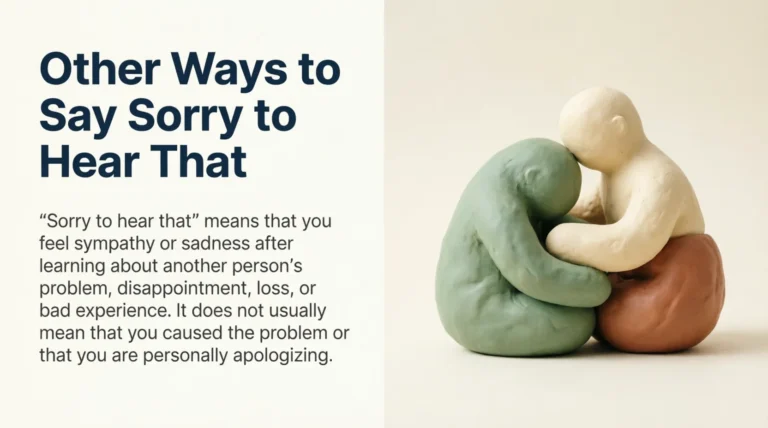
The phrase “sorry to hear that” is a kind and common way to show sympathy when someone shares bad news, a problem, or a difficult experience.
It works well in everyday English, but using the same phrase every time can sound repetitive.
Learning other ways to say sorry to hear that helps you sound more natural, caring, and confident.
The best alternative depends on the situation.
You may need a formal phrase for a coworker, a warm phrase for a friend, or a gentle phrase for someone going through a serious problem.
Small changes in wording can make your message sound more professional, friendly, serious, or personal.
In this guide, you will learn 22 alternatives to “sorry to hear that,” with meanings, examples, tones, and practical advice for choosing the right expression.

What Does “Sorry to Hear That” Mean?
“Sorry to hear that” means that you feel sympathy or sadness after learning about another person’s problem, disappointment, loss, or bad experience.
It does not usually mean that you caused the problem or that you are personally apologizing.
For example:
“I heard that you lost your job. I’m sorry to hear that.”
Here, the speaker is showing sympathy.
Grammatically, “sorry” is an adjective, while “to hear that” is an infinitive phrase explaining what caused the feeling.
The complete form is:
I’m sorry to hear that.
In casual conversation, people often shorten it to:
Sorry to hear that.
You can use the phrase after many types of bad news, including illness, job problems, relationship issues, disappointments, accidents, or personal difficulties.
When to Use “Sorry to Hear That”
“Sorry to hear that” is useful in both spoken and written English.
Formal situations
You can use it with coworkers, clients, managers, customers, or professional contacts.
“I’m sorry to hear that your project was delayed.”
It is polite without sounding overly emotional.
Informal situations
With friends and family, the phrase can sound warm and natural.
“Sorry to hear that you’re having a rough day.”
Written communication
It works well in emails, text messages, social media messages, and workplace chats.
“I’m sorry to hear about the situation. I hope things improve soon.”
Spoken English
It is especially common in everyday conversations because it is short and easy to say.
Still, context matters. A serious situation may require stronger or more personal words than a simple “Sorry to hear that.”
Is “Sorry to Hear That” Professional and Polite?
Yes. “Sorry to hear that” is generally polite and professional.
It is especially suitable when you want to acknowledge someone’s difficult news without making the conversation too emotional.
For example:
“I’m sorry to hear that the meeting was canceled.”
However, the phrase can sometimes feel a little brief. If someone has experienced a serious loss, a more thoughtful response may be better.
For example:
“I’m very sorry for your loss. Please accept my deepest condolences.”
In business communication, keep your response respectful and relevant. Avoid jokes, overly casual slang, or dramatic language when the situation is serious.
For sensitive situations, adding a supportive sentence can make your message more meaningful:
“I’m sorry to hear that. Please let me know if there’s anything I can do to help.”
Pros and Cons of Using “Sorry to Hear That”
Pros
- Simple: It is easy for English learners to use.
- Polite: It shows sympathy without being too personal.
- Versatile: It works in formal and informal situations.
- Natural: Native English speakers commonly use it.
- Safe: It usually does not assume too much about the situation.
Cons
- Repetitive: Using it every time can make your responses sound predictable.
- Brief: It may feel too short for serious news.
- Less personal: It does not always show deep emotional support.
- Context-sensitive: A serious situation may need a stronger response.
- Limited emotion: It may not express encouragement, concern, or empathy clearly.

22 Other Ways to Say “Sorry to Hear That”
1. I’m Sorry to Hear That
Meaning: A complete and slightly more polished version of the common phrase.
Explanation: Adding “I’m” makes the sentence feel complete. It is useful when you want to sound polite and sincere.
Example Sentence: “I’m sorry to hear that your presentation did not go as planned.”
Best Use: Formal, Business, Friendly
Worst Use: Extremely casual situations where a quick response is more natural.
Tone: Neutral
2. I’m Sorry to Hear About That
Meaning: You feel sympathy about a particular situation.
Explanation: This phrase is useful when referring to an event or problem that has already been discussed.
Example Sentence: “I’m sorry to hear about that. It sounds like a difficult situation.”
Best Use: Formal, Informal, Business
Worst Use: When you need to respond to very serious personal loss with deeper sympathy.
Tone: Friendly
3. That’s Really Tough
Meaning: The situation sounds difficult or painful.
Explanation: This is more conversational than “sorry to hear that.” It shows that you recognize how hard the situation may be.
Example Sentence: “You’ve been working for months and the project was canceled? That’s really tough.”
Best Use: Informal, Casual
Worst Use: Very formal business correspondence.
Tone: Friendly
4. I’m Sorry You’re Going Through This
Meaning: You feel sympathy for someone experiencing a difficult period.
Explanation: This phrase focuses on the person’s ongoing experience rather than one specific piece of news.
Example Sentence: “I’m sorry you’re going through this. I hope things get easier soon.”
Best Use: Friendly, Supportive, Personal
Worst Use: Minor problems where the phrase may sound too serious.
Tone: Emphatic
5. That Must Be Difficult
Meaning: You recognize that someone’s situation is probably hard for them.
Explanation: This phrase is useful when you want to show empathy without pretending you know exactly how the person feels.
Example Sentence: “That must be difficult, especially after all the work you put into it.”
Best Use: Formal, Business, Supportive
Worst Use: Very light problems where it may sound overly serious.
Tone: Neutral
6. I’m Sorry You’re Dealing With This
Meaning: You feel sympathy for someone’s current problem.
Explanation: It sounds caring and supportive. It works well when the problem has not been resolved.
Example Sentence: “I’m sorry you’re dealing with this at work.”
Best Use: Friendly, Professional, Supportive
Worst Use: Very casual situations where the issue is extremely minor.
Tone: Friendly
7. That Sounds Really Difficult
Meaning: The situation appears hard based on what someone has told you.
Explanation: “Sounds” shows that you are responding to the information you received. It does not claim that you fully understand the person’s feelings.
Example Sentence: “That sounds really difficult. I hope you have someone you can talk to.”
Best Use: Friendly, Informal, Supportive
Worst Use: Very formal condolences.
Tone: Friendly
8. I’m Sorry You Had to Go Through That
Meaning: You feel sympathy about something difficult that happened in the past.
Explanation: This is useful when the difficult event has already happened.
Example Sentence: “I’m sorry you had to go through that during your first week at the company.”
Best Use: Personal, Friendly, Supportive
Worst Use: Routine workplace problems that do not require emotional language.
Tone: Emphatic
9. That’s Unfortunate
Meaning: Something bad or disappointing has happened.
Explanation: This is a more neutral expression. It is useful when you want to acknowledge bad news without sounding highly emotional.
Example Sentence: “That’s unfortunate. I hope the issue can be resolved soon.”
Best Use: Formal, Business
Worst Use: Very serious personal loss, where it may sound too distant.
Tone: Formal
10. I’m Sorry to Hear About Your Situation
Meaning: You are expressing sympathy about someone’s current circumstances.
Explanation: This phrase is broad and professional. It can work when you do not know every detail.
Example Sentence: “I’m sorry to hear about your situation. Please let me know if we can assist.”
Best Use: Formal, Business
Worst Use: Close friends, where warmer language may sound more natural.
Tone: Formal
11. That’s Really Hard
Meaning: You recognize that someone’s experience is painful or difficult.
Explanation: It is short, natural, and emotional without being overly dramatic.
Example Sentence: “You have to move so far away? That’s really hard.”
Best Use: Informal, Casual, Personal
Worst Use: Formal business letters.
Tone: Friendly
12. I Hate to Hear That
Meaning: You feel upset or concerned after hearing bad news.
Explanation: This is a warm conversational phrase. It often sounds more emotionally involved than “sorry to hear that.”
Example Sentence: “I hate to hear that you’re having such a stressful week.”
Best Use: Informal, Friendly
Worst Use: Formal corporate communication.
Tone: Emphatic
13. That’s Such a Shame
Meaning: You think something unfortunate or disappointing has happened.
Explanation: This phrase is common in conversational English. It is often used for missed opportunities, cancellations, or disappointments.
Example Sentence: “The concert was canceled? That’s such a shame.”
Best Use: Informal, Casual
Worst Use: Serious grief or major personal tragedy.
Tone: Friendly
14. I’m Sorry Things Didn’t Work Out
Meaning: You feel sympathy because a plan, opportunity, or relationship failed.
Explanation: It is especially useful when someone tried to achieve something but the result was disappointing.
Example Sentence: “I’m sorry things didn’t work out with the new job.”
Best Use: Friendly, Professional
Worst Use: Situations involving serious loss where the phrase may sound too general.
Tone: Neutral
15. I Can Understand Why You’re Upset
Meaning: You recognize why someone feels unhappy or disappointed.
Explanation: This phrase focuses on understanding the person’s emotional reaction rather than simply acknowledging the news.
Example Sentence: “I can understand why you’re upset after hearing that decision.”
Best Use: Supportive, Friendly, Professional
Worst Use: When you do not know enough about the person’s feelings.
Tone: Friendly
16. My Heart Goes Out to You
Meaning: You are expressing deep sympathy and emotional support.
Explanation: This is a stronger expression than “sorry to hear that.” It is often used for serious or painful situations.
Example Sentence: “My heart goes out to you and your family during this difficult time.”
Best Use: Personal, Supportive, Serious
Worst Use: Small everyday problems.
Tone: Emphatic
17. Please Accept My Sympathy
Meaning: You are formally expressing sympathy.
Explanation: This is more formal than most alternatives. It is usually connected with serious personal situations.
Example Sentence: “Please accept my sympathy during this difficult time.”
Best Use: Formal, Written, Professional
Worst Use: Minor disappointments or everyday problems.
Tone: Formal
18. You Have My Sympathy
Meaning: You are offering sympathy to someone facing a difficult situation.
Explanation: This phrase is direct and respectful. It can sound formal, especially in written communication.
Example Sentence: “You have my deepest sympathy during this difficult period.”
Best Use: Formal, Serious
Worst Use: Casual conversations about small problems.
Tone: Formal
19. I’m Thinking of You
Meaning: You are letting someone know that they are in your thoughts during a difficult time.
Explanation: This phrase is warm and personal. It can provide comfort without focusing directly on the bad news.
Example Sentence: “I’m thinking of you and hoping things get better soon.”
Best Use: Friendly, Personal, Supportive
Worst Use: Routine business problems.
Tone: Friendly
20. I Hope Things Get Better Soon
Meaning: You are expressing a positive wish for someone’s situation to improve.
Explanation: This phrase adds encouragement. It works especially well after an expression of sympathy.
Example Sentence: “I’m sorry you’re dealing with this. I hope things get better soon.”
Best Use: Friendly, Casual, Supportive
Worst Use: Situations where a quick resolution is impossible or where stronger sympathy is needed.
Tone: Friendly
21. I’m Here for You
Meaning: You are offering emotional or practical support.
Explanation: This goes beyond sympathy. It tells the person that you are willing to listen or help.
Example Sentence: “I’m sorry you’re going through this. I’m here for you if you need anything.”
Best Use: Personal, Friendly, Supportive
Worst Use: Professional situations where you do not have a close relationship.
Tone: Emphatic
22. I’m Sorry This Happened
Meaning: You feel sympathy about an unfortunate event.
Explanation: This is a simple alternative that directly acknowledges what happened. It is useful when the event itself is the focus.
Example Sentence: “I’m sorry this happened. I hope everyone is okay.”
Best Use: Formal, Informal, Business, Casual
Worst Use: Situations where you are personally responsible and need to give a genuine apology.
Tone: Neutral
Quick Comparison of the Best Alternatives
| Alternative | Tone | Best Setting |
|---|---|---|
| That Must Be Difficult | Neutral | Professional & supportive |
| That’s Unfortunate | Formal | Business |
| I’m Sorry You’re Going Through This | Emphatic | Personal |
| That’s Really Tough | Friendly | Casual |
| I’m Here for You | Emphatic | Close relationships |
| Please Accept My Sympathy | Formal | Serious situations |
| I’m Sorry This Happened | Neutral | General use |
The key is to match the phrase with the situation. A casual problem may need only “That’s really tough,” while serious news may call for “My heart goes out to you.”
How to Choose the Right Alternative
Think about three things before choosing your words: the seriousness of the situation, your relationship with the person, and the communication setting.
For a coworker, you could say:
“I’m sorry to hear about the situation. I hope everything gets resolved soon.”
For a close friend:
“I’m sorry you’re going through this. I’m here for you.”
For serious personal news:
“Please accept my sympathy during this difficult time.”
For a small disappointment:
“That’s such a shame.”
This simple approach helps English learners avoid sounding too formal, too casual, or emotionally distant.
Frequently Asked Questions
What is another way to say “sorry to hear that”?
Some common alternatives are “I’m sorry to hear about that,” “That must be difficult,” “That’s really tough,” and “I’m sorry you’re going through this.”
What is a formal way to say “sorry to hear that”?
For professional or formal situations, try “That’s unfortunate,” “Please accept my sympathy,” or “I’m sorry to hear about your situation.”
What can I say instead of “sorry to hear that” to a friend?
Try a warmer phrase such as “That’s really tough,” “I hate to hear that,” “I’m here for you,” or “I’m sorry you’re dealing with this.”
Is “sorry to hear that” an apology?
Usually, no. In this expression, “sorry” means that you feel sympathy, not that you caused the problem.
What should I say when someone shares serious bad news?
Use a sincere and supportive phrase such as “I’m so sorry,” “My heart goes out to you,” or “Please accept my sympathy.” You can also offer practical support when appropriate.
Conclusion
Knowing other ways to say sorry to hear that can make your English more natural, flexible, and thoughtful.
The best phrase depends on the situation and your relationship with the other person.
Use simple options such as “That’s really tough” with friends, professional expressions such as “That’s unfortunate” at work, and stronger phrases such as “My heart goes out to you” for serious situations.
Do not worry about memorizing every alternative.
Start with a few that match your everyday needs.
With practice, you will be able to choose words that sound more fluent, caring, and appropriate in both spoken and written English.

Alden Rowen is the author behind Meanings Path, sharing clear and reliable insights into the meanings, origins, and significance of words, names, and phrases. His goal is to make language simple, useful, and easy to understand.