

The phrase “as you can see” is common in everyday English.
We use it when we want to point out something that is visible, clear, or easy to understand.
For example, you may say, “As you can see, the results have improved.” The phrase is correct, but using it too often can make your speech or writing sound repetitive.
Learning other ways to say “as you can see” can help you sound more fluent, natural, and confident.
Different situations also need different tones.
A business email may need a formal expression, while a friendly conversation can use a simpler phrase.
Presentations may need clear signposting, while academic writing may need more objective language.
In this guide, you will learn 22 alternatives to “as you can see”, including formal, professional, casual, and neutral choices.
| Term | Most Common Meaning | Full Form | Tone | Usage |
|---|---|---|---|---|
| As you can see | Something is visible or clear | N/A | Neutral | Speaking and writing |
What Does “As You Can See” Mean?
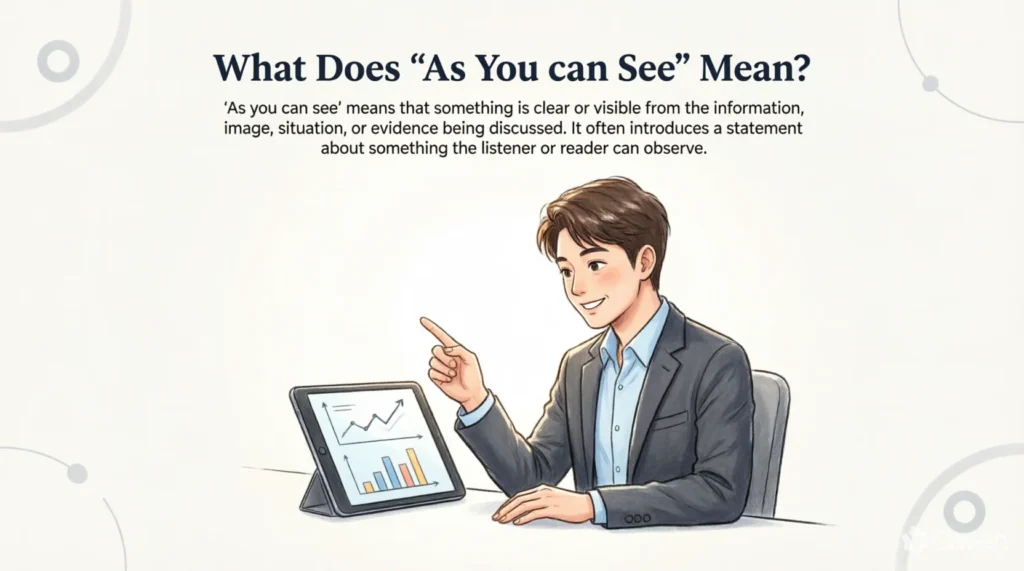
“As you can see” means that something is clear or visible from the information, image, situation, or evidence being discussed.
It often introduces a statement about something the listener or reader can observe.
Example:
As you can see, the sales numbers increased this year.
The phrase usually works as an introductory clause. It is often followed by a comma before the main statement.
It can refer to:
- Something physically visible
- Information in a chart or table
- Evidence in a report
- A situation that is easy to understand
- A result that has already been explained
Although it is grammatically correct, repeating it too often can make your writing feel predictable.
When to Use “As You Can See”
You can use “as you can see” in many situations.
In Presentations
It is useful when pointing to a chart, image, graph, or slide.
Example:
As you can see, website traffic increased in June.
In Business Communication
It can introduce information that the reader can verify from a document or report.
Example:
As you can see, the project is progressing according to schedule.
In Academic Writing
It can sometimes be used when discussing tables, figures, or visual evidence. However, more objective wording may be better in formal academic work.
Example:
As shown in Figure 2, the results changed significantly.
In Casual Conversation
It can point to something obvious or visible.
Example:
As you can see, I finally finished the project!
In Emails
It may be appropriate when referring to an attachment, document, or previous information.
Example:
As you can see from the attached report, the figures have improved.
Is It Professional or Polite to Say “As You Can See”?
Yes. “As you can see” is grammatically correct and generally polite. It is also acceptable in professional communication.
However, context matters.
In a presentation, it can sound natural:
As you can see, the new design is much simpler.
In a business email, it can also work:
As you can see from the attached document, all requested changes have been completed.
But there are situations where it can sound slightly obvious or even a little patronizing. If the information is not actually visible or clear to the reader, “as you can see” may sound like you are assuming too much.
For a more professional style, try alternatives such as “as shown below,” “as demonstrated,” “as illustrated,” or “the data indicates.”
The best alternative depends on what you are referring to and how formal your communication needs to be.
Pros and Cons of Using “As You Can See”
Pros
- Easy to understand: Most English speakers understand it immediately.
- Versatile: It works in speech, presentations, emails, and general writing.
- Natural: It sounds normal in everyday English.
- Useful for visuals: It works well with charts, images, tables, and demonstrations.
- Short: It communicates the idea without unnecessary words.
Cons
- Can become repetitive: Frequent use may make your writing sound less varied.
- Sometimes sounds obvious: The reader may already know that something is visible.
- Can sound slightly patronizing: In some contexts, it may imply that the information should be obvious.
- Not always ideal for academic writing: More objective alternatives may be preferred.
- Limited nuance: It does not always explain why the information matters.
22 Other Ways to Say “As You Can See”
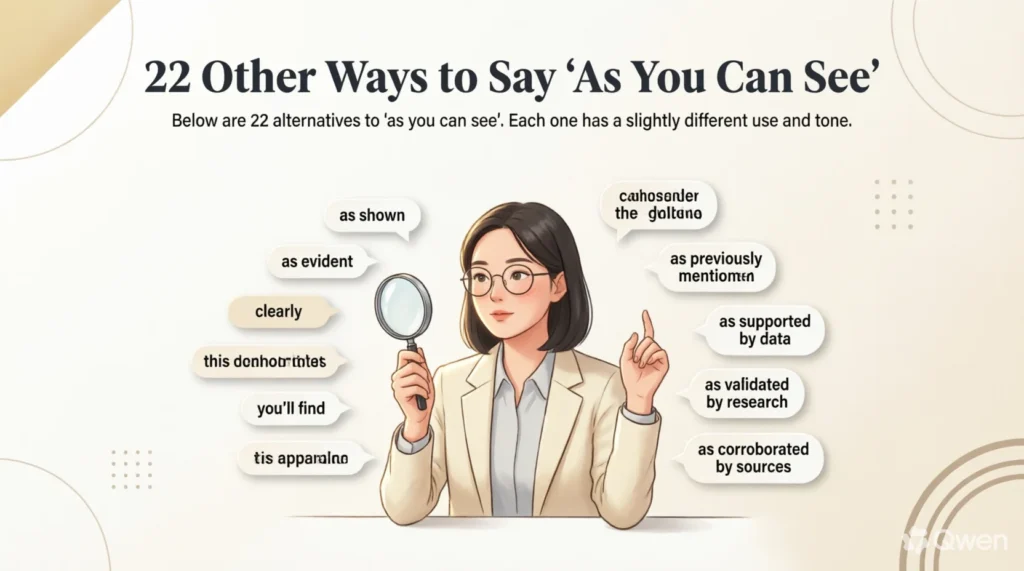
Below are 22 alternatives to “as you can see”. Each one has a slightly different use and tone.
1. As Shown Below
Meaning: The information is displayed below the current text.
Explanation: “As shown below” is useful in reports, documents, guides, and professional writing. It directly tells readers to look at information that follows.
Example Sentence:
As shown below, customer satisfaction increased during the final quarter.
Best Use: Formal / Business
Worst Use: Casual conversation
Tone: Formal
2. As Shown Above
Meaning: The information has already been displayed earlier.
Explanation: Use “as shown above” when referring to a previous chart, table, image, or statement.
Example Sentence:
As shown above, the two products have very similar features.
Best Use: Formal / Business / Academic
Worst Use: Informal conversation
Tone: Formal
3. As Demonstrated
Meaning: Something has been clearly shown through evidence or action.
Explanation: “As demonstrated” sounds professional and is useful when discussing results, skills, processes, or evidence.
Example Sentence:
As demonstrated by the results, the new method is more efficient.
Best Use: Formal / Academic / Business
Worst Use: Very casual chats
Tone: Formal
4. As Illustrated
Meaning: Something is made clear through an example, image, chart, or illustration.
Explanation: This is a strong choice for reports, articles, presentations, and educational writing.
Example Sentence:
As illustrated in the chart, online sales have grown steadily.
Best Use: Formal / Academic / Business
Worst Use: Casual texting
Tone: Formal
5. As Evidenced By
Meaning: Something is supported or made clear by evidence.
Explanation: “As evidenced by” focuses more on proof than simple visibility. It is useful when presenting facts or results.
Example Sentence:
As evidenced by the latest figures, the company is moving in the right direction.
Best Use: Formal / Business / Academic
Worst Use: Friendly conversation
Tone: Formal
6. As Indicated
Meaning: Something is shown or suggested by available information.
Explanation: “As indicated” is useful in professional reports and formal documents. It sounds objective and concise.
Example Sentence:
As indicated in the report, the project remains within budget.
Best Use: Formal / Business
Worst Use: Casual conversation
Tone: Formal
7. As the Data Shows
Meaning: The data clearly provides certain information.
Explanation: This is one of the best formal ways to say “as you can see” when discussing statistics, research, or business results.
Example Sentence:
As the data shows, customer demand has increased significantly.
Best Use: Business / Academic / Formal
Worst Use: Personal conversation without data
Tone: Neutral
8. As the Results Show
Meaning: The results make something clear.
Explanation: Use this phrase after an experiment, survey, analysis, or project has produced results.
Example Sentence:
As the results show, the updated process saves valuable time.
Best Use: Formal / Academic / Business
Worst Use: Casual small talk
Tone: Neutral
9. As You Will Notice
Meaning: The speaker expects the listener to notice something.
Explanation: This phrase directly guides the reader or listener toward an important detail.
Example Sentence:
As you will notice, the second option requires less maintenance.
Best Use: Formal / Business
Worst Use: Very informal texting
Tone: Polite / Formal
10. As You May Notice
Meaning: The listener may observe a particular detail.
Explanation: “As you may notice” is softer than saying something is completely obvious. It gives the reader room to observe the detail themselves.
Example Sentence:
As you may notice, the layout is easier to navigate.
Best Use: Professional / Neutral
Worst Use: Highly casual conversation
Tone: Friendly / Neutral
11. As Is Clear From
Meaning: Something can be understood from the available information.
Explanation: This expression works well when the evidence or information makes a conclusion clear.
Example Sentence:
As is clear from the report, the company needs a new strategy.
Best Use: Formal / Academic
Worst Use: Casual chat
Tone: Formal
12. As Can Be Seen
Meaning: Something is visible or understandable from the information provided.
Explanation: “As can be seen” is a more impersonal alternative. It is often used in formal and academic writing.
Example Sentence:
As can be seen from the graph, prices increased throughout the year.
Best Use: Formal / Academic
Worst Use: Casual conversation
Tone: Formal
13. As Is Apparent
Meaning: Something is clearly noticeable or understandable.
Explanation: This phrase has a formal tone. It is useful when a fact or conclusion is especially clear.
Example Sentence:
As is apparent from the findings, further research is necessary.
Best Use: Formal / Academic
Worst Use: Friendly conversation
Tone: Formal
14. Clearly
Meaning: Something is easy to understand or recognize.
Explanation: “Clearly” is a short and powerful alternative to “as you can see.” It can make a sentence more direct.
Example Sentence:
Clearly, the new system has improved productivity.
Best Use: Formal / Business / Casual
Worst Use: When the point is not actually clear
Tone: Emphatic
15. Obviously
Meaning: Something seems very easy to understand or recognize.
Explanation: “Obviously” can replace “as you can see,” but use it carefully. It may sound impatient or dismissive if the information is not obvious to everyone.
Example Sentence:
Obviously, we need to review the plan before moving forward.
Best Use: Casual / Informal
Worst Use: Sensitive business or professional discussions
Tone: Emphatic
16. From This, We Can See
Meaning: The available information allows us to understand something.
Explanation: This phrase connects evidence with a conclusion. It is especially useful in educational and analytical writing.
Example Sentence:
From this, we can see that the first approach is more effective.
Best Use: Academic / Educational / Professional
Worst Use: Very short casual messages
Tone: Neutral
17. This Shows That
Meaning: The information provides evidence for a particular conclusion.
Explanation: “This shows that” is simple and clear. It is a good choice for English learners because the meaning is direct.
Example Sentence:
The number of users doubled. This shows that demand is growing.
Best Use: Formal / Neutral / Academic
Worst Use: When no evidence has been presented
Tone: Neutral
18. This Makes It Clear That
Meaning: Something provides strong evidence for a clear conclusion.
Explanation: This phrase emphasizes that the evidence removes doubt about the point being discussed.
Example Sentence:
The customer feedback makes it clear that the service needs improvement.
Best Use: Business / Professional
Worst Use: When the evidence is uncertain
Tone: Emphatic
19. The Evidence Shows
Meaning: Available proof supports a particular conclusion.
Explanation: This is a strong alternative when you want to sound objective. It shifts attention from what the reader can see to what the evidence supports.
Example Sentence:
The evidence shows that regular training improves performance.
Best Use: Academic / Business / Formal
Worst Use: Casual conversation without evidence
Tone: Formal / Neutral
20. The Figure Shows
Meaning: A chart, graph, or figure provides specific information.
Explanation: Use “the figure shows” when referring to a visual element in a report, article, presentation, or research paper.
Example Sentence:
The figure shows a steady increase in website visitors.
Best Use: Academic / Business / Reports
Worst Use: Casual conversation
Tone: Formal
21. Notice That
Meaning: Directs someone to pay attention to a particular detail.
Explanation: “Notice that” is shorter and more direct. It works well when teaching, presenting, or explaining something.
Example Sentence: Notice that the final column contains the highest values.
Best Use: Educational / Presentation / Casual
Worst Use: Formal business writing where a softer style is needed
Tone: Friendly / Direct
22. You Can Clearly See That
Meaning: Something is very easy to observe or understand.
Explanation: This phrase keeps the original idea but adds emphasis. It is useful when the evidence is particularly strong or visible.
Example Sentence: You can clearly see that the new design is easier to use.
Best Use: Presentation / Informal / Neutral
Worst Use: Formal academic writing when an impersonal style is preferred
Tone: Emphatic
Quick Comparison of the Best Alternatives
| Alternative | Tone | Best Context |
|---|---|---|
| As shown below | Formal | Reports and documents |
| As demonstrated | Formal | Business and academic writing |
| As illustrated | Formal | Charts and presentations |
| As the data shows | Neutral | Research and business |
| Clearly | Emphatic | General communication |
| Notice that | Friendly | Teaching and presentations |
| The evidence shows | Formal | Academic and professional writing |
How to Choose the Right Alternative
The best alternative depends on your audience.
For formal writing, choose phrases such as “as demonstrated,” “as illustrated,” “as indicated,” or “as shown below.”
For business communication, phrases such as “as the data shows,” “the evidence shows,” and “as demonstrated” can sound clear and professional.
For academic writing, more objective choices are often better. “As can be seen,” “as illustrated,” and “the figure shows” can work well when discussing evidence or visual information.
For casual conversation, simpler expressions are usually better. You can use “clearly,” “notice that,” or “you can clearly see that.”
The goal is not to avoid “as you can see” completely. The goal is to choose the phrase that matches your meaning and audience.
Common Mistakes to Avoid
Using “Obviously” Too Often
“Obviously” can sound rude when someone does not understand something.
Instead of:
Obviously, this is the best option.
Try:
The results suggest that this is the best option.
Using Formal Language in Casual Chats
A phrase like “as evidenced by” may sound too formal in a message to a friend.
A simpler option is:
As you can see, everything is ready.
Saying Something Is Clear When It Is Not
Avoid phrases such as “clearly” when the evidence is weak or confusing. Strong language should match strong evidence.
Repeating the Same Phrase
Using “as you can see” several times in one article, presentation, or email can sound repetitive. Use natural variation when appropriate.
FAQs
1. What is the best formal alternative to “as you can see”?
“As demonstrated,” “as illustrated,” “as indicated,” and “as shown below” are strong formal alternatives. The best choice depends on whether you are referring to evidence, a chart, a document, or an example.
2. What is a simple synonym for “as you can see”?
“Clearly” is one of the simplest alternatives. “Notice that” is another easy option when you want to direct attention to a specific detail.
3. Is “as you can see” professional?
Yes. “As you can see” is professional and grammatically correct. However, more objective alternatives may be better for formal reports or academic writing.
4. How can I avoid repeating “as you can see”?
Use alternatives based on the context. For example, use “as illustrated” for a chart, “as shown below” for a document, and “the evidence shows” when discussing proof.
5. What is the best alternative for business emails?
For business emails, “as shown below,” “as indicated,” “as demonstrated,” and “as the data shows” are useful choices. Choose the one that accurately describes the information you are discussing.
Conclusion
Learning other ways to say “as you can see” can make your English more flexible and natural.
The original phrase is useful, but you do not need to use it every time you point to information or evidence.
Formal alternatives such as “as demonstrated” and “as illustrated” work well in professional writing, while simple choices such as “clearly” and “notice that” are useful in everyday communication.
By choosing words that match your audience, purpose, and tone, you can communicate with greater confidence and avoid repetitive writing.
Try these alternatives in your emails, presentations, essays, and conversations.

Alden Rowen is the author behind Meanings Path, sharing clear and reliable insights into the meanings, origins, and significance of words, names, and phrases. His goal is to make language simple, useful, and easy to understand.