
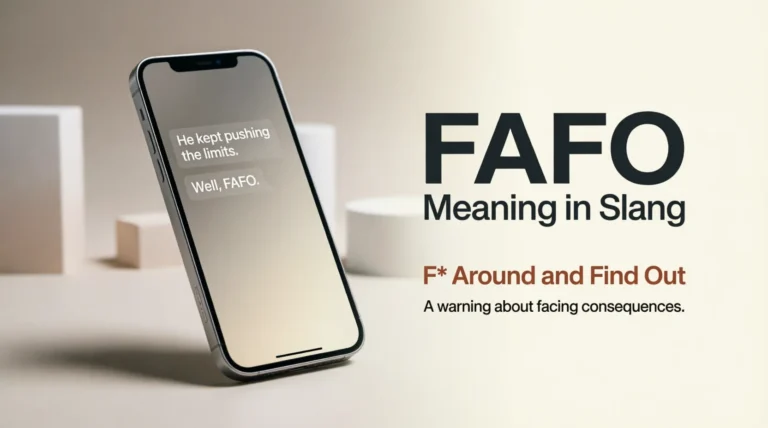
If you’ve seen FAFO in a text message, meme, TikTok comment, or social media post, you may have wondered what it means.
The most common meaning of FAFO is “F* Around and Find Out.”** It is a slang expression used to warn someone that reckless actions often lead to unpleasant consequences.
Depending on the situation, it can sound humorous, sarcastic, confident, or even threatening.
People search for this term because it appears across online conversations, reaction videos, gaming communities, and everyday chats.
While its basic meaning usually stays the same, the tone can change based on the relationship between the people involved, the emojis used, and the overall conversation.
This guide explains what FAFO means, where it came from, how people use it, common misunderstandings, and how to respond when someone says it.
| Term | Most Common Meaning | Full Form | Typical Tone | Common Usage |
|---|---|---|---|---|
| FAFO | Actions have consequences | F*** Around and Find Out | Humorous, sarcastic, confident, warning, or confrontational | Texting, memes, social media, gaming, online discussions |
Quick Answer:
FAFO means “F* Around and Find Out.”** It is slang that warns someone they may experience the consequences of their own actions if they keep pushing boundaries.
What Does FAFO Mean in Text & Chat?
In texting and online chat, FAFO usually means that someone is about to learn the consequences of their choices the hard way.
Sometimes the phrase is aimed directly at another person as a warning. Other times it simply describes a situation where someone ignored advice and faced predictable results.
For example, if someone knowingly breaks the rules and later gets into trouble, another person might comment, “That’s pure FAFO.”
The expression is often used:
- In private messages
- Group chats
- Gaming conversations
- Meme captions
- Reaction posts
- Sports discussions
- Online debates
Tone Matters
FAFO can sound very different depending on the context.
| Situation | Likely Tone |
|---|---|
| Friends joking | Playful |
| Meme or viral video | Humorous |
| Online argument | Sarcastic or confrontational |
| Serious warning | Firm or intimidating |
| Self-reflection | Accepting responsibility |
Adding laughing emojis like 😂 usually softens the message. Writing it in all caps with angry punctuation can make it sound much more aggressive.
Full Form, Stands For & Short Meaning of FAFO
FAFO stands for:
F* Around and Find Out**
The shortened version keeps the original phrase recognizable while avoiding writing the profanity in full.
Short Meaning
Simply put:
If you make careless, risky, or disrespectful choices, you should expect whatever consequences follow.
The phrase does not always suggest violence or punishment. Sometimes the “finding out” is simply:
- Losing a game
- Getting embarrassed
- Failing an exam after not studying
- Breaking something by using it incorrectly
- Facing the natural result of a bad decision
That flexibility is one reason FAFO has become widely recognized online.
Origin, History & First Known Use of FAFO
The exact first use of FAFO cannot be confirmed with certainty. The longer phrase, “F* Around and Find Out,”** existed in spoken English before it became a common internet abbreviation.
Over time, internet users shortened it to FAFO because acronyms are easier to type in fast-moving conversations.
How It Became Popular
The abbreviation spread through:
- Internet memes
- Short-form videos
- Gaming communities
- Online reaction culture
- Social media discussions
Its popularity increased because it delivers a complete idea in only four letters. Rather than explaining that actions have consequences, users can simply write “FAFO.”
Since slang evolves quickly, it is difficult to identify one person or one platform that created the abbreviation.
How People Use FAFO in Daily Conversations
People often use FAFO after someone ignores advice, takes an unnecessary risk, or challenges someone without thinking ahead.
Common Situations
- Someone refuses to read instructions.
- A friend keeps teasing another friend.
- A player ignores game strategy.
- Someone knowingly breaks workplace rules.
- A prank goes badly.
- Someone underestimates a difficult challenge.
Rather than being a literal threat, FAFO is frequently used as commentary after events have already happened.
Everyday Examples
Person A: “I tried fixing my laptop without watching a tutorial.”
Person B: “Classic FAFO. 😂”
Meaning: The speaker is joking that the result was predictable.
Person A: “He kept ignoring every warning.”
Person B: “Well… FAFO.”
Meaning: The consequences were expected.
FAFO Meaning Across WhatsApp, Instagram, TikTok & Snapchat
The core meaning of FAFO stays remarkably consistent across major platforms.
| Platform | Typical Use |
|---|---|
| Friendly jokes or warnings between friends | |
| Meme captions, comment sections, reaction posts | |
| TikTok | Viral videos showing consequences or unexpected outcomes |
| Snapchat | Casual conversations and humorous reactions |
Does the Meaning Change?
Usually, no.
Instead, the tone changes more than the definition.
For example:
- 😂 suggests playful teasing.
- 😬 may show sympathy.
- 💀 often indicates the situation is so ridiculous that it’s funny.
- 😡 can make FAFO sound confrontational.
Reading the entire conversation is more important than focusing on the abbreviation alone.
Different Meanings of FAFO in Other Fields
Although “F* Around and Find Out”** is by far the most common meaning today, abbreviations can occasionally represent different phrases in specialized environments.
Examples include:
- Internal company abbreviations
- Personal note-taking systems
- Team project codes
- Gaming clan names
These uses are uncommon and highly context-dependent.
If you see FAFO in everyday texting or social media, the slang meaning is almost always the correct interpretation.
Common Confusions, Mistakes & Wrong Interpretations
Some people assume FAFO always means violence or physical retaliation. That is not accurate.
The expression often refers to ordinary consequences rather than harm.
Common Misunderstandings
| Mistake | Reality |
|---|---|
| It always means a fight. | It often refers to any consequence. |
| It is always offensive. | Context determines how offensive it sounds. |
| It is used only by younger people. | Adults also use it online and offline. |
| It always targets another person. | People also use it about themselves. |
Understanding the surrounding conversation helps avoid misreading the speaker’s intent.
Similar Terms, Alternatives & Related Slang
Several expressions communicate a similar idea.
| Expression | Similar Meaning |
|---|---|
| Actions have consequences | Neutral version |
| You asked for it | Direct consequence |
| Lesson learned | Reflection after a mistake |
| Karma | Consequences returning to someone |
| Play foolish games, win foolish prizes | Similar internet saying |
These alternatives vary in tone.
For professional conversations, “actions have consequences” is usually more appropriate than FAFO.
Examples of FAFO in Real Chat Situations
Playful
Person A: “I ate the hottest wings without any water.”
Person B: “FAFO! 🌶️😂”
Meaning: Light-hearted teasing.
Serious
Person A: “He ignored every safety rule.”
Person B: “That’s FAFO.”
Meaning: The speaker believes the consequences were predictable.
Sarcastic
Person A: “I kept clicking random buttons.”
Person B: “FAFO at its finest.”
Meaning: Gentle sarcasm.
Self-Reflection
Person A: “I stayed up gaming instead of studying.”
Person B: “Sounds like I FAFO’d myself. 😅”
Meaning: The speaker admits responsibility for their own mistake.
How to Reply When Someone Says FAFO
Your response should match the tone of the conversation.
| Situation | Good Reply |
|---|---|
| Friendly joke | “Fair enough! 😂” |
| Agreeing | “I definitely learned my lesson.” |
| Confused | “What does FAFO mean?” |
| Serious discussion | “I understand the consequences now.” |
| Conversation feels rude | “Let’s keep this respectful.” |
Example Replies
Playful
Person A: “FAFO 😂”
Person B: “You’re not wrong!”
Serious
Person A: “FAFO.”
Person B: “I understand. I’ll be more careful next time.”
Confused
Person A: “FAFO.”
Person B: “I’ve never heard that before. What does it mean?”
Potentially Rude
Person A: “FAFO.”
Person B: “I’d rather have a respectful conversation.”
Is FAFO Still Popular? Trends & Online Usage
FAFO continues to appear regularly in online conversations, especially in meme culture, sports discussions, gaming communities, and social media comment sections.
Its popularity comes from being:
- Short
- Easy to remember
- Highly expressive
- Flexible across many situations
While internet slang changes over time, FAFO remains recognizable because it communicates a familiar idea: people often experience the results of their own choices.
Like many slang terms, its frequency may rise or fall with online trends, but the underlying expression remains widely understood by many internet users.
Frequently Asked Questions
What does FAFO mean?
FAFO most commonly stands for “F* Around and Find Out.”** It means someone’s actions may lead to predictable consequences.
Is FAFO rude?
It can be. Because it includes a profanity in its full form, it may sound casual among friends but inappropriate in formal or professional settings.
Can FAFO be used as a joke?
Yes. Many people use it humorously after harmless mistakes or funny situations. Context determines whether it feels playful or confrontational.
Does FAFO mean the same thing on TikTok and Instagram?
Yes. Across TikTok, Instagram, WhatsApp, Snapchat, and most other platforms, the meaning usually stays the same. The tone changes more than the definition.
How should I reply to FAFO?
You can laugh if it’s a joke, acknowledge the lesson if it’s serious, ask for clarification if you’re unsure, or calmly redirect the conversation if the message feels disrespectful.
Is FAFO appropriate for work?
Generally, no. Because its full form contains profanity, it is best avoided in professional communication unless you’re certain the audience finds it acceptable.
Conclusion
FAFO most commonly means “F* Around and Find Out,”** a popular slang expression reminding people that actions often bring consequences.
In most conversations, it is used humorously, sarcastically, or as a warning after someone takes an unnecessary risk or ignores good advice.
While the definition remains consistent across texting apps and social media platforms, the emotional tone depends heavily on context, punctuation, emojis, and the relationship between the people involved.
Understanding those cues helps you interpret the phrase correctly and respond appropriately.
As online slang continues to evolve, learning terms like FAFO makes digital conversations easier to follow.
If you’re interested in modern internet language, explore other popular abbreviations and text-message slang to stay current.

Alden Rowen is the author behind Meanings Path, sharing clear and reliable insights into the meanings, origins, and significance of words, names, and phrases. His goal is to make language simple, useful, and easy to understand.