
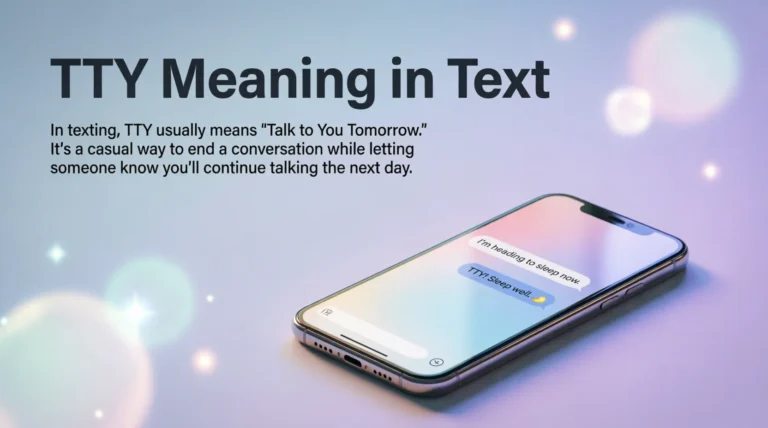
If you’ve received a message ending with TTY and wondered what it means, you’re not alone.
In modern texting, TTY most commonly stands for “Talk to You Tomorrow.” People use it to end a conversation politely while letting the other person know they’ll continue chatting the next day.
You’ll often see TTY in text messages, private chats, gaming conversations, and messaging apps like WhatsApp, Instagram, Snapchat, and Discord.
However, outside casual texting, TTY can also have technical meanings, such as Teletypewriter, which is used in accessibility and telecommunications.
This guide explains the most common meaning of TTY in text, its full forms, history, different uses, examples, reply ideas, and common misunderstandings.
By the end, you’ll know exactly what TTY means whenever you see it.
| Term | Most Common Meaning | Full Form | Typical Tone | Common Usage |
|---|---|---|---|---|
| TTY | Talk to You Tomorrow | Talk to You Tomorrow | Friendly, casual, warm | Text messages, chats, social media |
Quick Answer: In texting, TTY usually means “Talk to You Tomorrow.” It’s a casual way to end a conversation while letting someone know you’ll continue talking the next day.
What Does TTY Mean in Text & Chat?
In text conversations, TTY almost always means “Talk to You Tomorrow.” It acts as a friendly sign-off instead of writing a full sentence.
People use it when they’re going to bed, finishing work, studying, or simply ending a conversation for the day.
The tone is usually:
- Friendly
- Casual
- Caring
- Neutral
It is rarely negative by itself. Instead, it suggests the conversation is simply being paused.
The exact tone depends on the rest of the message. Emojis, punctuation, and your relationship with the other person all influence how it feels.
Examples
- “I’m exhausted. TTY! 😊” → Warm and friendly.
- “Busy now. TTY.” → Neutral and practical.
- “Alright, TTY ❤️” → Affectionate.
- “Fine… TTY.” → Depending on context, it could sound slightly distant.
Because context matters, TTY should always be interpreted alongside the rest of the conversation.
Full Form, Stands For & Short Meaning of TTY
The most common full form is:
TTY = Talk to You Tomorrow
This simply tells someone you’ll continue the conversation the following day.
Short Meaning
- I’ll message you tomorrow.
- We’ll continue talking tomorrow.
- Goodnight, see you tomorrow.
Although this is the primary texting meaning, TTY has other established meanings in different contexts.
| Context | Meaning |
|---|---|
| Text messaging | Talk to You Tomorrow |
| Telecommunications | Teletypewriter |
| Accessibility | Text telephone device for people with hearing or speech disabilities |
| Computing | Sometimes refers to terminal devices or virtual terminals |
When chatting with friends, the texting meaning is almost always the correct interpretation unless the conversation is about technology or accessibility.
Origin, History & First Known Use of TTY
Unlike some internet slang that has a clearly documented origin, there is no confirmed first recorded use of TTY meaning “Talk to You Tomorrow.”
It likely developed naturally as texting became more popular and people looked for shorter ways to end conversations. Similar abbreviations such as:
- BRB
- TTYL
- GTG
- CU
all became common because they saved time when typing on early mobile phones.
It’s important not to confuse this texting abbreviation with the much older technical term TTY, which has long referred to Teletypewriter devices and later computer terminals.
So today, the meaning depends almost entirely on the conversation.
How People Use TTY in Daily Conversations
People usually send TTY when ending a conversation for the day.
Common situations include:
- Going to sleep
- Leaving work
- Starting class
- Family time
- Traveling
- Logging off a game
Everyday Examples
Person A: “I’m heading to bed now.”
Person B: “Sleep well! TTY 😊”
Meaning: They’ll continue chatting tomorrow.
Person A: “I have an early meeting.”
Person B: “Good luck tomorrow. TTY!”
Meaning: Friendly goodbye.
Person A: “My battery is almost dead.”
Person B: “No worries. TTY.”
Meaning: Conversation paused until tomorrow.
The abbreviation feels natural between people who already chat regularly.
TTY Meaning Across WhatsApp, Instagram, TikTok & Snapchat
The meaning of TTY generally stays the same across social platforms.
| Platform | Typical Meaning |
|---|---|
| Talk to You Tomorrow | |
| Instagram DMs | Talk to You Tomorrow |
| Snapchat | Talk to You Tomorrow |
| TikTok Messages | Talk to You Tomorrow |
| Discord | Talk to You Tomorrow |
People may write it differently:
- tty
- TTY
- Tty
Capitalization doesn’t usually change the meaning.
The tone changes more because of surrounding messages than because of the platform.
For example:
- “TTY 😂” sounds playful.
- “TTY ❤️” feels affectionate.
- “TTY!!” sounds enthusiastic.
- “TTY.” can feel neutral or slightly formal.
Different Meanings of TTY in Other Fields
Although “Talk to You Tomorrow” is the common texting meaning, TTY also has established meanings elsewhere.
Telecommunications
TTY stands for Teletypewriter.
Originally, these machines transmitted typed messages over communication lines.
Accessibility
TTY can also refer to text telephone devices that help people with hearing or speech disabilities communicate by typing instead of speaking.
Computing
In computer systems, TTY may describe a terminal or virtual terminal used to interact with an operating system.
These technical meanings are unrelated to casual texting.
| Context | Meaning |
|---|---|
| Casual chat | Talk to You Tomorrow |
| Accessibility | Text telephone |
| Telecommunications | Teletypewriter |
| Computing | Terminal interface |
Always use the surrounding conversation to decide which meaning fits.
Common Confusions, Mistakes & Wrong Interpretations
One common mistake is confusing TTY with TTYL.
Although they’re similar, they are different.
| Term | Meaning |
|---|---|
| TTY | Talk to You Tomorrow |
| TTYL | Talk To You Later |
TTYL is much broader.
TTY specifically points to talking tomorrow, while TTYL could mean later today, tomorrow, or another time.
Another misunderstanding happens when someone assumes every use of TTY refers to “Talk to You Tomorrow.” In technical discussions, that may not be correct.
Reading the conversation first helps avoid confusion.
Similar Terms, Alternatives & Related Slang
People also use other abbreviations when ending conversations.
| Slang | Meaning |
|---|---|
| TTYL | Talk To You Later |
| GTG | Got To Go |
| BRB | Be Right Back |
| CU | See You |
| GN | Good Night |
| CYA | See You |
Each has a slightly different purpose.
For example:
- BRB suggests a short break.
- GTG means leaving now.
- GN wishes someone a good night.
- TTY promises another conversation tomorrow.
Choosing the right abbreviation depends on the situation.
Examples of TTY in Real Chat Situations
Friendly
Person A: “I’m falling asleep already.”
Person B: “Same here. TTY 😊”
Tone: Warm and relaxed.
Playful
Person A: “Don’t forget our movie tomorrow!”
Person B: “Never! TTY 😂”
Tone: Cheerful and excited.
Affectionate
Person A: “Sweet dreams.”
Person B: “You too ❤️ TTY”
Tone: Caring and close.
Slightly Serious
Person A: “We can finish this tomorrow.”
Person B: “Sounds good. TTY.”
Tone: Calm and practical.
Notice how emojis make the same abbreviation feel warmer and more personal.
How to Reply When Someone Says TTY
There isn’t one perfect reply. It depends on the conversation.
| Situation | Good Reply |
|---|---|
| Friendly | “Sounds good! Sleep well 😊” |
| Playful | “Don’t disappear tomorrow 😂” |
| Serious | “Okay, we’ll continue then.” |
| Affectionate | “Can’t wait. Good night ❤️” |
| Unsure | “Sure, talk tomorrow!” |
If the message seems cold or confusing, it’s okay to ask politely:
“Do you mean talk tomorrow?”
Most people will happily clarify.
Is TTY Still Popular? Trends & Online Usage
TTY still appears in personal messaging, although it is less common than abbreviations like TTYL, GN, or simply writing “Talk tomorrow.”
Many people now type full sentences because smartphone keyboards make texting easier than they once were.
Even so, TTY remains easy to recognize among people who enjoy abbreviations or want to keep messages brief.
Its meaning has stayed consistent over time, and readers can usually understand it immediately from context.
Rather than focusing on a specific platform, TTY survives because it is short, clear, and friendly.
Frequently Asked Questions
What does TTY mean in a text message?
It usually means “Talk to You Tomorrow.” It’s a friendly way to end a conversation and say you’ll continue chatting the next day.
Is TTY the same as TTYL?
No. TTY means “Talk to You Tomorrow,” while TTYL means “Talk To You Later,” which is less specific about when you’ll talk again.
Is TTY rude?
Not by itself. It’s generally friendly or neutral. The tone depends on the surrounding message, punctuation, emojis, and the relationship between the people chatting.
Does TTY mean the same thing on WhatsApp, Instagram, TikTok, and Snapchat?
Yes. In most personal chats across these platforms, TTY keeps the same meaning: “Talk to You Tomorrow.”
Can TTY have another meaning?
Yes. Outside texting, TTY can refer to a Teletypewriter, a text telephone used for accessibility, or a computer terminal, depending on the context.
How should I reply to TTY?
A simple reply works well, such as “Talk tomorrow!”, “Good night!”, “See you then 😊”, or another response that matches the tone of your conversation.
Conclusion
In everyday texting, TTY most commonly means “Talk to You Tomorrow.” It’s a simple, friendly abbreviation that lets someone know you’re ending the conversation for today but plan to continue it later.
While the acronym also has well-established technical meanings related to telecommunications, accessibility, and computing, those interpretations usually appear only in specialized contexts.
The easiest way to understand TTY is to look at the surrounding conversation.
Emojis, punctuation, and your relationship with the sender can make it sound warm, playful, affectionate, or simply practical.
Once you know the context, the intended meaning is usually clear.
If you’re exploring more texting abbreviations, learning related slang can make online conversations even easier to understand.

Alden Rowen is the author behind Meanings Path, sharing clear and reliable insights into the meanings, origins, and significance of words, names, and phrases. His goal is to make language simple, useful, and easy to understand.