
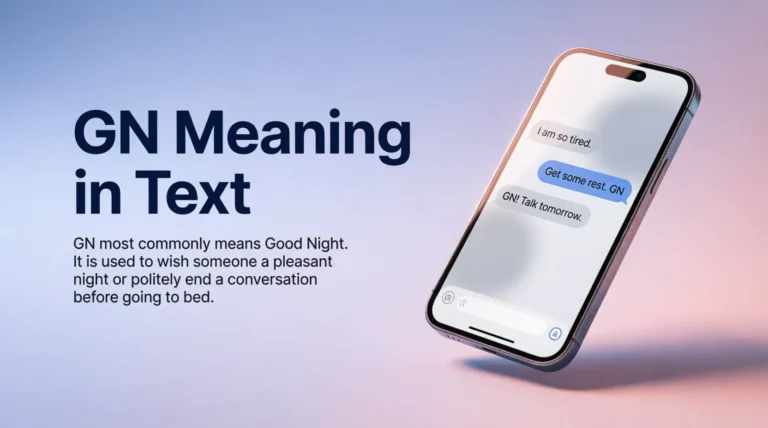
If you’ve received a message ending with GN, you may have wondered what it means.
In most text conversations, GN simply stands for “Good Night.” It’s a short, friendly way to say goodbye before going to sleep or ending a late-night chat.
People commonly use GN in text messages, group chats, gaming conversations, and on social media platforms such as WhatsApp, Instagram, Snapchat, TikTok, and Messenger.
While the meaning is usually straightforward, the tone can change depending on the relationship between the people, the emojis used, or the rest of the conversation.
In this guide, you’ll learn what GN means in text, its full form, where it came from, how people use it across different platforms, other possible meanings, common mistakes, realistic chat examples, and the best ways to reply.
| Term | Most Common Meaning | Full Form | Typical Tone | Common Usage |
|---|---|---|---|---|
| GN | Good Night | Good Night | Friendly, caring, polite | Text messages, social media, chats, gaming |
Quick Answer:
GN most commonly means “Good Night.” It is used to wish someone a pleasant night or politely end a conversation before going to bed.
What Does GN Mean in Text & Chat?
In texting and online chatting, GN almost always means “Good Night.” It is one of the most common abbreviations people use to end conversations in a quick and friendly way.
Instead of typing the full phrase, many people simply send GN because it is shorter and easier, especially during casual conversations.
The meaning stays simple:
- Wishing someone a good night’s sleep
- Ending a conversation politely
- Showing care or friendliness
- Saying goodbye until the next day
The tone depends on the situation.
| Message | Possible Tone |
|---|---|
| GN | Neutral and brief |
| GN 😊 | Friendly and warm |
| GN ❤️ | Affectionate |
| GN!! | Cheerful and energetic |
| GN… | May sound distant or tired |
Someone you know well might send only GN, while another person may add emojis or extra words to make it feel warmer.
For example:
Person A: “I’m heading to bed now.”
Person B: “GN! Sleep well. 🌙”
Here, GN is caring and polite.
Full Form, Stands For & Short Meaning of GN
The full form of GN is:
Good Night
It is one of the oldest and most widely recognized texting abbreviations.
Short Meaning
GN means:
- Good night
- Sleep well
- Goodbye for today
- Talk to you tomorrow
Although these ideas are related, Good Night remains the primary meaning.
People often pair GN with other abbreviations:
| Abbreviation | Meaning |
|---|---|
| GN | Good Night |
| GN8 | Good Night (“8” sounds like “ate”) |
| GNG | Good Night, Good Game (gaming context) |
| GNSD | Good Night, Sweet Dreams |
| GM | Good Morning |
| TC | Take Care |
Most of the time, if you see GN without extra context, you can safely read it as Good Night.
Origin, History & First Known Use of GN
The abbreviation GN became popular as texting and instant messaging grew.
When mobile phones had small keyboards and SMS character limits, people shortened common phrases to save time and space. Expressions like GN, GM, TY, and BRB became everyday shortcuts.
Why It Became Popular
People liked GN because it is:
- Fast to type
- Easy to understand
- Universally recognized
- Suitable for casual conversations
There is no verified record showing exactly who first used GN or the first time it appeared online. Instead, it gradually became common through text messaging, internet chat rooms, and messaging apps.
Today, it remains one of the most familiar chat abbreviations across age groups.
How People Use GN in Daily Conversations
People use GN in many everyday situations.
Between Friends
Friends often use GN casually before ending a conversation.
Person A: “See you tomorrow.”
Person B: “GN! 😊”
The tone is relaxed and friendly.
Between Family Members
Parents, siblings, and relatives may use GN to wish each other a restful night.
Person A: “Don’t stay up too late.”
Person B: “GN, love you.”
Here it feels caring.
Between Couples
GN can sound affectionate.
Person A: “Sweet dreams.”
Person B: “GN ❤️”
The heart emoji adds warmth.
In Group Chats
People sometimes write:
“GN everyone!”
This politely ends their participation for the night.
GN Meaning Across WhatsApp, Instagram, TikTok & Snapchat
The meaning of GN usually stays the same across major social media platforms.
| Platform | Typical Meaning |
|---|---|
| Good Night | |
| Good Night | |
| Snapchat | Good Night |
| TikTok | Good Night in comments or messages |
| Messenger | Good Night |
| Discord | Good Night before leaving chat |
Although the meaning rarely changes, the tone may.
Often used with family and close friends.
Example:
“GN 🌙”
Common in direct messages and replies to late-night conversations.
Snapchat
Usually ends a conversation before someone logs off.
TikTok
People sometimes comment “GN” on nighttime videos or tell followers good night.
Across these platforms, context matters more than the platform itself.
Different Meanings of GN in Other Fields
While Good Night is the most common meaning in texting, GN can represent other phrases in different industries.
| Field | Possible Meaning |
|---|---|
| Text Messaging | Good Night |
| Business | Depends on company terminology |
| Science | Can represent technical abbreviations |
| Gaming | Usually Good Night |
| Internal Organizations | May have unique meanings |
These alternative meanings depend entirely on context.
For example, if someone is discussing science, engineering, or workplace documents, GN may not mean Good Night.
Always consider the surrounding conversation before assuming the meaning.
Common Confusions, Mistakes & Wrong Interpretations
Most confusion happens when people ignore the conversation’s context.
Common mistakes include:
- Assuming every GN has a romantic meaning
- Thinking GN is rude because it is short
- Confusing GN with other abbreviations
- Believing every platform uses it differently
Usually, none of these assumptions are correct.
A simple GN is often just a polite way to say good night.
However, if someone suddenly replies with only GN during an argument, it may feel abrupt or dismissive.
Context changes tone more than the abbreviation itself.
Similar Terms, Alternatives & Related Slang
Many expressions have a similar purpose.
| Term | Meaning |
|---|---|
| Good Night | Full phrase |
| GN8 | Good Night |
| Night | Informal goodbye |
| Sleep well | Friendly wish |
| Sweet dreams | Warm bedtime wish |
| Catch you tomorrow | Goodbye until tomorrow |
| See you tomorrow | Friendly farewell |
Each option has a slightly different tone.
- GN is short.
- Sweet dreams sounds warmer.
- Sleep well feels thoughtful.
- Night is very casual.
Examples of GN in Real Chat Situations
Friendly Conversation
Person A: “I have an early class tomorrow.”
Person B: “GN! Hope it goes well. 😊”
Meaning: Friendly encouragement.
Playful Conversation
Person A: “Don’t stay awake watching another episode.”
Person B: “No promises 😂 GN.”
Meaning: Lighthearted joking.
Romantic Conversation
Person A: “I’ll miss talking to you.”
Person B: “GN ❤️ Sweet dreams.”
Meaning: Affectionate.
Slightly Distant Conversation
Person A: “Okay…”
Person B: “GN.”
Meaning: Could simply be tired, but the short reply might also feel less warm depending on earlier messages.
How to Reply When Someone Says GN
There is no single correct response.
Choose one based on the tone.
| Situation | Good Reply |
|---|---|
| Friendly | “GN! Sleep well 😊” |
| Playful | “GN! Don’t oversleep 😂” |
| Romantic | “GN ❤️ Sweet dreams.” |
| Serious | “Good night. Rest well.” |
| Confusing | “Good night! Talk tomorrow?” |
| Abrupt or possibly rude | “Okay, good night.” |
Your reply should match your relationship with the other person.
Adding emojis can make your response feel warmer, while keeping it plain can sound more neutral.
Is GN Still Popular? Trends & Online Usage
Yes. GN remains widely used because it is simple, familiar, and easy to type.
Even though people now have voice messages, GIFs, stickers, and emojis, many still send GN as a quick nighttime farewell.
Its popularity also comes from its flexibility.
People can send:
- GN
- GN 😊
- GN ❤️
- GN everyone
- GN, talk tomorrow
These small variations let people express different emotions while keeping the message short.
Although some users prefer typing the full words Good Night, the abbreviation continues to be common in everyday digital conversations.
Frequently Asked Questions
What does GN mean in texting?
GN usually means Good Night. It is a simple way to end a conversation before going to sleep.
Is GN romantic?
Not necessarily. GN is usually friendly or polite. It only sounds romantic when combined with affectionate language, hearts, or other loving messages.
Does GN mean the same on WhatsApp and Snapchat?
Yes. On both platforms, GN almost always means Good Night. The tone depends on the conversation rather than the app.
How should I reply to GN?
A simple reply like “GN! Sleep well 😊” or “Good night, talk tomorrow!” works well in most situations.
Can GN have other meanings?
Yes. In technical, business, or specialized fields, GN may represent different terms. In everyday texting, however, Good Night is by far the most common meaning.
Is sending only GN considered rude?
Usually no. Many people use it simply because it is quick. However, during an emotional conversation, a very short “GN” may seem distant depending on the context.
Conclusion
The meaning of GN in text is usually simple: Good Night.
It is one of the most common abbreviations used to end conversations politely before going to sleep.
Whether you’re chatting with friends, family, coworkers, or someone special, GN is a quick and widely understood way to wish someone a restful night.
Even though the definition rarely changes, the tone can.
Emojis, punctuation, previous messages, and your relationship with the other person all influence how GN feels.
A plain “GN” may sound neutral, while “GN ❤️” or “GN 😊” feels much warmer.
Now that you understand what GN means, you’ll be able to recognize it confidently in chats, respond naturally, and better understand the tone behind the message.
Exploring other common texting abbreviations can also make online conversations easier to follow.

Alden Rowen is the author behind Meanings Path, sharing clear and reliable insights into the meanings, origins, and significance of words, names, and phrases. His goal is to make language simple, useful, and easy to understand.