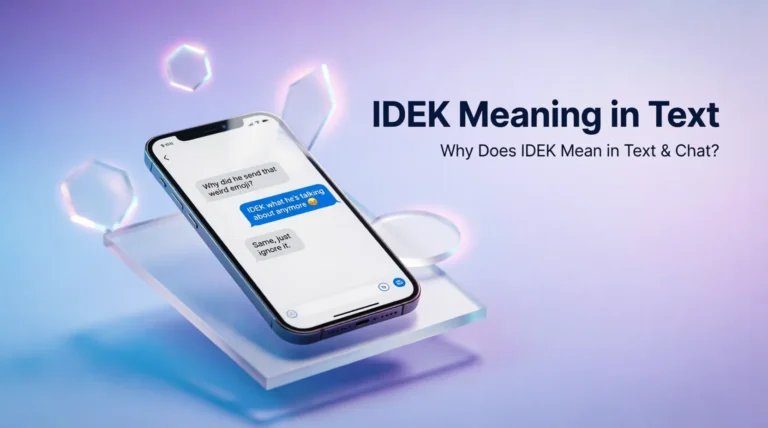
If you’ve seen someone reply with “IDEK” in a text message or social media comment, you may be wondering what it means.
The most common IDEK meaning in text is “I Don’t Even Know.” People use it to express confusion, surprise, frustration, disbelief, or uncertainty in a quick and casual way.
You’ll often spot IDEK in text messages, group chats, WhatsApp conversations, Instagram comments, TikTok captions, Snapchat streaks, and other online discussions.
Depending on the situation, it can sound serious, humorous, sarcastic, or simply honest.
This guide explains exactly what IDEK means, where it came from, how people use it, how its tone changes with context, and how you can reply naturally when someone sends it.
| Term | Most Common Meaning | Full Form | Typical Tone | Common Usage |
|---|---|---|---|---|
| IDEK | I Don’t Even Know | I Don’t Even Know | Casual, confused, surprised, sarcastic, frustrated | Text messages, social media, online chats |
What Does IDEK Mean in Text & Chat?
Direct Answer
IDEK means “I Don’t Even Know.”
People use it when they genuinely don’t know the answer or when they’re so surprised, overwhelmed, or confused that they don’t know what to say.
Unlike simply saying “I don’t know,” IDEK often adds extra emotion. It suggests that the situation feels confusing, unexpected, or difficult to explain.
For example:
Person A: “Why did the meeting get canceled?”
Person B: “IDEK anymore. 😅”
Here, the speaker isn’t just missing information—they’re expressing mild frustration and uncertainty.
Other common situations include:
- Not knowing an answer.
- Feeling mentally exhausted.
- Reacting to unexpected news.
- Expressing disbelief.
- Making a sarcastic comment.
- Showing playful confusion.
The meaning usually stays the same, but the emotion behind it changes depending on punctuation, emojis, and the relationship between the people chatting.
Quick Answer Box
IDEK = I Don’t Even Know
Used to express uncertainty, confusion, disbelief, frustration, or humorous exaggeration in casual digital conversations.
Full Form, Stands For & Short Meaning of IDEK
The full form of IDEK is:
I Don’t Even Know
Each word contributes to the overall feeling:
- I – the speaker.
- Don’t – indicates a negative statement.
- Even – adds emphasis.
- Know – refers to understanding or having an answer.
Without the word “even,” the sentence becomes “I don’t know,” which sounds much more neutral.
Adding “even” makes the expression stronger. It often suggests:
- Total confusion.
- Emotional exhaustion.
- Surprise.
- Mild annoyance.
- Giving up on figuring something out.
Tone Comparison
| Expression | Meaning | Emotional Strength |
|---|---|---|
| IDK | I don’t know | Neutral |
| IDEK | I don’t even know | Stronger emotion |
| No clue | I have absolutely no idea | Casual |
| Beats me | I don’t know either | Informal |
Because of this emphasis, IDEK often feels more expressive than IDK without becoming overly dramatic.
Origin, History & First Known Use of IDEK
Like many internet abbreviations, IDEK developed naturally as people looked for faster ways to type common phrases.
It likely became more common alongside smartphones, instant messaging, and social media, where short acronyms help people communicate quickly. Instead of typing “I don’t even know” every time, users shortened it to IDEK.
There isn’t a single confirmed creator or documented first use. Unlike official acronyms created by organizations, internet slang usually spreads gradually through online communities.
Today, IDEK appears across:
- Private text conversations.
- Gaming chats.
- Online forums.
- Social media comments.
- Short-form video captions.
- Group messaging apps.
Its popularity comes from its simplicity. The phrase captures an emotional reaction in only four letters.
Because internet language evolves constantly, IDEK remains widely understood among many English-speaking online users, especially in informal settings.
How People Use IDEK in Daily Conversations
People rarely use IDEK to answer factual questions alone. More often, they use it to communicate emotion.
Genuine Confusion
Person A: “Where did I save that file?”
Person B: “IDEK. I looked everywhere.”
Tone: Honest and uncertain.
Playful Reaction
Person A: “How did you finish that pizza by yourself?”
Person B: “IDEK 😂”
Tone: Funny and lighthearted.
Frustration
Person A: “Why is the app crashing again?”
Person B: “IDEK anymore.”
Tone: Annoyed.
Sarcasm
Person A: “Why do Mondays exist?”
Person B: “IDEK.”
Tone: Sarcastic or humorous.
Small changes affect the meaning:
- IDEK 😭 → overwhelmed.
- IDEK 😂 → laughing about it.
- IDEK… → disappointed.
- IDEK!! → shocked.
- idek → relaxed and casual.
IDEK Meaning Across WhatsApp, Instagram, TikTok & Snapchat
The core meaning of IDEK usually stays the same across platforms.
| Platform | Typical Meaning | Common Tone |
|---|---|---|
| Genuine uncertainty | Casual | |
| Reaction to posts or comments | Funny or surprised | |
| TikTok | Response to trends or videos | Humorous, exaggerated |
| Snapchat | Casual conversations | Friendly and informal |
Friends often use IDEK during everyday conversations when they don’t know something or feel confused.
It commonly appears in comments reacting to surprising photos, memes, or stories.
TikTok
On TikTok, IDEK often accompanies dramatic reactions, jokes, or relatable situations.
Snapchat
Because Snapchat conversations are casual and fast, IDEK fits naturally into everyday chats.
While platform culture changes the style of conversation, the definition itself remains remarkably consistent.
Different Meanings of IDEK in Other Fields
In everyday online English, IDEK almost always means “I Don’t Even Know.”
Unlike some abbreviations that have many technical meanings, IDEK has relatively few widely recognized alternatives.
In rare situations, someone may assign different meanings within a workplace, school, gaming group, or private community. Those are usually internal abbreviations rather than broadly accepted definitions.
If you encounter IDEK in a specialized document, always read the surrounding context before assuming its meaning.
For most readers, however, the texting meaning is the correct interpretation.
Common Confusions, Mistakes & Wrong Interpretations
A common mistake is confusing IDEK with IDK.
Although they look similar, they are not identical.
| Abbreviation | Meaning | Difference |
|---|---|---|
| IDK | I Don’t Know | Neutral uncertainty |
| IDEK | I Don’t Even Know | Stronger emotional emphasis |
Another misunderstanding is assuming IDEK always sounds rude.
In reality, tone depends on context.
Examples:
- “IDEK, sorry.” → polite.
- “IDEK 😂” → playful.
- “IDEK anymore.” → frustrated.
- “IDEK bro.” → casual.
- “IDEK why you asked.” → could sound dismissive depending on wording.
Reading the full conversation helps avoid misunderstanding.
Similar Terms, Alternatives & Related Slang
Several internet abbreviations express similar ideas.
| Term | Meaning | Typical Use |
|---|---|---|
| IDK | I Don’t Know | Neutral |
| IDC | I Don’t Care | Indifference |
| TBH | To Be Honest | Honest opinion |
| SMH | Shaking My Head | Disappointment |
| BRB | Be Right Back | Temporary absence |
| IMO | In My Opinion | Personal opinion |
You can also use full phrases instead of abbreviations:
- I have no idea.
- I’m not sure.
- Beats me.
- No clue.
- Honestly, I don’t know.
- Your guess is as good as mine.
Each carries a slightly different tone, so choose one that matches the conversation.
Examples of IDEK in Real Chat Situations
Casual Confusion
Person A: “Who’s bringing snacks tonight?”
Person B: “IDEK. Nobody has answered yet. 😊”
Meaning: The speaker genuinely doesn’t know.
Funny Reaction
Person A: “I somehow locked myself out twice today.”
Person B: “IDEK how that’s even possible. 😂”
Meaning: Amused disbelief.
Frustrated Mood
Person A: “Why is the internet still down?”
Person B: “IDEK anymore… I’ve restarted everything.”
Meaning: Frustration and exhaustion.
Light Sarcasm
Person A: “Why do printers stop working right before deadlines?”
Person B: “IDEK. They just know.”
Meaning: A playful joke rather than a literal answer.
How to Reply When Someone Says IDEK
Your reply depends on why the person said it.
| Situation | Natural Reply |
|---|---|
| Serious confusion | “Let’s figure it out together.” |
| Honest uncertainty | “That’s okay. We’ll find out.” |
| Playful joke | “Fair enough. 😂” |
| Frustration | “Hopefully it gets sorted soon.” |
| Slightly rude tone | “No worries. I’ll ask someone else.” |
Examples:
Serious
Person A: “IDEK what’s happening.”
Person B: “Tell me what happened, and we’ll work through it.”
Playful
Person A: “IDEK why I did that. 😂”
Person B: “It made the story funnier!”
Confused
Person A: “IDEK.”
Person B: “Want me to explain?”
Potentially Dismissive
Person A: “IDEK why you’re asking.”
Person B: “That’s okay. I was just curious.”
Matching the other person’s mood usually leads to the most natural conversation.
Is IDEK Still Popular? Trends & Online Usage
IDEK continues to appear in everyday online conversations because it is short, expressive, and easy to understand.
Although internet slang changes over time, many long-standing abbreviations remain useful because they communicate common emotions efficiently.
Today, IDEK is especially common in:
- Text messaging.
- Social media comments.
- Group chats.
- Gaming conversations.
- Casual online discussions.
Some people, especially in professional settings, prefer writing the full phrase instead of using abbreviations. In personal conversations, however, IDEK remains familiar to many internet users.
As always, consider your audience. Using the full sentence may be clearer when chatting with someone unfamiliar with texting slang.
Frequently Asked Questions
What does IDEK mean in texting?
It usually means “I Don’t Even Know.” It expresses confusion, uncertainty, surprise, or frustration in casual conversations.
Is IDEK the same as IDK?
No. IDK simply means “I Don’t Know,” while IDEK adds emphasis, making the statement sound more emotional or expressive.
Is IDEK rude?
Not by itself. It is usually neutral or casual. However, surrounding words, punctuation, and the conversation can make it sound playful, frustrated, sarcastic, or dismissive.
Can I use IDEK in professional emails?
It’s generally better to avoid texting abbreviations in formal communication. Writing “I don’t know” or “I’m not sure” is usually more appropriate.
Does IDEK mean the same thing on WhatsApp, Instagram, TikTok, and Snapchat?
Yes. Across these platforms, IDEK almost always means “I Don’t Even Know.” The tone may vary, but the definition usually stays the same.
How should I reply to IDEK?
Respond based on the context. You can offer help if someone is genuinely confused, laugh along if they’re joking, or acknowledge their frustration if they seem overwhelmed.
Conclusion
The most common IDEK meaning in text is “I Don’t Even Know.” It’s a simple abbreviation that helps people express more than just uncertainty.
Depending on the conversation, it can show confusion, surprise, frustration, sarcasm, or playful humor.
The meaning itself rarely changes across messaging apps and social media platforms, but the tone often does.
Emojis, punctuation, and the relationship between the people chatting all shape how IDEK is understood.
When you see IDEK, don’t focus only on the four letters.
Look at the surrounding conversation to understand the speaker’s intent.
As you continue exploring online slang and texting abbreviations, recognizing these subtle differences will make digital conversations much easier to understand.

Alden Rowen is the author behind Meanings Path, sharing clear and reliable insights into the meanings, origins, and significance of words, names, and phrases. His goal is to make language simple, useful, and easy to understand.