
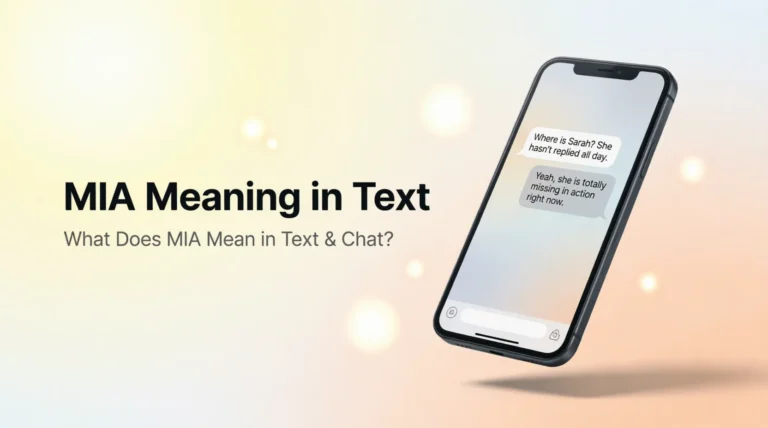
If you’ve received a message saying “MIA” or seen someone post “I’ve been MIA lately,” you might wonder what it means.
In text messages and online conversations, MIA most commonly means “Missing in Action.” While the phrase originally came from the military, it is now widely used as internet slang to describe someone who has disappeared from conversations, stopped replying, or has been inactive for a while.
People commonly use MIA in texting, WhatsApp, Instagram, TikTok, Snapchat, Discord, and other social platforms.
Depending on the situation, it can sound playful, concerned, apologetic, or even slightly sarcastic.
Understanding the context helps you interpret the intended meaning correctly.
This guide explains what MIA means, where it came from, how people use it today, examples in real chats, suitable replies, and other meanings you may come across.
| Term | Most Common Meaning | Full Form | Typical Tone | Common Usage |
|---|---|---|---|---|
| MIA | Missing in Action | Missing in Action | Neutral, playful, apologetic, or concerned | Texting, social media, chats, gaming, online conversations |
What Does MIA Mean in Text & Chat?
Direct Answer
In text messages, MIA usually means “Missing in Action.” It describes someone who has not replied, disappeared from a conversation, or has been inactive online for some time.
Unlike its original military meaning, everyday texting uses MIA figuratively. It does not usually suggest that someone is literally missing. Instead, it simply means they have been absent from chats, social media, or regular communication.
For example:
- “You’ve been MIA all week!”
- “Sorry, I’ve been MIA because work has been shocking.”
The tone depends on the conversation.
- Playful: Friends joking about someone disappearing.
- Concerned: Checking if someone is okay.
- Apologetic: Explaining a delayed reply.
- Sarcastic: Lightly teasing someone for ignoring messages.
Context matters. A close friend saying “You’ve gone MIA 😂” feels very different from a worried family member asking why someone has been MIA.
Quick Summary
| Situation | Meaning |
|---|---|
| Friend disappeared from chat | They’ve been inactive |
| Late reply | Explaining absence |
| Social media break | Offline for a while |
| Gaming | Player hasn’t been online |
Full Form, Stands For & Short Meaning of MIA
MIA stands for Missing in Action.
Originally, the phrase described military personnel whose whereabouts were unknown during combat. Today, everyday conversations have broadened its meaning.
Short Meaning
In texting, MIA simply means:
- Away for a while
- Not replying
- Offline
- Absent
- Missing from conversations
Most people use it casually without thinking about its military origin.
When It Sounds Natural
Examples include:
- “Sorry I’ve been MIA.”
- “Where have you been? Totally MIA.”
- “He’s been MIA from the group chat.”
The abbreviation is widely understood by internet users, making it useful for short messages.
Origin, History & First Known Use of MIA
MIA originated as a military abbreviation meaning Missing in Action. It referred to service members whose location or status was unknown during military operations.
Over time, people adopted the phrase into everyday English. Rather than referring to combat situations, it became a metaphor for someone who suddenly disappeared from normal communication.
There is no single confirmed date when internet users first began using MIA as chat slang. Its shift into casual conversation happened gradually as online messaging, email, forums, and texting became more common.
Today, most younger users recognize MIA as a general expression for being absent rather than its original military usage.
It is important to distinguish these meanings:
| Context | Meaning |
|---|---|
| Military | Missing in Action |
| Texting | Absent or not responding |
| Social media | Inactive for some time |
How People Use MIA in Daily Conversations
People use MIA whenever someone unexpectedly disappears from normal communication.
Apologizing
“I’ve been MIA because I’ve had exams.”
This politely explains a delayed response.
Asking About Someone
“You’ve been MIA lately. Everything okay?”
This shows concern.
Friendly Joke
“You vanished again. Total MIA 😂”
Here, the tone is teasing rather than serious.
Talking About Social Breaks
“I went MIA on social media for a month.”
This means taking a break from posting or messaging.
Small details like emojis, punctuation, and your relationship with the other person influence how MIA sounds.
| Tone | Example |
|---|---|
| Friendly | “You’ve been MIA 😄” |
| Concerned | “You’ve been MIA. Are you okay?” |
| Apologetic | “Sorry I’ve been MIA lately.” |
| Sarcastic | “Nice to see you’re no longer MIA.” |
MIA Meaning Across WhatsApp, Instagram, TikTok & Snapchat
The meaning of MIA stays mostly the same across platforms.
Usually refers to someone not replying or disappearing from chats.
Example:
“Why have you been MIA?”
Often means someone hasn’t posted stories or photos recently.
Example:
“I’ve been MIA from Instagram.”
TikTok
Creators sometimes explain breaks by saying they’ve been MIA.
Example:
“Sorry I’ve been MIA—life got busy.”
Snapchat
Usually means someone stopped sending snaps or disappeared from conversations.
Platform Comparison
| Platform | Common Meaning |
|---|---|
| Not replying | |
| Inactive posting | |
| TikTok | Taking a break |
| Snapchat | Missing from chats |
| Discord | Offline or inactive |
| Gaming | Player absent |
The meaning rarely changes between platforms. Only the type of activity changes.
Different Meanings of MIA in Other Fields
Although texting usually refers to “Missing in Action,” MIA can represent other things depending on context.
| Field | Possible Meaning |
|---|---|
| Military | Missing in Action |
| Aviation | Miami International Airport code |
| Geography | Miami abbreviation |
| Business | Company-specific abbreviations |
| Education | Internal abbreviations |
When someone simply texts “MIA,” the casual meaning of being absent is almost always intended.
If you encounter MIA in travel documents, airport information, or professional settings, check the surrounding context before assuming its meaning.
Common Confusions, Mistakes & Wrong Interpretations
One common mistake is assuming MIA always refers to military situations.
In everyday texting, it almost never does.
Another misunderstanding is believing someone is in danger whenever MIA appears. Usually, the sender simply means the person hasn’t replied or has been inactive.
People also confuse MIA with:
- AFK (Away From Keyboard)
- Ghosting
- Offline
- Ignoring messages
These are related but not identical.
For example:
- AFK often means temporarily away.
- Ghosting suggests intentionally cutting off communication.
- MIA simply means absent, without explaining why.
Similar Terms, Alternatives & Related Slang
Several expressions communicate a similar idea.
| Term | Meaning |
|---|---|
| AFK | Away temporarily |
| Ghosting | Suddenly stopping communication |
| Offline | Not connected |
| Silent | Not responding |
| Taking a break | Choosing time away |
| Inactive | Not participating |
MIA is one of the most natural ways to describe someone who has disappeared from normal online conversations without implying bad intentions.
Examples of MIA in Real Chat Situations
Example 1: Friendly
Person A: “You’ve been MIA all weekend!”
Person B: “I needed a little break from my phone. 😊”
Meaning: Friendly teasing.
Example 2: Apologetic
Person A: “Everything okay?”
Person B: “Sorry I’ve been MIA. Work has been overwhelming.”
Meaning: Explaining absence.
Example 3: Concerned
Person A: “You were MIA yesterday.”
Person B: “I’m okay now. I just needed some rest.”
Meaning: Genuine concern.
Example 4: Playful
Person A: “Thought you forgot us 😂”
Person B: “Never! I’ve just been MIA for a few days.”
Meaning: Light-hearted conversation.
Example 5: Slightly Sarcastic
Person A: “Look who’s finally back from being MIA.”
Person B: “I know, I know. My inbox won.”
Meaning: Gentle teasing.
How to Reply When Someone Says MIA
Your reply depends on why they used the term.
| Situation | Good Reply |
|---|---|
| They are joking | “Haha, I’m back now!” |
| They are concerned | “Thanks for checking. Everything’s okay.” |
| You’re apologizing | “Sorry, life’s been busy lately.” |
| They sound annoyed | “I understand. I should’ve replied sooner.” |
Some natural replies include:
- “Sorry! I’ve been really busy.”
- “I’m back now.”
- “Thanks for checking on me.”
- “I needed a little break.”
- “Everything’s good now.”
A sincere reply usually works best if someone genuinely worried about your absence.
Is MIA Still Popular? Trends & Online Usage
Yes, MIA remains a common expression in online communication because it is short, familiar, and easy to understand.
People continue to use it when:
- Returning after a long absence
- Explaining delayed replies
- Talking about social media breaks
- Describing inactive friends
- Discussing gaming or group chats
Although internet slang changes over time, MIA has stayed recognizable because it uses a well-known English phrase rather than a trend tied to a single platform.
Instead of sounding outdated, it remains a natural part of everyday digital conversations.
Frequently Asked Questions
What does MIA mean in text messages?
It usually means Missing in Action, referring to someone who has been absent, inactive, or slow to reply.
Is MIA rude?
Not usually. It is generally neutral. Depending on the wording, it can sound playful, concerned, apologetic, or mildly sarcastic.
How should I reply if someone says I’ve been MIA?
A simple response works well, such as, “Sorry, I’ve been busy,” or “I’m back now. Thanks for checking!”
Does MIA have the same meaning on WhatsApp, Instagram, and Snapchat?
Yes. Across most platforms, MIA still refers to someone being absent or inactive, although the specific activity—messaging, posting, or snapping—may differ.
Is MIA the same as ghosting?
No. Ghosting usually implies intentionally cutting off communication, while MIA simply means someone has been absent. The reason may be unknown or completely innocent.
Can MIA mean something other than Missing in Action?
Yes. In different contexts, MIA can refer to places, organizations, or technical abbreviations. In casual texting, however, “Missing in Action” is by far the most common meaning.
Conclusion
MIA most commonly means “Missing in Action” in text messages, but its everyday meaning is much simpler than its military origin.
It usually describes someone who has been away from conversations, slow to respond, or inactive online for a period of time.
Whether you’re chatting on WhatsApp, Instagram, TikTok, Snapchat, or another platform, the meaning generally stays the same.
The tone can be playful, concerned, apologetic, or lightly sarcastic, depending on the relationship, wording, and surrounding emojis.
By paying attention to context, you can understand what the sender really means and choose an appropriate reply.
If you’re learning modern texting language, exploring related abbreviations and internet slang will make online conversations even easier to understand.

Alden Rowen is the author behind Meanings Path, sharing clear and reliable insights into the meanings, origins, and significance of words, names, and phrases. His goal is to make language simple, useful, and easy to understand.