
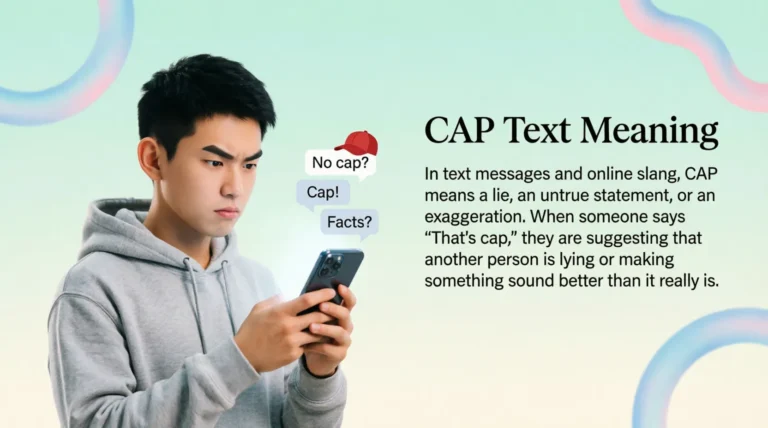
Have you ever received a text saying “No cap” or “That’s cap” and wondered what it means? In texting and internet slang, CAP means a lie, a false statement, or something that is not true.
People often use it to say that someone is lying, exaggerating, or not being honest. The word “cap” can also mean a joke or a playful accusation, depending on the conversation.
You may see CAP in text messages, WhatsApp chats, Instagram comments, TikTok videos, and Snapchat conversations.
It is especially useful to understand the related expressions “no cap” and “stop the cap,” which have slightly different uses. This guide explains the CAP text meaning, its slang origins, common examples, and how to reply when someone uses it.
You will also learn how context, emojis, and punctuation can change its tone.
| Term | Meaning |
|---|---|
| Slang term | CAP |
| Most common meaning | A lie or false claim |
| Related expression | No cap = no lie; honestly |
| Typical tone | Casual, playful, skeptical, or confrontational |
| Common usage | Text messages, social media, and online conversations |
Quick answer
What does CAP mean in text?
CAP means a lie or something untrue. If someone says “That’s cap,” they mean they do not believe what you said. If they say “No cap,” they mean they are being honest or serious.
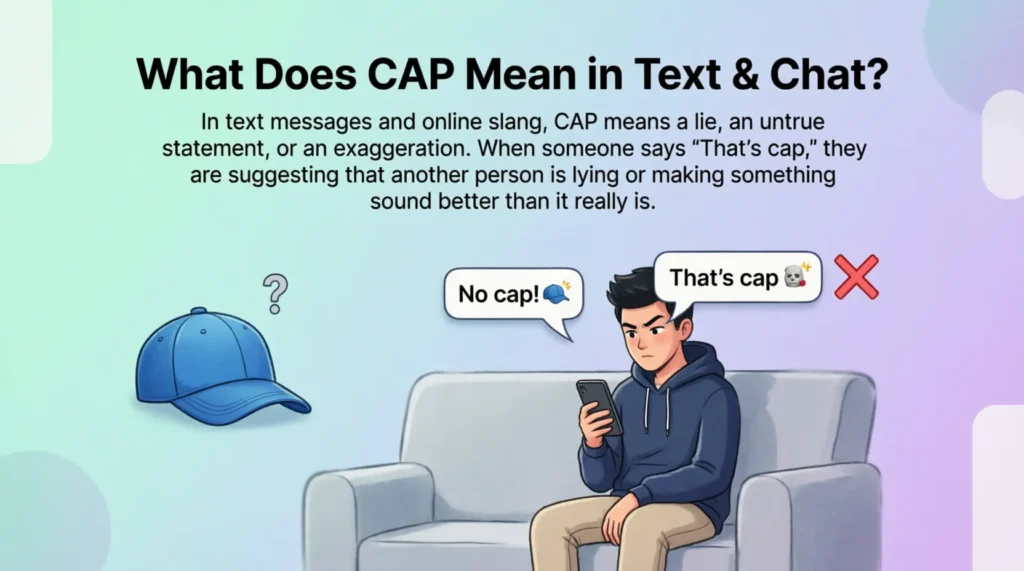
What Does CAP Mean in Text & Chat?
In text messages and online slang, CAP means a lie, an untrue statement, or an exaggeration. When someone says “That’s cap,” they are suggesting that another person is lying or making something sound better than it really is.
For example, imagine your friend says they finished a difficult exam in five minutes. You might reply, “That’s cap 😂.” This means you find their claim hard to believe.
CAP is informal slang. It is common in casual conversations where people joke, challenge each other’s stories, or emphasize whether something is true.
What Does “That’s Cap” Mean?
“That’s cap” means “That’s a lie” or “I don’t believe you.”
Person A: “I scored 100% on every test this year.”
Person B: “That’s cap 😂”
Meaning: Person B doubts the claim. The laughing emoji suggests playful disbelief rather than serious anger.
However, the same phrase can sound rude if the conversation is tense. Without a friendly tone or emoji, it may feel like a direct accusation.
What Does “No Cap” Mean?
“No cap” means “No lie,” “I’m telling the truth,” or “Honestly.”
For example:
Person A: “That was the best movie I’ve watched all year.”
Person B: “No cap, it was amazing!”
Meaning: Person B agrees and emphasizes that the statement is genuine.
CAP and no cap express opposite ideas in many slang conversations. CAP questions someone’s honesty, while no cap stresses that a statement is true.
Full Form, Stands For & Short Meaning of CAP
CAP is not usually an acronym in internet slang. It is an ordinary English word that has developed an informal slang meaning.
In casual texting, CAP means a lie, false claim, or exaggeration. There is no standard full form in which each letter stands for a separate word.
What Does Each Expression Mean?
| Expression | Simple meaning | Example |
|---|---|---|
| Cap | A lie or false claim | “That story is cap.” |
| That’s cap | That’s not true | “You finished already? That’s cap.” |
| No cap | Honestly; no lie | “This food is great, no cap.” |
| Stop the cap | Stop lying or exaggerating | “Stop the cap and tell me what happened.” |
| Capping | Lying or exaggerating | “Are you capping right now?” |
| You cappin’ | You’re lying or exaggerating | “You cappin’ if you think I believe that.” |
Is CAP an Acronym?
In its slang use, CAP is generally not an acronym. It does not stand for a phrase made from the letters C, A, and P.
The slang meaning is separate from other uses of the word “cap,” such as a hat, a limit, or a cover. Capital letters do not create a new meaning by themselves.
For example, someone might write “CAP,” “cap,” or “Cap” in a message. The intended slang meaning is usually the same if the surrounding conversation is about truth or lies.
What Is the Shortest Meaning of CAP?
The easiest way to remember it is:
- CAP: A lie.
- NO CAP: No lie; honestly.
- STOP THE CAP: Stop lying or exaggerating.
These short definitions cover the most common slang uses. The full conversation still matters because “cap” has other meanings in standard English.
Origin, History & First Known Use of CAP
The slang use of cap has roots in African American English and is associated with expressions about lying, boasting, and exaggeration. The phrase “no cap” later became widely familiar through music, online conversations, and social media.
However, slang rarely has one simple origin story. It is important to distinguish the documented history of a word from the way people use it today.
How Did CAP Become Slang?
The word “cap” has been used in informal expressions connected with lying or exaggeration. Related expressions, including “capping” and “no cap,” became part of conversational slang.
The exact path by which the word developed its modern meaning is not fully settled in everyday explanations of the term. Claims that one particular person invented it or that it began on a specific social media platform should be treated with caution.
How Did Social Media Spread CAP?
Music, videos, memes, and online conversations helped bring the expression to a wider audience. As people shared slang across communities, phrases such as “no cap” became familiar to many users who did not originally use them.
Today, CAP may appear in short comments, reaction videos, jokes, and private messages. Some people use it naturally, while others use it mainly because they have seen it online.
It is also worth remembering that a phrase can become popular beyond the community where it developed. Understanding its cultural roots helps readers recognize that internet slang does not simply appear from nowhere.
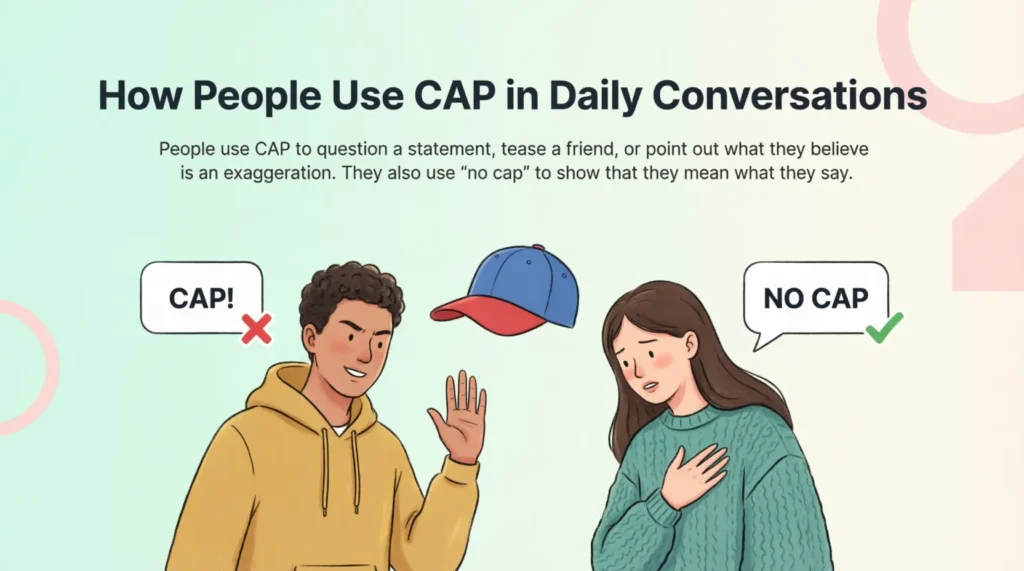
How People Use CAP in Daily Conversations
People use CAP to question a statement, tease a friend, or point out what they believe is an exaggeration. They also use “no cap” to show that they mean what they say.
The tone depends on the people involved and the subject of the conversation.
To Call Out a Lie
Person A: “I ran ten miles before breakfast today.”
Person B: “That’s cap. You told me you woke up five minutes ago! 😂”
Meaning: Person B thinks the story is untrue and uses humor to challenge it.
To Emphasize Honesty
Person A: “Was the restaurant really that good?”
Person B: “No cap, it’s one of the best places I’ve tried.”
Meaning: Person B is emphasizing that the praise is sincere.
To React to an Achievement
Person A: “I got the highest score in the class!”
Person B: “No cap? That’s awesome!”
Meaning: Person B is surprised and wants to know whether the news is true. Here, the question mark makes the message a request for confirmation.
To Challenge an Exaggeration
Person A: “I can finish that entire project in ten minutes.”
Person B: “Stop the cap and give yourself some time.”
Meaning: Person B thinks the claim is unrealistic.
CAP can be playful between close friends, but it may sound disrespectful when used to accuse someone of lying about something important. When the topic is serious, clear language is often better than slang.
CAP Meaning Across WhatsApp, Instagram, TikTok & Snapchat
CAP usually has the same slang meaning across major social platforms: a lie, an exaggeration, or a statement the speaker does not believe. The platform may change the situation, but it does not normally change the core definition.
| Platform | Example | Likely meaning |
|---|---|---|
| “That’s cap 😂” | I don’t believe you | |
| “No cap, your outfit looks great.” | I’m being honest | |
| TikTok | “This video is cap.” | The claim in the video seems false |
| Snapchat | “Stop the cap!” | Stop lying or exaggerating |
| Discord | “You’re capping.” | You’re not telling the truth |
CAP on WhatsApp
In WhatsApp messages, CAP may appear when friends share stories or challenge each other’s claims.
For example, “No cap, I really saw him there” means the sender insists that the story is true.
CAP on Instagram and TikTok
On Instagram, people may use “no cap” to emphasize a compliment or opinion. On TikTok, CAP may appear in comments reacting to a video or a claim made by a creator.
A comment such as “This has to be cap” means the viewer doubts the claim. It does not prove that the video is false; it only shows the commenter’s reaction.
CAP on Snapchat and Discord
On Snapchat, CAP can be used in quick exchanges between friends. In Discord communities, it may appear in gaming chats, discussions, and jokes.
Across all these platforms, context is important. A laughing emoji may make the accusation playful, while a serious statement without an emoji may sound more direct.
Different Meanings of CAP in Other Fields
Although CAP commonly means “a lie” in slang, the word has several unrelated meanings in standard English and specialized fields. These meanings should not be confused with the slang definition.
CAP as a Hat or Cover
In everyday English, a cap is a type of hat or a cover placed over an object.
For example, “Put the cap back on the bottle” refers to a physical cover, not a lie.
CAP as a Limit or Maximum
Cap can also mean a limit on an amount, number, or level.
For example, “There is a spending cap of $100” means the spending limit is $100.
In online discussions, someone might say “There’s a cap on the number of entries.” This is a standard use of the word rather than internet slang.
CAP in Business, Education, and Technology
CAP may appear as an acronym in different professional fields. Its full form depends on the specific subject, organization, or technical system.
For instance, the word may be part of the name of a certification, program, or technical concept. It would be misleading to give one universal full form for every field.
| Context | Meaning |
|---|---|
| Internet slang | A lie or exaggeration |
| Clothing | A type of hat |
| Objects | A cover or closure |
| Rules or budgets | A limit or maximum |
| Technical or professional writing | Depends on the specific acronym |
When CAP appears in a casual message about whether a story is true, the slang meaning is likely. When it appears in a technical report or a sentence about a limit, another definition may fit better.
Common Confusions, Mistakes & Wrong Interpretations
CAP is easy to learn, but several common misunderstandings can lead to confusion.
Confusing CAP With NO CAP
These expressions usually communicate opposite ideas.
- “That’s cap” means “That’s a lie.”
- “No cap” means “I’m telling the truth.”
For example, “This is the best burger ever, no cap” means the speaker genuinely thinks the burger is excellent.
Thinking CAP Always Means a Serious Lie
CAP can refer to a small exaggeration, a joke, or a claim that sounds unbelievable. It does not always mean someone has told a deliberate or harmful lie.
A friend might say, “You’re capping 😂” after hearing an unlikely story. That could be playful teasing rather than a serious accusation.
Assuming CAP Is Always Rude
The word can sound rude if it challenges someone’s honesty during a serious conversation. However, it can also be friendly or humorous among people who often joke with each other.
Compare these messages:
- “That’s cap 😂” may sound playful.
- “Stop the cap.” may sound firm.
- “You’re lying to me, and you know it.” is a much more direct accusation.
The words, punctuation, and relationship all affect the tone.
Treating CAP as a Full Form
In slang, CAP is generally a word rather than an acronym. It does not have one official expansion for each letter.
If someone asks what CAP stands for in a specific workplace or technical document, the answer may depend on that context. In a casual text, it usually refers to a lie or exaggeration.
Similar Terms, Alternatives & Related Slang
Several slang terms have meanings close to CAP, but they are not all interchangeable.
| Term | Meaning | How it differs from CAP |
|---|---|---|
| No cap | Honestly; no lie | Emphasizes truth |
| Capping | Lying or exaggerating | Describes the action |
| Lying | Saying something untrue | More direct and widely understood |
| BS | Nonsense or something believed to be untrue | Can sound harsher or more vulgar |
| For real (FR) | Seriously; genuinely | Often asks for or confirms truth |
| Fake | Not genuine or not real | Can describe an object, account, story, or claim |
| Sus | Suspicious or questionable | Expresses doubt without directly saying someone lied |
| Facts | That’s true; I agree | Often expresses agreement |
| Bet | Okay; agreed | Usually signals acceptance, not honesty |
| Stop the cap | Stop lying or exaggerating | Directly challenges a claim |
What Is the Difference Between CAP and FR?
CAP means a lie or false claim. FR usually means “for real” and can express surprise, agreement, or a request for confirmation.
For example:
Person A: “I met my favorite singer yesterday.”
Person B: “FR? That’s amazing!”
Here, Person B is asking whether the statement is true. If they instead said “That’s cap,” they would be expressing doubt.
What Is the Difference Between CAP and SUS?
SUS means suspicious or questionable. CAP is a more direct way to suggest that a statement is untrue.
For example, “That story sounds sus” means something about the story seems suspicious. “That’s cap” more clearly suggests that the speaker does not believe it.
Examples of CAP in Real Chat Situations
These examples show how CAP and related expressions work in everyday messages.
1. Playful Disbelief
Person A: “I finished all my homework in three minutes.”
Person B: “That’s cap 😂”
Meaning: Person B thinks the claim is unlikely and is teasing the other person.
2. Emphasizing the Truth
Person A: “Do you really like this song that much?”
Person B: “No cap, I’ve listened to it twenty times today.”
Meaning: Person B is emphasizing genuine enthusiasm.
3. Reacting to an Achievement
Person A: “I just got accepted into my first-choice university!”
Person B: “No cap? That’s incredible! 🎉”
Meaning: Person B is surprised and wants confirmation before celebrating.
4. Calling Out an Exaggeration
Person A: “Everyone in town knows my name.”
Person B: “You’re capping a little 😂”
Meaning: Person B thinks the statement is exaggerated, but the laughing emoji keeps the tone light.
5. Giving an Honest Compliment
Person A: “Do you think my presentation went well?”
Person B: “No cap, you did a great job.”
Meaning: Person B is stressing that the compliment is sincere.
6. Responding to a Suspicious Claim
Person A: “This app says I can become fluent in a language overnight.”
Person B: “That sounds like cap. Learning takes practice.”
Meaning: Person B doubts the claim. The message challenges the statement rather than attacking a person.
7. A Serious Conversation
Person A: “You said you sent the payment yesterday.”
Person B: “I did.”
Person A: “Stop the cap. I checked the account.”
Meaning: The phrase sounds confrontational because the discussion involves a serious matter.
8. Using CAP as a Joke Between Friends
Person A: “I make the best pizza in the world.”
Person B: “Cap 😂 I haven’t even tried your pizza yet.”
Meaning: Person B is joking about an exaggerated claim rather than making a serious accusation.
How to Reply When Someone Says CAP
Your response depends on whether the other person is joking, questioning your honesty, or discussing something serious.
If Someone Says “That’s Cap”
If you are telling the truth, you can reply:
- “No cap, I’m serious.”
- “I’m telling you the truth!”
- “I can show you if you don’t believe me.”
- “Believe it or not, it really happened.”
If you were joking, you could say:
- “Okay, you caught me 😂”
- “I’m just messing with you.”
- “Fine, maybe I exaggerated a little.”
If Someone Says “No Cap”
You can respond naturally with:
- “For real!”
- “I believe you.”
- “Same here, no cap.”
- “Honestly, I agree.”
For example, if a friend says, “No cap, that was the best day ever,” you might reply, “For real! We should do it again.”
If Someone Says “Stop the Cap”
If the conversation is playful, you can respond with humor. If the topic is serious, it is better to explain what happened clearly.
Possible replies include:
- “I’m not lying. Let me explain.”
- “I understand why it sounds unbelievable.”
- “I was joking, sorry if that wasn’t clear.”
- “Let’s talk about what actually happened.”
If the Message Feels Rude
You do not have to respond with slang or argue about who is right.
You could say, “I’m being honest, but you don’t have to believe me,” or “Let’s discuss this without accusing each other.”
A calm response can help prevent a small misunderstanding from turning into a bigger conflict.
Is CAP Still Popular? Trends & Online Usage
CAP and expressions such as “no cap” remain recognizable parts of internet slang. However, their use varies among communities, age groups, and platforms. It would be inaccurate to claim that every social media user uses these terms or that their popularity is rising without reliable trend data.
Why Do People Use CAP?
CAP is short and expressive. It lets people challenge a claim without writing a long sentence.
People use it to:
- Call out a statement they believe is false.
- Tease friends about exaggerated stories.
- Emphasize that they are telling the truth.
- React to surprising claims online.
- Add humor to comments and private messages.
The related expression “no cap” is especially useful when someone wants to stress that an opinion or statement is genuine.
Is CAP Used by Gen Z?
CAP and “no cap” are associated with modern internet slang and are familiar to many younger social media users. However, slang use is not limited to one generation, and not every member of Gen Z uses the same expressions.
The best way to understand a slang term is to look at how people use it in context rather than assume that everyone in a certain age group knows it.
Should You Use CAP in 2026?
You can use CAP in casual chats with friends who understand the expression. It works well in jokes, comments, and informal messages.
In professional emails, school assignments, or serious conversations, clearer phrases such as “That isn’t true” or “I’m being honest” may be more suitable.
CAP is useful when the tone is right, but clear communication matters more than using trendy slang.
Frequently Asked Questions
What does CAP mean in text?
CAP means a lie, false statement, or exaggeration in internet slang. “That’s cap” means “That’s not true,” while “no cap” means “I’m being honest.”
What does NO CAP mean in texting?
NO CAP means “no lie,” “honestly,” or “I’m telling the truth.” People use it to emphasize that a statement or opinion is genuine.
What does “stop the cap” mean?
“Stop the cap” means “Stop lying” or “Stop exaggerating.” It can be playful among friends or serious during an argument.
Is CAP a bad word?
No. CAP is not generally considered a swear word. However, saying “That’s cap” can sound rude if it suggests that someone is lying about something important.
What does CAP mean on TikTok?
On TikTok, CAP usually means a lie or an exaggerated claim. A comment such as “This is cap” shows that the commenter doubts what the video claims.
Does CAP stand for anything?
In slang, CAP is generally a word, not an acronym. It means a lie or false claim. In professional settings, CAP may be an acronym with a meaning specific to the field.
What is the difference between CAP and CAPPING?
CAP is the slang noun used for a lie or false claim. CAPPING describes the act of lying or exaggerating. For example, “That’s cap” and “You’re capping” express similar ideas in different grammatical forms.
How do I reply when someone calls me a liar using CAP?
If you are telling the truth, explain your point calmly or offer evidence if appropriate. If you were joking, you can clarify that you were not being serious. Your reply should match the situation.
Is CAP the same as fake?
Not exactly. CAP usually refers to a lie or false claim, while fake can describe something that is not genuine, such as a fake account, fake product, or fake story.
Can CAP be used in a professional message?
It is usually better to avoid slang such as CAP in formal communication. Phrases like “That information appears to be incorrect” or “I want to clarify what happened” sound clearer and more professional.
Conclusion
CAP in text means a lie, an untrue statement, or an exaggeration. When someone says “That’s cap,” they are expressing doubt or suggesting that something is not true.
In contrast, “no cap” means “honestly” or “no lie,” while “stop the cap” asks someone to stop lying or exaggerating.
The expression is common in casual online conversations, including text messages, social media comments, and gaming chats.
Its tone can be playful, skeptical, or confrontational, depending on the situation. A laughing emoji may make it feel like friendly teasing, while the same words in a serious argument may sound rude.
Now that you understand the CAP text meaning, you can recognize it more easily in everyday chats. Remember to consider the context before replying, and explore related slang terms such as FR, SUS, and TBH to improve your understanding of online conversations.

Alden Rowen is the author behind Meanings Path, sharing clear and reliable insights into the meanings, origins, and significance of words, names, and phrases. His goal is to make language simple, useful, and easy to understand.