If you’ve seen IDT in a text message, social media comment, or online chat, you’re probably wondering what it means.
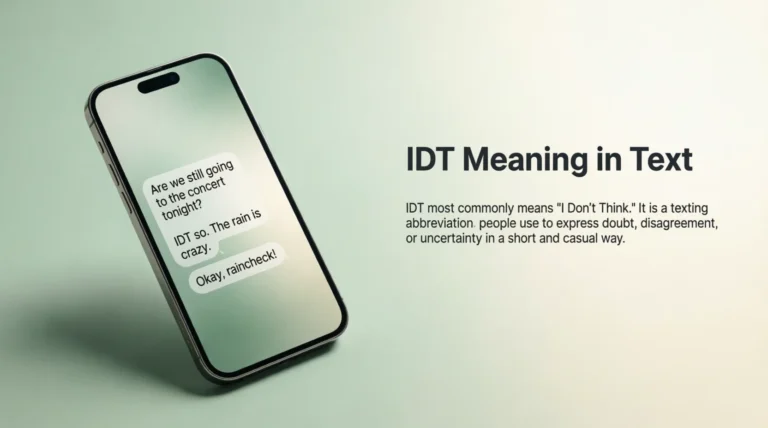
In most casual conversations, IDT stands for “I Don’t Think.” People use it as a quick way to share an opinion, express uncertainty, or politely disagree without typing the full phrase.
You’ll commonly find IDT on WhatsApp, Instagram, Snapchat, TikTok, Discord, and in everyday SMS conversations.
Its meaning usually stays the same, but the tone can change depending on the message, emojis, punctuation, and the relationship between the people chatting.
This guide explains the most common meaning of IDT, its full form, how people use it, where you might see it, possible alternative meanings, reply ideas, common mistakes, and real chat examples to help you understand it with confidence.
| Term | Most Common Meaning | Full Form | Typical Tone | Common Usage |
|---|---|---|---|---|
| IDT | I Don’t Think | I Don’t Think | Neutral, thoughtful, polite, sometimes sarcastic | Text messages, chats, social media, online conversations |
Quick Answer:
IDT most commonly means “I Don’t Think.” It is a texting abbreviation people use to express doubt, disagreement, or uncertainty in a short and casual way.
What Does IDT Mean in Text & Chat?
In text messaging, IDT almost always means “I Don’t Think.”
Instead of typing the full sentence, people shorten it to save time. The abbreviation introduces an opinion rather than stating something as a definite fact.
For example:
- “IDT it’s going to rain.”
- “IDT that’s the right answer.”
- “IDT we should leave yet.”
Using IDT often makes a message sound softer than directly saying “No.” It leaves room for discussion and shows that the speaker is sharing their viewpoint rather than making a firm statement.
The tone depends on context:
| Situation | Tone |
|---|---|
| Giving an opinion | Neutral |
| Friendly conversation | Casual |
| Playful debate | Light-hearted |
| Argument | Can sound dismissive |
| With laughing emojis | Joking |
| With periods or all caps | More serious or stronger |
For example:
- “IDT 😂” feels playful.
- “IDT.” sounds firmer.
- “IDT that’s true 😊” sounds polite.
Full Form, Stands For & Short Meaning of IDT
The full form of IDT in texting is:
IDT = I Don’t Think
Short Meaning
It simply means:
- I don’t believe so.
- I doubt it.
- I don’t think that’s correct.
- I’m not sure that’s true.
It is often used before giving an opinion.
Examples:
- “IDT she’s coming today.”
- “IDT this app works offline.”
- “IDT we’ll finish before dinner.”
Although this is the most common meaning, IDT can represent different phrases in technical, business, or organizational settings. Those meanings depend entirely on the conversation and should not be confused with the everyday texting abbreviation.
Origin, History & First Known Use of IDT
Like many internet abbreviations, IDT developed naturally as people looked for faster ways to type common phrases during online conversations.
It became more common alongside instant messaging, texting, chat rooms, and mobile messaging. Because “I don’t think” is a phrase people use frequently, shortening it to three letters made conversations quicker.
There is no widely accepted or verified record identifying exactly who created IDT or the precise date it first appeared. Rather than being invented by a single person, it seems to have spread gradually through everyday online communication.
Today, it remains one of many informal abbreviations that help people write faster while keeping conversations natural.
How People Use IDT in Daily Conversations
People usually use IDT when expressing uncertainty, disagreement, or personal opinion.
Expressing Doubt
Person A: “Will the meeting finish early?”
Person B: “IDT it will. 😊”
Meaning: The speaker doubts it.
Politely Disagreeing
Person A: “This is the best movie ever.”
Person B: “IDT it’s my favorite.”
Meaning: A respectful difference of opinion.
Being Unsure
Person A: “Did Jake already leave?”
Person B: “IDT so.”
Meaning: The speaker isn’t completely certain.
Playful Conversation
Person A: “You’re going to beat me at the game.”
Person B: “IDT 😂”
Meaning: Friendly teasing or modesty.
Emojis often make the message feel warmer, while punctuation like “IDT.” can sound more final.
IDT Meaning Across WhatsApp, Instagram, TikTok & Snapchat
The meaning of IDT usually stays consistent across major social platforms.
| Platform | Typical Meaning |
|---|---|
| I Don’t Think | |
| I Don’t Think | |
| TikTok | I Don’t Think |
| Snapchat | I Don’t Think |
| Discord | I Don’t Think |
| SMS | I Don’t Think |
Although the abbreviation remains the same, the style of conversation changes.
Often used in everyday conversations with friends and family.
Example:
“IDT we’ll make it before 8.”
Appears in comments, direct messages, or replies.
Example:
“IDT that’s what happened.”
TikTok
Often used while reacting to videos or debating opinions.
Example:
“IDT that’s real 😂”
Snapchat
Usually appears in quick, informal chats.
The meaning rarely changes across these platforms. The surrounding conversation provides the real context.
Different Meanings of IDT in Other Fields
Outside texting, IDT may stand for different terms depending on the industry.
Some examples include:
| Field | Possible Meaning |
|---|---|
| Business | Company initials |
| Technology | Product or system abbreviation |
| Education | Department or course abbreviation |
| Organizations | Name of an institution |
These meanings are unrelated to texting.
When someone writes:
“IDT you’re right.”
they almost certainly mean “I Don’t Think,” not a technical abbreviation.
Always use the surrounding conversation to determine the intended meaning.
Common Confusions, Mistakes & Wrong Interpretations
One common mistake is assuming every abbreviation has only one meaning.
With IDT, context matters.
People sometimes confuse it with other abbreviations like:
- IDC — I Don’t Care
- IDK — I Don’t Know
- IMO — In My Opinion
- IMHO — In My Humble Opinion
These phrases express different ideas.
| Abbreviation | Meaning |
|---|---|
| IDT | I Don’t Think |
| IDK | I Don’t Know |
| IDC | I Don’t Care |
| IMO | In My Opinion |
Another misunderstanding is reading IDT as rude.
On its own, it is usually neutral. However, messages like:
“IDT you’re listening.”
may sound critical depending on tone and context.
Similar Terms, Alternatives & Related Slang
People often use these alternatives instead of IDT:
- I doubt it
- Probably not
- Doesn’t seem likely
- I don’t believe so
- Maybe not
- I guess not
- Not really
- I don’t think so
These expressions carry similar meanings but vary in certainty and tone.
For example:
“I doubt it” may sound stronger than “IDT.”
“Maybe not” often sounds softer.
Choosing the right phrase depends on how confident or polite someone wants to be.
Examples of IDT in Real Chat Situations
Example 1: Friendly Opinion
Person A: “Do you think they’ll cancel school?”
Person B: “IDT they will. 😊”
Tone: Neutral and friendly.
Example 2: Playful Joke
Person A: “You’re definitely winning tonight.”
Person B: “IDT 😂”
Tone: Playful and modest.
Example 3: Respectful Disagreement
Person A: “That rumor is true.”
Person B: “IDT that’s accurate.”
Tone: Calm disagreement.
Example 4: Uncertainty
Person A: “Did Emma call already?”
Person B: “IDT so.”
Tone: Unsure but helpful.
Example 5: Slight Frustration
Person A: “You forgot again.”
Person B: “IDT that’s fair.”
Tone: Defensive but not necessarily rude.
How to Reply When Someone Says IDT
Your reply depends on the conversation.
| Situation | Good Reply |
|---|---|
| Serious discussion | “Why do you think that?” |
| Friendly chat | “Maybe you’re right.” |
| Playful joke | “We’ll see 😂” |
| Confusion | “What makes you think that?” |
| Possible disagreement | “That’s fair. I see it differently.” |
Examples:
Serious
Person A: “IDT that’s the best option.”
Person B: “Can you explain your reasoning?”
Playful
Person A: “IDT you’ll beat me.”
Person B: “Challenge accepted! 😄”
Confused
Person A: “IDT.”
Person B: “What do you mean?”
Respectful
Person A: “IDT that’s correct.”
Person B: “Thanks for sharing your opinion.”
Is IDT Still Popular? Trends & Online Usage
Yes, IDT is still used in casual digital conversations, although many people now type the full phrase, especially because modern smartphones offer fast typing and predictive text.
The abbreviation remains common among users who prefer short messages or quick replies. It is most often seen in personal chats, online discussions, gaming communities, and social media comments.
Unlike some internet slang that becomes outdated quickly, IDT continues to be easy to understand because it represents a simple everyday phrase.
That said, usage varies by age, writing style, and personal preference. Some people never abbreviate it, while others use it regularly in informal conversations.
Frequently Asked Questions
What does IDT mean in a text message?
In most text messages, IDT means “I Don’t Think.” It expresses doubt, disagreement, or uncertainty.
Is IDT rude?
Not usually. It is generally neutral. However, depending on wording and tone, it can sound dismissive or critical.
Does IDT mean the same thing on Snapchat and Instagram?
Yes. On both platforms, it almost always means “I Don’t Think.” The surrounding conversation determines the tone.
How should I reply to IDT?
Reply based on the context. You can ask for clarification, agree politely, explain your opinion, or respond playfully if the conversation is lighthearted.
Is IDT the same as IDK?
No.
- IDT = I Don’t Think
- IDK = I Don’t Know
One expresses an opinion, while the other expresses a lack of knowledge.
Can IDT have other meanings?
Yes. In specialized fields, IDT can represent different organizations, products, or technical terms. In everyday texting, though, it almost always means “I Don’t Think.”
Conclusion
The most common IDT meaning in text is “I Don’t Think.” It’s a simple abbreviation people use to express doubt, uncertainty, or a polite opinion without typing the full phrase.
Whether you’re chatting on WhatsApp, Instagram, TikTok, Snapchat, Discord, or through regular text messages, the meaning usually stays the same.
Even so, context is always important. The surrounding words, emojis, punctuation, and relationship between the people involved can make IDT sound serious, playful, sarcastic, or simply thoughtful.
Understanding those small cues helps you interpret the message correctly and respond naturally.
As you come across more internet abbreviations and chat slang, you’ll find that learning their meanings makes online conversations faster, clearer, and much easier to follow.

Alden Rowen is the author behind Meanings Path, sharing clear and reliable insights into the meanings, origins, and significance of words, names, and phrases. His goal is to make language simple, useful, and easy to understand.