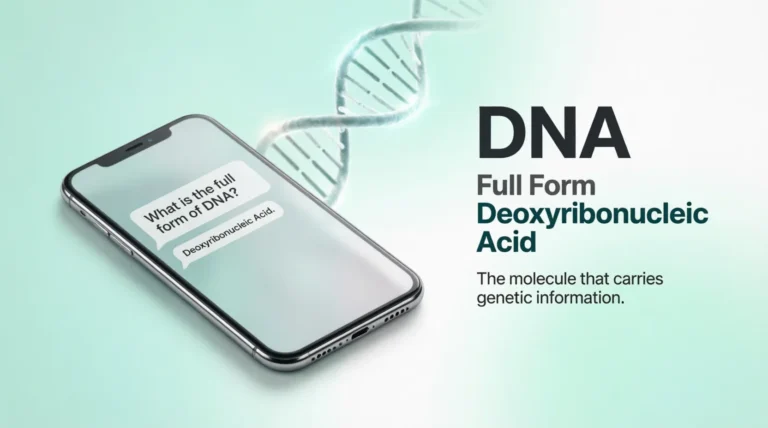
The DNA full form is Deoxyribonucleic Acid.
It is one of the most important biological terms because DNA carries the genetic instructions that determine how living organisms grow, function, and reproduce.
People often search for the DNA full form for school assignments, competitive exams, interviews, general knowledge, or simply to understand how genetics works.
Unlike internet abbreviations or chat slang, DNA is a scientific acronym with a single widely accepted meaning.
You may come across it in biology textbooks, medical reports, crime investigations, ancestry testing, and health-related discussions.
In this guide, you’ll learn the complete DNA full form, its meaning, history, uses, examples, common misconceptions, and why it remains one of the most significant discoveries in modern science.
| Term | Most Common Meaning | Full Form | Typical Tone | Common Usage |
|---|---|---|---|---|
| DNA | Genetic material in living organisms | Deoxyribonucleic Acid | Scientific and educational | Biology, medicine, genetics, forensic science, healthcare |
What Does DNA Mean in Text & Chat?
Direct Answer
In everyday conversations, DNA almost always refers to Deoxyribonucleic Acid, the molecule that contains genetic information in humans, animals, plants, and many other living organisms.
Outside science, people sometimes use DNA as a metaphor. For example, someone might say, “Innovation is in our company’s DNA.” In this context, DNA means a core characteristic or an essential part of something rather than the biological molecule.
Common Meanings in Conversations
| Context | Meaning |
|---|---|
| Biology | Genetic material |
| Healthcare | Hereditary information |
| Crime shows | DNA evidence |
| Family discussions | Shared inherited traits |
| Business | Core identity or culture |
| Sports | Natural style or tradition |
The intended meaning is usually clear from the surrounding conversation.
Full Form, Stands For & Short Meaning of DNA
DNA Full Form
DNA stands for Deoxyribonucleic Acid.
It is the hereditary material found in nearly every cell of the human body. DNA stores genetic instructions that help cells build proteins, grow, repair themselves, and reproduce.
Short Meaning
In simple words, DNA is the body’s instruction manual.
It tells cells:
- How to grow
- How to function
- Which proteins to produce
- Which inherited characteristics to develop
Direct Answer Box
DNA Full Form: Deoxyribonucleic Acid
Meaning: The molecule that stores and passes genetic information from one generation to the next.
Used In: Biology, genetics, medicine, biotechnology, forensic science, and ancestry research.
Origin, History & First Known Use of DNA
The term Deoxyribonucleic Acid comes from chemistry.
- Deoxy refers to one of the sugars found in the molecule.
- Ribo relates to ribose, a type of sugar.
- Nucleic indicates that the substance was first identified in the cell nucleus.
- Acid describes its chemical properties.
Scientists gradually uncovered DNA’s importance through decades of research. Over time, researchers demonstrated that DNA carries hereditary information, and later work revealed its famous double-helix structure. These discoveries transformed biology, medicine, agriculture, and genetics.
Rather than appearing suddenly, the understanding of DNA developed through many scientific breakthroughs supported by evidence and experimentation.
Today, DNA research continues to improve disease diagnosis, personalized medicine, crop development, and genetic research.
How People Use DNA in Daily Conversations
Although DNA is a scientific word, it appears surprisingly often in everyday language.
Scientific Use
People discuss DNA when talking about:
- Genetics
- Family resemblance
- Medical conditions
- Biology classes
- Laboratory research
Example:
Person A: “The doctor recommended a DNA test.”
Person B: “That may help identify inherited conditions.”
Figurative Use
People also use DNA to describe something fundamental.
Examples include:
- “Creativity is in her DNA.”
- “Customer service is part of our company’s DNA.”
- “Winning has always been in the team’s DNA.”
In these cases, DNA symbolizes something deeply rooted rather than literal genetics.
DNA Meaning Across WhatsApp, Instagram, TikTok & Snapchat
Unlike many online abbreviations, the meaning of DNA remains almost identical across social media platforms.
| Platform | Typical Meaning |
|---|---|
| Genetics or family discussions | |
| Health, science, fitness, or metaphorical identity | |
| TikTok | Educational videos, ancestry, health topics, or jokes about inherited traits |
| Snapchat | Casual conversations about family or science |
The platform itself rarely changes the meaning.
However, the surrounding caption, emojis, or hashtags can make the tone more serious or playful.
Examples:
- “Good music is in my DNA 🎵” (playful)
- “DNA results are finally here.” (serious)
- “Adventure is in our DNA 🌍” (figurative)
Different Meanings of DNA in Other Fields
The primary meaning of DNA is always Deoxyribonucleic Acid, but people also use “DNA” figuratively across many industries.
| Field | Meaning |
|---|---|
| Biology | Genetic material |
| Medicine | Genetic testing and inherited conditions |
| Forensic science | Identification through biological evidence |
| Business | Company culture or identity |
| Marketing | Brand personality |
| Sports | Long-standing traditions or values |
These figurative meanings build on the scientific idea that DNA represents something essential and defining.
There is no widely accepted alternative full form that replaces Deoxyribonucleic Acid in general usage.
Common Confusions, Mistakes & Wrong Interpretations
Some people misunderstand DNA because they hear it used in different situations.
Common misconceptions include:
- Thinking DNA has different official full forms.
- Assuming every DNA test reveals every future disease.
- Believing DNA is found only in humans.
- Confusing DNA with RNA.
Quick Comparison
| DNA | RNA |
|---|---|
| Stores genetic information | Helps use genetic information |
| Usually double-stranded | Usually single-stranded |
| Long-term genetic storage | Protein production and regulation |
Understanding the context helps prevent these common mistakes.
Similar Terms, Alternatives & Related Slang
DNA is not internet slang, but several related scientific terms often appear alongside it.
- Gene
- Genome
- Chromosome
- RNA
- Genetics
- Heredity
- Mutation
- Genetic code
These words describe different parts of genetics rather than acting as substitutes for DNA.
People may also casually say:
- “Genetic blueprint”
- “Inherited code”
- “Biological instructions”
These phrases explain DNA but are not official scientific replacements.
Examples of DNA in Real Chat Situations
Example 1: School Discussion
Person A: “Do you know the DNA full form?”
Person B: “Yes! It stands for Deoxyribonucleic Acid. 😊”
Meaning: Educational conversation.
Example 2: Family Conversation
Person A: “You smile exactly like your grandfather.”
Person B: “I guess it’s in my DNA! 😄”
Meaning: Playful reference to inherited traits.
Example 3: Business Meeting
Person A: “Helping customers is part of our DNA.”
Person B: “That’s what makes our brand different.”
Meaning: DNA represents core company values.
Example 4: Medical Discussion
Person A: “The doctor suggested DNA testing.”
Person B: “That could provide useful genetic information.”
Meaning: Serious healthcare context.
How to Reply When Someone Says DNA
Your reply depends entirely on the context.
| Situation | Suitable Reply |
|---|---|
| Biology discussion | “DNA stands for Deoxyribonucleic Acid.” |
| Medical conversation | “I hope the test provides helpful answers.” |
| Joke | “Looks like it’s in your genes! 😄” |
| Business meeting | “That sounds like one of your core values.” |
| If confused | “Do you mean genetics or something figurative?” |
Unlike slang abbreviations, DNA is rarely rude or offensive. The tone depends almost entirely on the surrounding conversation.
Is DNA Still Popular? Trends & Online Usage
DNA remains one of the most searched scientific abbreviations because it appears in education, healthcare, genealogy, biotechnology, and media.
Interest increases whenever people discuss:
- Family ancestry
- Genetic testing
- Medical research
- Crime investigations
- Personalized medicine
- Biology education
Unlike internet slang that changes over time, the meaning of DNA has remained stable for decades because it is an internationally recognized scientific term.
Its figurative use in business, sports, and marketing has also become increasingly common, making the term familiar even outside science.
Frequently Asked Questions
What is the DNA full form?
DNA stands for Deoxyribonucleic Acid, the molecule that stores genetic information in living organisms.
What does DNA do?
DNA contains the instructions that guide growth, development, reproduction, and normal body functions by directing how proteins are made.
Is DNA only found in humans?
No. DNA is found in humans, animals, plants, fungi, and many microorganisms.
Does DNA have different meanings?
Its primary and official meaning is Deoxyribonucleic Acid. People may also use “DNA” figuratively to describe a person’s or organization’s core identity.
Is DNA a slang term?
No. DNA is a scientific acronym, although it is sometimes used metaphorically in everyday language.
Why is DNA important?
DNA carries hereditary information, helping pass genetic traits from parents to offspring while supporting the growth and function of living organisms.
Conclusion
The DNA full form is Deoxyribonucleic Acid, the molecule that stores and passes genetic information in nearly all living organisms.
It is essential to biology, medicine, genetics, forensic science, and many other fields.
While its scientific meaning remains the same everywhere, people also use DNA metaphorically to describe the core identity or defining characteristics of a person, organization, or idea.
Understanding DNA helps explain how inherited traits are passed from one generation to the next and why genetic research has become so important in modern healthcare.
Whether you encounter the term in a classroom, a medical discussion, a news article, or a casual conversation, knowing its meaning makes it much easier to understand the context.
If you’re interested in scientific abbreviations or educational terminology, exploring related genetics and biology terms is a great next step.

Alden Rowen is the author behind Meanings Path, sharing clear and reliable insights into the meanings, origins, and significance of words, names, and phrases. His goal is to make language simple, useful, and easy to understand.