
The word “said” is one of the most common reporting verbs in English.
It is correct, simple, and useful, but using it too often can make your writing feel repetitive.
Learning other ways to say said in writing can help you make your stories, essays, emails, reports, and professional messages more clear and interesting.
The best synonym depends on the speaker’s meaning and tone.
For example, “explained” gives more detail, while “whispered” shows a quiet voice. “Argued” can show disagreement, while “stated” sounds more formal.
In this guide, you will learn 17 useful alternatives to said, including formal ways to say said, casual options, and phrases that add emotion or detail.
| Word/Phrase | Main Purpose | Common Tone |
|---|---|---|
| Said | General speech | Neutral |
| Explained | Gives information | Clear |
| Stated | Gives a fact or position | Formal |
| Mentioned | Refers to something briefly | Neutral |
| Replied | Answers someone | Neutral |
| Added | Gives extra information | Neutral |
| Asked | Requests information | Neutral |
| Argued | Gives a strong opinion | Emphatic |
What Does “Said” Mean?
“Said” is the past tense and past participle of “say.” It is a reporting verb used to show what someone spoke or communicated.
For example:
Maria said, “I will call you later.”
Here, “said” tells the reader that Maria spoke those words.
You can use said before, after, or around direct speech:
- John said, “I am ready.”
- “I am ready,” John said.
- “I am ready,” said John.
You can also use it with reported speech:
- She said that she was tired.
- He said he would arrive soon.
Because said is neutral, it works in almost every type of writing. However, repeating it many times can make longer writing less varied. That is why writers use synonyms for said when another verb gives the reader more useful information.
When to Use “Said”
Said is appropriate in almost any situation.
Formal writing
You can use said in reports, academic writing, news writing, and professional communication.
Example:
The manager said that the project would continue next month.
However, formal writing may sometimes benefit from words such as stated, explained, or reported when they describe the speaker’s purpose more precisely.
Informal writing
Said is very natural in texts, emails, conversations, and social media.
Example:
She said she was coming over later.
There is no need to replace said simply because you want to sound more advanced. Clear writing is usually better than complicated writing.
Creative writing
In stories, writers may use alternatives to said to show emotion, volume, or intention.
For example:
“Leave me alone!” he shouted.
The word shouted gives the reader information that said does not.
Is “Said” Professional and Polite to Say?
Yes. “Said” is completely professional and polite.
There is nothing wrong with using it in business writing. In fact, it is often better to use a simple word than a dramatic synonym that does not fit the situation.
For example:
The client said that she needed more time.
This sounds professional and natural.
You could also write:
The client stated that she needed more time.
This sounds slightly more formal.
The important point is accuracy. Do not use argued, insisted, or admitted unless the person actually argued, insisted, or admitted something.
In professional writing, choose the verb that describes the communication accurately.
Pros and Cons of Using “Said”
Pros
- Simple: Everyone understands it.
- Neutral: It does not add unnecessary emotion.
- Professional: It works well in business and academic writing.
- Flexible: It works with direct and reported speech.
- Natural: Native speakers use it very often.
Cons
- Repetition: Using it too often can become boring.
- Less detail: It may not show how something was communicated.
- Limited emotion: It does not tell readers whether someone whispered, shouted, or argued.
- Less descriptive: Creative writing may need stronger reporting verbs.
The goal is not to remove said from your writing. The goal is to use it when it is the best choice and use an alternative when another word adds useful meaning.
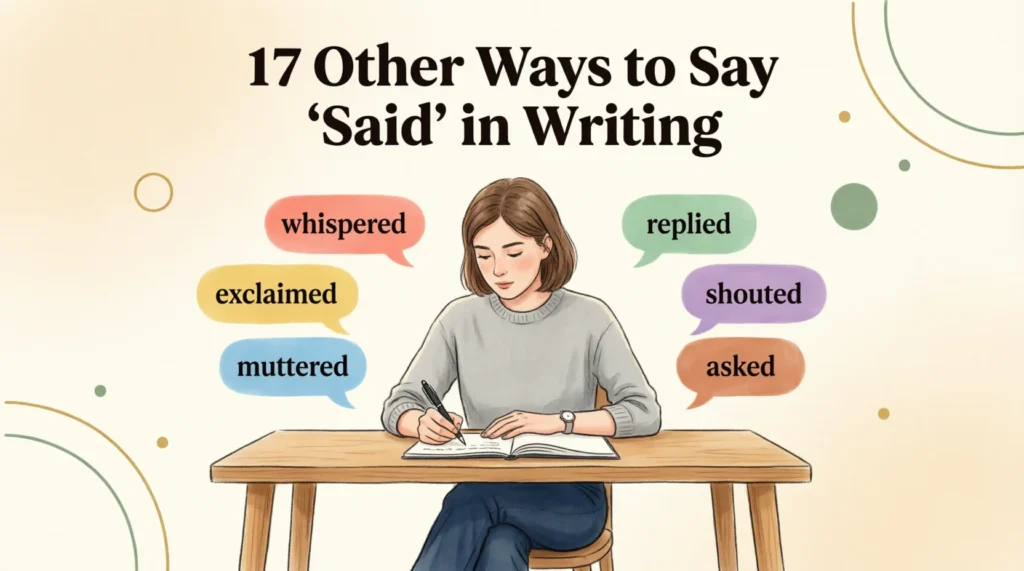
17 Other Ways to Say “Said” in Writing
1. Stated
Meaning: To express something clearly and directly.
Explanation: Stated is one of the best formal alternatives to said. It often suggests that someone presented a fact, opinion, position, or official statement clearly.
Example Sentence:
The director stated that the company would review the policy.
Best Use: Formal, Business
Worst Use: Casual conversations where it sounds unnecessarily formal.
Tone: Formal
2. Explained
Meaning: To make an idea or situation clear.
Explanation: Use explained when someone gives information or helps another person understand something. It is more specific than said because it suggests that the speaker provided details.
Example Sentence:
The teacher explained how the new system works.
Best Use: Formal, Business, Educational
Worst Use: A simple statement with no explanation.
Tone: Clear and Neutral
3. Mentioned
Meaning: To refer to something briefly.
Explanation: Mentioned works when a person brings up a subject without discussing it in great detail.
Example Sentence:
Sarah mentioned that she might attend the meeting.
Best Use: Formal, Informal, Business
Worst Use: When someone gives a long explanation or makes a strong argument.
Tone: Neutral
4. Replied
Meaning: To answer someone.
Explanation: Use replied when a person responds to a question, comment, or statement. It makes the relationship between two speakers clear.
Example Sentence:
“I can help you,” James replied.
Best Use: Formal, Informal, Casual
Worst Use: When there is no previous statement or question to answer.
Tone: Neutral
5. Responded
Meaning: To answer or react to something.
Explanation: Responded is similar to replied, but it can sound slightly more formal. It is useful when someone reacts to a question, request, complaint, or situation.
Example Sentence:
The company responded to the customer’s complaint.
Best Use: Business, Formal
Worst Use: Very relaxed dialogue where a simpler word sounds more natural.
Tone: Neutral/Formal
6. Added
Meaning: To give additional information.
Explanation: Use added when someone continues speaking and provides another point or detail. It is especially useful when several ideas appear in the same conversation.
Example Sentence:
“We should leave early,” she added.
Best Use: Formal, Informal, Business
Worst Use: As the only reporting verb when there is no previous idea.
Tone: Neutral
7. Asked
Meaning: To request information or make a question.
Explanation: Asked is the natural choice when the speaker is looking for information or making a request in question form.
Example Sentence:
“Are you ready?” Tom asked.
Best Use: Formal, Informal, Casual
Worst Use: A simple statement that is not a question or request.
Tone: Neutral
8. Revealed
Meaning: To make information known that was previously unknown or private.
Explanation: Revealed adds a sense of discovery. It works best when the information is new, surprising, hidden, or important.
Example Sentence:
The company revealed its new product during the event.
Best Use: Formal, Business, News
Worst Use: Ordinary everyday statements.
Tone: Emphatic
9. Admitted
Meaning: To acknowledge that something is true, especially something difficult or embarrassing.
Explanation: Admitted is stronger than said. It often suggests that the speaker was accepting responsibility or acknowledging an uncomfortable fact.
Example Sentence:
He admitted that he had forgotten the deadline.
Best Use: Formal, Informal, Narrative
Worst Use: Neutral facts that do not involve acknowledgment.
Tone: Emphatic
10. Argued
Meaning: To give reasons for an opinion or position.
Explanation: Argued does not always mean that people were fighting. In formal writing, it often means that someone presented reasons to support an idea.
Example Sentence:
The researcher argued that better training could improve results.
Best Use: Academic, Formal, Professional
Worst Use: A simple factual statement.
Tone: Emphatic/Formal
11. Insisted
Meaning: To say something firmly and strongly.
Explanation: Insisted shows that the speaker strongly maintains a position, even when someone may disagree.
Example Sentence:
She insisted that she had followed the instructions.
Best Use: Narrative, Formal, Informal
Worst Use: Neutral statements where there is no strong feeling.
Tone: Emphatic
12. Whispered
Meaning: To speak very quietly.
Explanation: Whispered describes the speaker’s voice. It is useful in stories and scenes where the speaker does not want others to hear.
Example Sentence:
“Please be quiet,” she whispered.
Best Use: Creative Writing, Casual
Worst Use: Formal reports unless the quiet voice is important.
Tone: Soft
13. Shouted
Meaning: To speak very loudly.
Explanation: Shouted shows volume and often strong emotion. It can suggest anger, excitement, fear, or urgency depending on the context.
Example Sentence:
“Watch out!” he shouted.
Best Use: Creative Writing, Informal
Worst Use: Calm business communication.
Tone: Emphatic
14. Suggested
Meaning: To offer an idea or possibility.
Explanation: Suggested is useful when someone proposes an option without presenting it as an absolute command.
Example Sentence:
Emma suggested taking the earlier train.
Best Use: Formal, Business, Informal
Worst Use: When the person gives a firm order or definite fact.
Tone: Neutral/Friendly
15. Noted
Meaning: To point out or record something important.
Explanation: Noted is common in professional and formal writing. It often introduces an observation or important detail.
Example Sentence:
The manager noted that sales had increased during the quarter.
Best Use: Formal, Business, Academic
Worst Use: Casual conversations where it may sound too formal.
Tone: Formal
16. Commented
Meaning: To give an opinion or observation about something.
Explanation: Commented works when someone gives a short observation, reaction, or opinion.
Example Sentence:
“That was a difficult task,” Maria commented.
Best Use: Formal, Informal, Creative Writing
Worst Use: When the speaker is making a formal declaration or giving detailed instructions.
Tone: Neutral
17. Declared
Meaning: To announce something clearly and firmly.
Explanation: Declared is much stronger than said. It suggests an official, confident, or forceful announcement.
Example Sentence:
The leader declared that the project was officially complete.
Best Use: Formal, Business, News, Creative Writing
Worst Use: Everyday casual conversation about ordinary matters.
Tone: Formal/Emphatic
Quick Comparison: Top Alternatives to “Said”
| Alternative | Tone | Best Use |
| Stated | Formal | Business and formal writing |
| Explained | Clear | Education and professional writing |
| Mentioned | Neutral | Everyday and business writing |
| Replied | Neutral | Dialogue and conversations |
| Argued | Emphatic | Academic and professional writing |
| Whispered | Soft | Stories and creative writing |
| Declared | Strong | Official announcements |
The key is to choose the word that matches the speaker’s actual meaning. A thesaurus can give you many synonyms for said, but not every synonym works in every sentence.
Frequently Asked Questions
What are the best other ways to say “said” in writing?
Some useful alternatives are stated, explained, mentioned, replied, responded, added, asked, suggested, and commented. The best option depends on what the speaker actually did.
What is a formal way to say “said”?
Stated is one of the most useful formal alternatives to said. Noted, explained, declared, and reported can also work depending on the context.
How can I avoid repeating “said” in an essay?
First, make sure said is actually repetitive. Then replace some uses with precise verbs such as explained, argued, suggested, noted, or stated when they accurately describe the speaker’s purpose.
Is “said” better than its synonyms?
Not always. Said is often the best choice because it is simple and neutral. A synonym is better when it adds useful information about the speaker’s meaning, tone, or action.
Can I use these alternatives in professional writing?
Yes. Words such as stated, explained, noted, mentioned, responded, and suggested are especially useful in professional communication. Choose the word that accurately describes what was communicated.
Conclusion
Learning other ways to say said in writing can make your English more natural, precise, and varied.
Still, you do not need to replace said every time.
It is a useful and professional word because it is simple and neutral.
The best approach is to choose a reporting verb that adds meaning.
Use explained for details, stated for formal statements, replied for answers, whispered for quiet speech, and argued for supported opinions.
With practice, these alternatives to said can help you write with greater confidence and make your message clearer to every reader.

Alden Rowen is the author behind Meanings Path, sharing clear and reliable insights into the meanings, origins, and significance of words, names, and phrases. His goal is to make language simple, useful, and easy to understand.