
The phrase “according to” is common in everyday English, academic writing, business emails, reports, and conversations.
It means that information comes from a particular person, source, rule, or piece of evidence.
For example, “According to the manager, the meeting starts at 10 a.m.”
Knowing other ways to say according to can make your English more natural and flexible.
Using the same phrase again and again can make your writing sound repetitive.
The right alternative can also change the tone.
Some choices sound formal, while others feel friendly, direct, or professional.
In this guide, you will learn 21 alternatives to “according to.” Each phrase includes its meaning, usage, example, best use, worst use, and tone.
By the end, you will know which synonyms for “according to” work best in emails, essays, reports, conversations, and professional communication.
What Does “According To” Mean?
“According to” means that information, an opinion, or a statement comes from a particular source.
It is often followed by a person, organization, document, rule, or source.
Examples:
- According to Sarah, the project is almost finished.
- According to the report, sales increased this year.
- According to the company policy, employees must wear ID badges.
- According to the weather forecast, it will rain tomorrow.
The basic grammar pattern is:
According to + source + information
For example:
According to the teacher, the exam will be next Monday.
It is important to remember that “according to” does not always mean that the speaker personally agrees with the information. It simply shows where the information comes from.
When to Use “According To”
“According to” is useful in many situations. It works well in both spoken and written English.
Formal and Academic Writing
You can use it when referring to research, studies, reports, experts, or official sources.
According to the latest study, regular exercise can improve overall well-being.
Business Communication
It is common in reports, presentations, meetings, and emails.
According to our sales report, customer demand has increased.
Everyday Conversations
The phrase is not limited to formal English.
According to Mike, the restaurant closes at 11 p.m.
Rules and Instructions
You can use it to refer to policies, laws, schedules, or instructions.
According to the school rules, students must arrive before 8:30 a.m.
While “according to” is perfectly natural, using alternatives can help you avoid repetition and choose a phrase that better matches your intended tone.
Is It Professional/Polite to Say “According To”?
Yes. “According to” is professional, polite, and grammatically correct.
It is suitable for:
- Business emails
- Academic essays
- Research papers
- Reports
- Presentations
- Workplace conversations
- Formal documents
- Everyday conversations
For example:
According to our records, your payment was received on Monday.
The phrase is neutral. It does not sound too formal or too casual.
However, context matters. In some professional situations, alternatives such as “as stated by,” “as reported by,” or “based on” may sound more precise.
For example:
According to the data, customer satisfaction increased.
You could also say:
Based on the data, customer satisfaction increased.
The second version places more emphasis on the evidence behind the conclusion.
Pros and Cons of Using “According To”
Pros
- Clear: It immediately shows where information comes from.
- Professional: It works well in business and academic writing.
- Flexible: You can use it with people, organizations, reports, and rules.
- Easy to understand: English learners can use it confidently.
- Neutral: It does not strongly express agreement or disagreement.
Cons
- Can become repetitive: Using it many times in one article can sound monotonous.
- Sometimes lacks precision: Another phrase may better explain the relationship between the source and information.
- Can sound generic: In detailed professional writing, a more specific expression may be stronger.
- Not every alternative works everywhere: Some alternatives are formal, while others are conversational.
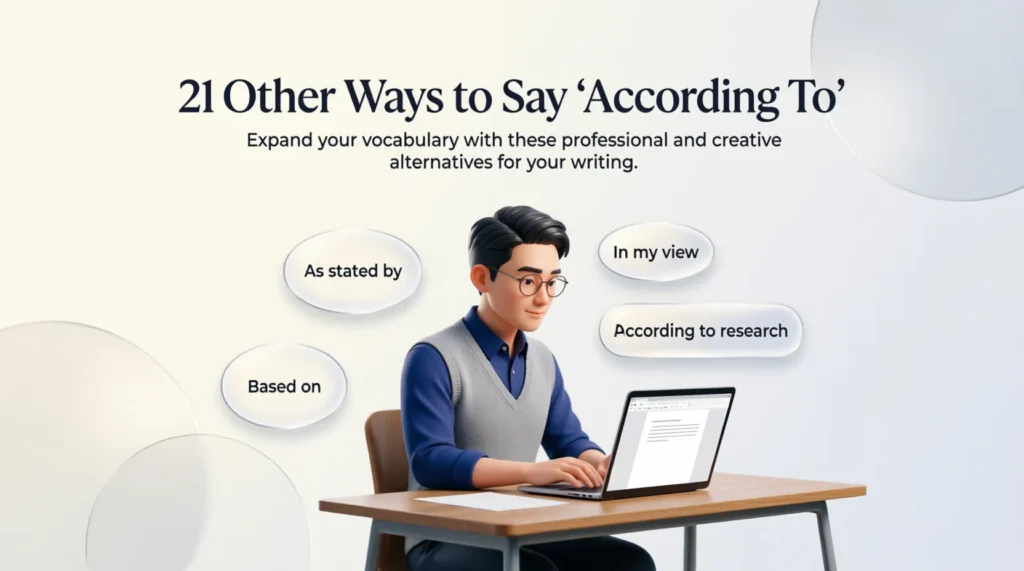
21 Other Ways to Say “According To”
1. As Stated By
Meaning: Information was directly stated by a person, organization, or source.
Explanation: “As stated by” is a formal alternative to “according to.” It works especially well when the source clearly made a statement.
Example Sentence:
As stated by the director, the company will expand its services next year.
Best Use: Formal, Business, Academic
Worst Use: Casual conversations where a simpler phrase would sound more natural.
Tone: Formal
2. As Reported By
Meaning: Information was reported by a person, organization, journalist, or publication.
Explanation: Use this phrase when a source has presented or reported information. It is common in news writing and professional reports.
Example Sentence:
As reported by the local newspaper, the new bridge will open next month.
Best Use: Formal, Business, News
Worst Use: Very casual conversations.
Tone: Formal
3. As Noted By
Meaning: A person or source pointed out or mentioned something.
Explanation: “As noted by” is useful when someone has highlighted an important fact or observation.
Example Sentence:
As noted by the researcher, the results require further investigation.
Best Use: Academic, Formal, Professional
Worst Use: Informal texting.
Tone: Formal
4. As Mentioned By
Meaning: Someone previously said or mentioned something.
Explanation: This is useful when referring back to something another person has already said.
Example Sentence:
As mentioned by the manager, the deadline has been extended.
Best Use: Business, Professional, Written
Worst Use: Situations where the source is unknown or unimportant.
Tone: Neutral
5. As Reported In
Meaning: Information appears in a particular publication, report, or document.
Explanation: Use “as reported in” when the source is a written publication or document rather than directly naming a person.
Example Sentence:
As reported in the annual review, revenue increased by 12%.
Best Use: Formal, Business, Academic
Worst Use: Casual conversation.
Tone: Formal
6. Based On
Meaning: Information or a conclusion is supported by particular evidence or information.
Explanation: “Based on” is one of the most useful alternatives to “according to,” but the meaning is slightly different. It focuses more on the evidence used to reach a conclusion.
Example Sentence:
Based on the available data, we should change our marketing strategy.
Best Use: Business, Academic, Professional
Worst Use: When you simply want to identify who said something.
Tone: Neutral
7. Per
Meaning: In accordance with or as stated by a particular source, rule, or instruction.
Explanation: “Per” is short and common in business communication. It is often followed by a person, policy, agreement, or request.
Example Sentence:
Per the manager’s request, the report has been updated.
Best Use: Business, Professional
Worst Use: Friendly everyday conversation.
Tone: Formal
8. In The Words Of
Meaning: Using the exact or memorable words of a person.
Explanation: This phrase is useful when you want to highlight someone’s own words or viewpoint.
Example Sentence:
In the words of the CEO, “Our customers come first.”
Best Use: Formal, Speeches, Writing
Worst Use: Simple factual statements where a direct source reference is enough.
Tone: Emphatic
9. As Explained By
Meaning: Information was explained by a particular person or source.
Explanation: Use this phrase when the source did more than simply state a fact. It suggests that the person gave an explanation.
Example Sentence:
As explained by the instructor, the new system will save employees time.
Best Use: Academic, Professional, Educational
Worst Use: When the source only provided a simple fact.
Tone: Neutral
10. As Indicated By
Meaning: Something is shown or suggested by evidence, information, or a source.
Explanation: This phrase sounds formal and is useful when evidence points toward a conclusion.
Example Sentence:
As indicated by the survey results, customers prefer the new design.
Best Use: Formal, Academic, Business
Worst Use: Casual conversation.
Tone: Formal
11. As Shown By
Meaning: Evidence demonstrates or supports a particular idea.
Explanation: “As shown by” is clear and easy to understand. It works well when discussing numbers, results, charts, or evidence.
Example Sentence:
As shown by the sales figures, the new product is performing well.
Best Use: Business, Academic, Presentations
Worst Use: When there is no visible or measurable evidence.
Tone: Neutral
12. As Confirmed By
Meaning: Information has been verified by a person or source.
Explanation: This phrase is stronger than “according to” because it suggests that the information has been confirmed.
Example Sentence:
As confirmed by the supplier, the order will arrive on Friday.
Best Use: Business, Professional
Worst Use: When the source has not actually verified the information.
Tone: Formal
13. As Cited By
Meaning: A source is referenced or quoted to support information.
Explanation: “As cited by” is especially useful in academic and research writing. It shows that another source has been referenced.
Example Sentence:
As cited by several researchers, early education can have long-term benefits.
Best Use: Academic, Research
Worst Use: Casual speech.
Tone: Formal
14. In Line With
Meaning: Consistent with a rule, plan, standard, or information.
Explanation: This phrase is not a direct replacement in every sentence. It works best when you mean that something agrees with or follows a policy, plan, or standard.
Example Sentence:
The new policy was created in line with current safety standards.
Best Use: Business, Formal, Professional
Worst Use: Directly attributing a spoken statement to someone.
Tone: Formal
15. In Accordance With
Meaning: Following a rule, law, instruction, or requirement.
Explanation: This is a very formal alternative. It is often used in legal, corporate, and official writing.
Example Sentence:
The procedure was completed in accordance with company policy.
Best Use: Formal, Legal, Business
Worst Use: Casual conversation.
Tone: Formal
16. From the Perspective of
Meaning: Based on the viewpoint or position of a person or group.
Explanation: This phrase is useful when discussing opinions or viewpoints rather than simple facts.
Example Sentence:
From the perspective of the customer, the checkout process is too long.
Best Use: Academic, Business, Professional
Worst Use: When you only need to identify a factual source.
Tone: Neutral
17. From the Viewpoint of
Meaning: Considering something from a particular person’s or group’s point of view.
Explanation: This is similar to “from the perspective of.” It emphasizes how someone sees or understands an issue.
Example Sentence:
From the viewpoint of the employees, the new schedule may be difficult.
Best Use: Academic, Professional
Worst Use: Short casual messages where the phrase may feel too long.
Tone: Neutral
18. As Per
Meaning: In accordance with or as stated by something or someone.
Explanation: “As per” is common in workplace English, especially in emails. However, it can sound bureaucratic or overly formal in casual English.
Example Sentence:
As per your request, I have attached the revised document.
Best Use: Business, Formal
Worst Use: Friendly conversation.
Tone: Formal
19. In Reference To
Meaning: With regard to or concerning a particular subject or source.
Explanation: This phrase is useful when connecting a statement to a previous document, message, or topic. It is not always a direct synonym for “according to.”
Example Sentence:
In reference to the latest report, several changes are required.
Best Use: Business, Formal Writing
Worst Use: Casual speech.
Tone: Formal
20. Going By
Meaning: Using something as a basis for a judgment or conclusion.
Explanation: “Going by” is more conversational than many alternatives. It means that you are making a judgment based on available information.
Example Sentence:
Going by the current results, the project is on track.
Best Use: Informal, Conversational
Worst Use: Highly formal legal or academic documents.
Tone: Friendly
21. From What I Understand
Meaning: Based on the information or explanation the speaker has received.
Explanation: This phrase is useful when you want to show that you are sharing your understanding rather than claiming complete certainty.
Example Sentence:
From what I understand, the meeting has been moved to Thursday.
Best Use: Informal, Professional, Conversational
Worst Use: When you need to present verified information with certainty.
Tone: Friendly
Quick Comparison of the Best Alternatives
| Alternative | Tone | Best Use |
|---|---|---|
| As stated by | Formal | Reports and professional writing |
| Based on | Neutral | Evidence and decisions |
| As reported by | Formal | News and reports |
| Per | Formal | Business communication |
| In the words of | Emphatic | Quotes and speeches |
| Going by | Friendly | Everyday conversation |
| From what I understand | Friendly | Conversations and emails |
The best alternative depends on what you want to communicate. If you are naming a source, “as stated by” may work well. If you are discussing evidence, “based on” is often better. For casual English, “going by” can sound more natural.
How to Choose the Right Alternative
You do not need to replace “according to” every time you use it. It is already a correct and useful phrase.
Instead, think about your purpose.
If You Are Naming a Source
Use:
- According to
- As stated by
- As mentioned by
- As reported by
Example:
As stated by the manager, the deadline is Friday.
If You Are Using Evidence
Use:
- Based on
- As shown by
- As indicated by
Example:
Based on the data, sales should increase next quarter.
If You Are Following a Rule
Use:
- Per
- In accordance with
- In line with
Example:
The process was completed in accordance with company policy.
If You Are Speaking Casually
Use:
- Going by
- From what I understand
Example:
Going by the forecast, we should leave early.
This small distinction can make your English sound much more natural.
Common Mistakes With “According To” Alternatives
One common mistake is treating every alternative as an exact replacement. They are not always interchangeable.
For example:
According to John, the meeting is canceled.
This tells us that John gave the information.
But:
Based on John, the meeting is canceled.
This sounds unnatural because “based on” normally refers to evidence or information, not simply the person who said something.
Another mistake is using very formal phrases in casual conversations.
In accordance with your previous verbal communication, I will arrive at 7 p.m.
This is grammatically possible, but it sounds stiff for a message to a friend.
A natural version would be:
As you said, I’ll arrive at 7 p.m.
Good English is not only about grammar. It is also about choosing a phrase that matches the situation.
Why Learning Synonyms for “According To” Helps
Learning other ways to say “according to” gives you more control over your English.
Instead of repeating:
According to the report…
According to the manager…
According to the data…
You can write:
As reported in the review…
As stated by the manager…
Based on the data…
This creates more variety without making your writing complicated.
For English learners, this is especially helpful in essays, presentations, workplace communication, and professional emails. You can also avoid sounding repetitive when explaining information from several sources.
However, remember that a synonym should fit the meaning. Do not choose a difficult phrase simply because it sounds more advanced.
Frequently Asked Questions
What is the most common alternative to “according to”?
“As stated by” is a useful formal alternative when you are referring to something a person or source directly said. “Based on” is better when you are referring to evidence.
What is a casual way to say “according to”?
“Going by” and “from what I understand” can sound natural in informal conversations, depending on the context.
Is “as per” the same as “according to”?
They can have similar meanings, especially in workplace English. However, “as per” often sounds more formal or bureaucratic and is especially common in business communication.
Can I use “according to” in a professional email?
Yes. “According to” is polite, neutral, and professional. It is completely appropriate for business emails.
Which alternative is best for academic writing?
Phrases such as “as stated by,” “as noted by,” “as indicated by,” “as cited by,” and “based on” can work well in academic writing. The correct choice depends on whether you are referring to a source, quotation, or evidence.
Conclusion
Knowing other ways to say “according to” can make your English more varied, clear, and natural.
The best phrase depends on your purpose.
Use “as stated by” for a formal source, “based on” for evidence, “in accordance with” for rules, and “going by” for casual situations.
You do not need to avoid “according to” because it is already correct and professional.
Instead, learn when each alternative fits best.
Try using a few of these alternatives to “according to” in your emails, essays, reports, and conversations.
With practice, choosing the right phrase will become easier and your English will sound more confident.

Alden Rowen is the author behind Meanings Path, sharing clear and reliable insights into the meanings, origins, and significance of words, names, and phrases. His goal is to make language simple, useful, and easy to understand.