

“I appreciate you” is a warm way to show gratitude.
It tells someone that you value their help, kindness, time, effort, or support.
The phrase is common in everyday English, but using the same words again and again can feel repetitive.
Learning other ways to say I appreciate you can help you sound more natural and confident.
The best alternative depends on the situation.
You may want to thank a coworker in a professional way, show affection to a friend, or give someone a deeper and more personal compliment.
Small changes in wording can make your message sound formal, friendly, sincere, or emotional.
In this guide, you will learn 18 alternatives to “I appreciate you,” including their meanings, examples, tones, and best uses.
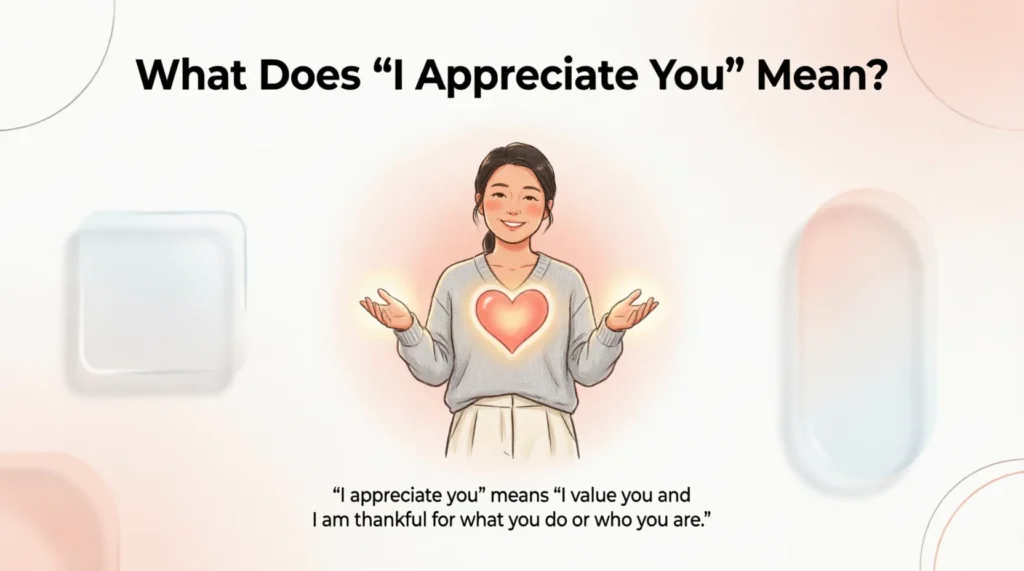
What Does “I Appreciate You” Mean?
“I appreciate you” means “I value you and I am thankful for what you do or who you are.”
The verb appreciate means to recognize the value, importance, or kindness of something or someone.
For example:
- I appreciate your help. = I am thankful for your help.
- I appreciate you. = I value and feel thankful for you.
- I really appreciate everything you do. = I am very grateful for your efforts.
Grammatically, appreciate is a verb. In “I appreciate you,” the pronoun you is the object of the verb.
There is also a small difference between “I appreciate you” and “I appreciate it.”
“I appreciate you” focuses on the person.
“I appreciate it” usually focuses on an action, favor, or thing.
For example:
“Thanks for staying late. I appreciate you.”
This sounds personal and warm.
“Thanks for staying late. I appreciate it.”
This sounds more neutral and focuses on the action.
When to Use “I Appreciate You”
You can use “I appreciate you” in many situations, but the tone is usually personal and warm.
In informal conversations
It works well with friends, family members, and people you know well.
“Thanks for always checking on me. I appreciate you.”
In spoken English
The phrase sounds natural when you want to thank someone directly.
“You helped me when I needed it. I appreciate you.”
In written messages
It is also common in texts, social media messages, and personal notes.
“Thank you for being there. I appreciate you so much.”
At work
You can use it with coworkers in some workplaces, especially when the relationship is friendly.
“Thanks for helping me finish the report. I appreciate you.”
However, it may sound more personal than traditional business language. In formal writing, alternatives such as “I greatly appreciate your assistance” may be a better choice.
Is It Professional or Polite to Say “I Appreciate You”?
Yes, “I appreciate you” is polite and positive. However, whether it sounds professional depends on the relationship and workplace culture.
In a friendly workplace, it can sound sincere:
“I appreciate you jumping in to help with the presentation.”
In a formal email, a more specific phrase may be better:
“I greatly appreciate your assistance with the presentation.”
The difference is mainly about tone.
“I appreciate you” focuses on the person and can feel warm or personal.
“I appreciate your help” focuses on the person’s action and usually sounds more neutral.
For business communication, it is often best to explain exactly what you value. This makes your gratitude clearer and more professional.
Instead of:
“I appreciate you.”
Try:
“I appreciate the time you took to review my proposal.”
This sounds specific, respectful, and professional.
Pros and Cons of Using “I Appreciate You”
Pros
- It sounds sincere.
- It shows personal gratitude.
- It is short and easy to understand.
- It works well in casual conversations.
- It can make someone feel valued.
- It can express more than simple thanks.
Cons
- It can sound personal in formal situations.
- Some learners may confuse it with “I appreciate it.”
- It may feel too emotional for certain business messages.
- It can become repetitive if used too often.
- The meaning can depend on the relationship and context.
The good news is that English offers many useful alternatives. Here are 18 options you can choose from.

18 Other Ways to Say “I Appreciate You”
1. I’m grateful for you.
Meaning: You feel thankful that this person is part of your life.
Explanation: This is a warm and sincere alternative. It often sounds deeper than simply saying “thank you.” It can show that you value the person, not just one thing they did.
Example Sentence:
“You have supported me through so much. I’m truly grateful for you.”
Best Use: Personal, friendly, emotional
Worst Use: Very formal corporate communication
Tone: Warm / Emphatic
2. I really value you.
Meaning: You consider someone important and meaningful.
Explanation: This phrase focuses strongly on the person’s importance. It can be used with friends, family, partners, mentors, and trusted coworkers.
Example Sentence:
“You always listen when I need to talk. I really value you.”
Best Use: Personal, friendly, workplace relationships
Worst Use: A very formal business letter where a specific thank-you would be clearer
Tone: Warm / Emphatic
3. Thank you for everything.
Meaning: You are thankful for all the person’s help or support.
Explanation: This is one of the easiest synonyms for “I appreciate you” to use. It is natural in both spoken and written English. The exact meaning depends on context.
Example Sentence:
“You helped me through a difficult time. Thank you for everything.”
Best Use: Personal, friendly, informal
Worst Use: Situations where you need to explain exactly what you are thankful for
Tone: Friendly / Warm
4. I’m thankful for your support.
Meaning: You are grateful because someone supported you.
Explanation: This is more specific than “I appreciate you.” It clearly identifies the reason for your gratitude. It also works well in professional communication.
Example Sentence:
“I’m thankful for your support during the project.”
Best Use: Business, professional, personal
Worst Use: When you want to thank someone for several different things
Tone: Neutral / Warm
5. I’m grateful for your help.
Meaning: You feel thankful because someone helped you.
Explanation: This is a simple and safe alternative. It is especially useful for English learners because the meaning is clear and natural.
Example Sentence:
“I’m grateful for your help with my presentation.”
Best Use: Formal, business, professional
Worst Use: When the goal is to express deep personal appreciation for the person themselves
Tone: Polite / Neutral
6. Thank you for being there for me.
Meaning: You are thankful because someone gave you support or stayed with you during a difficult time.
Explanation: This phrase is more emotional than a basic “thank you.” It often refers to emotional support rather than a single favor.
Example Sentence:
“Thank you for being there for me when I needed someone to talk to.”
Best Use: Personal, close friendships, family
Worst Use: Formal business emails
Tone: Warm / Emotional
7. I’m thankful to have you in my life.
Meaning: You feel lucky and grateful that someone is part of your life.
Explanation: This is a strong personal expression. It communicates that the person’s presence matters to you.
Example Sentence:
“You always make difficult days easier. I’m thankful to have you in my life.”
Best Use: Close relationships, friends, family
Worst Use: Formal workplace communication
Tone: Emotional / Affectionate
8. You mean a lot to me.
Meaning: Someone is very important to you.
Explanation: This does not directly say “thank you,” but it communicates deep appreciation. It is especially useful when you want your message to feel personal.
Example Sentence:
“Thank you for everything you have done. You mean a lot to me.”
Best Use: Personal and emotional situations
Worst Use: Formal professional messages
Tone: Emotional / Affectionate
9. I’m thankful for everything you do.
Meaning: You are grateful for someone’s ongoing efforts.
Explanation: This is useful when a person regularly helps or supports you. It recognizes repeated actions rather than one specific favor.
Example Sentence:
“You always help keep the team organized. I’m thankful for everything you do.”
Best Use: Personal, workplace, team settings
Worst Use: When only one specific action needs recognition
Tone: Friendly / Appreciative
10. Your support means a lot to me.
Meaning: You are deeply thankful for someone’s support.
Explanation: This is a natural way to make your gratitude more personal. It clearly explains what you value.
Example Sentence:
“Your support means a lot to me while I work toward this goal.”
Best Use: Personal, professional, mentoring situations
Worst Use: Very casual situations where a quick “thanks” is enough
Tone: Warm / Sincere
11. I can’t thank you enough.
Meaning: You are extremely thankful.
Explanation: This is an idiomatic expression. It does not mean that you literally cannot say “thank you.” It means your gratitude feels very strong.
Example Sentence:
“You helped me solve the problem at the last minute. I can’t thank you enough.”
Best Use: Strong gratitude, personal or professional situations
Worst Use: Routine situations where the expression may sound too strong
Tone: Emphatic / Grateful
12. I truly appreciate your kindness.
Meaning: You are sincerely thankful for someone’s kind behavior.
Explanation: This is a polished alternative that works well when someone has shown kindness or generosity. It is more specific than simply saying “I appreciate you.”
Example Sentence:
“I truly appreciate your kindness and patience during the process.”
Best Use: Formal, professional, polite
Worst Use: Very casual conversations where it may sound overly formal
Tone: Formal / Sincere
13. I’m grateful for all your support.
Meaning: You are thankful for the support someone has given you.
Explanation: This is an excellent choice for emails, workplace messages, and personal conversations. Adding “all” suggests that the support happened more than once.
Example Sentence:
“I’m grateful for all your support throughout this project.”
Best Use: Business, professional, personal
Worst Use: When the person has done only one small favor
Tone: Polite / Warm
14. I value everything you do.
Meaning: You recognize the importance of someone’s efforts.
Explanation: This phrase is useful when you want to sound respectful without being overly emotional. It works especially well in professional settings.
Example Sentence:
“I value everything you do to keep our team moving forward.”
Best Use: Business, workplace, professional relationships
Worst Use: Very intimate personal situations where a warmer phrase may fit better
Tone: Professional / Appreciative
15. Your help means so much to me.
Meaning: Someone’s help is very important to you.
Explanation: This phrase adds emotional weight to a thank-you. It is especially natural when the person’s help made a real difference.
Example Sentence:
“Your help means so much to me. I don’t know how I would have managed without you.”
Best Use: Personal, friendly, supportive situations
Worst Use: Routine corporate emails
Tone: Warm / Emotional
16. I’m glad to have you on my side.
Meaning: You are happy that someone supports you.
Explanation: This phrase is friendly and natural. It can describe emotional support, teamwork, or loyalty.
Example Sentence:
“Thanks for helping me prepare for the meeting. I’m glad to have you on my side.”
Best Use: Friendly, casual, teamwork
Worst Use: Formal business correspondence
Tone: Friendly / Positive
17. I’m thankful for your kindness and support.
Meaning: You are grateful for both someone’s kindness and help.
Explanation: This is a strong choice when you want to recognize more than one quality or action. It sounds polished without being too difficult.
Example Sentence:
“I’m thankful for your kindness and support during this important time.”
Best Use: Formal, professional, personal
Worst Use: Very quick casual exchanges
Tone: Polite / Warm
18. You’re amazing, and I appreciate everything you do.
Meaning: You strongly praise someone while expressing gratitude.
Explanation: This combines appreciation with a compliment. It is more energetic and personal than a simple thank-you.
Example Sentence:
“You stayed late to help me finish the project. You’re amazing, and I appreciate everything you do.”
Best Use: Friends, family, friendly coworkers
Worst Use: Highly formal business communication
Tone: Friendly / Emphatic
Quick Comparison of the Best Alternatives
| Alternative | Tone | Best Setting |
|---|---|---|
| I’m grateful for you. | Warm | Personal |
| I really value you. | Emphatic | Personal / Friendly |
| I’m grateful for your help. | Neutral | Business |
| I truly appreciate your kindness. | Formal | Professional |
| Your support means a lot to me. | Warm | Personal / Professional |
| I value everything you do. | Professional | Workplace |
| Thank you for everything. | Friendly | Casual / Personal |
The best alternatives to “I appreciate you” are not always interchangeable. Think about what you want to emphasize.
If you value the person, try “I really value you.”
If you value their help, try “I’m grateful for your help.”
If you value their support, try “Your support means a lot to me.”
If you need a professional option, try “I value everything you do.”
How to Choose the Right Alternative
Choosing the right phrase is mostly about context.
For a friend
Use something warm and natural:
“I’m grateful for you.”
For a family member
Use something more personal:
“I’m thankful to have you in my life.”
For a coworker
Use a phrase that recognizes their effort:
“I really appreciate your help with this.”
Or:
“I value everything you do for the team.”
For a manager or client
Keep the wording polite and specific:
“I’m grateful for your support.”
Or:
“I truly appreciate your assistance.”
For an emotional message
Choose a phrase that shows deeper feeling:
“You mean a lot to me.”
The key is to match the strength of your words with the situation. A very emotional phrase may sound strange in a routine business email, while a cold phrase may feel distant when speaking to a close friend.
Common Mistakes to Avoid
English learners sometimes use appreciation phrases in ways that sound unnatural.
Mistake 1: Using “I appreciate you” for every situation
The phrase is useful, but repetition can make your English sound limited. Try changing the wording based on what you appreciate.
Instead of:
“I appreciate you.”
Try:
“I appreciate your patience.”
Mistake 2: Using very emotional phrases at work
“You mean the world to me” may be appropriate in a personal relationship, but it is usually not suitable for a professional email.
Choose a more neutral phrase such as:
“I greatly value your support.”
Mistake 3: Being too vague
A specific thank-you often feels more sincere.
Compare:
“I appreciate you.”
with:
“I appreciate the time you took to explain the process.”
The second sentence tells the person exactly what you value.
Mistake 4: Confusing “appreciate you” and “appreciate it”
Use “I appreciate you” when focusing on the person.
Use “I appreciate it” when focusing on an action, favor, or thing.
“Thanks for helping me. I appreciate it.”
“You have always supported me. I appreciate you.”
Both are correct, but they have different focuses.
Frequently Asked Questions
What is another way to say “I appreciate you”?
Some natural alternatives are “I’m grateful for you,” “I really value you,” “Thank you for everything,” and “Your support means a lot to me.” The best option depends on the situation.
What is a professional way to say “I appreciate you”?
In professional English, try “I value your support,” “I’m grateful for your assistance,” or “I truly appreciate your help.” These phrases sound respectful and work well in business communication.
Is “I appreciate you” grammatically correct?
Yes. “I appreciate you” is grammatically correct. Here, appreciate is the verb and you is its object.
Is “I appreciate you” better than “thank you”?
Neither is always better. “Thank you” is more common and flexible. “I appreciate you” can sound more personal because it focuses on the person.
How can I sound more sincere when saying “I appreciate you”?
Be specific. Instead of only saying “I appreciate you,” explain what you value.
For example:
“I really appreciate you taking the time to help me today.”
This makes your gratitude clearer and more meaningful.
Conclusion
Learning other ways to say “I appreciate you” can make your English more natural, flexible, and expressive.
You can use simple phrases such as “Thank you for everything” in casual conversations or professional options such as “I value your support” at work.
For deeper emotions, phrases like “You mean a lot to me” can communicate stronger feelings.
The most important point is to match your words with the person, situation, and tone.
Do not be afraid to experiment with different expressions.
The more alternatives you learn, the easier it becomes to communicate gratitude with confidence and precision.

Alden Rowen is the author behind Meanings Path, sharing clear and reliable insights into the meanings, origins, and significance of words, names, and phrases. His goal is to make language simple, useful, and easy to understand.