

Thursday is often the point where the week starts to feel lighter.
Saying “Happy Thursday” is a simple way to wish someone a good day and share a little positive energy.
But using the same phrase every week can feel repetitive.
Learning other ways to say Happy Thursday can help you sound more natural, friendly, and confident in English.
The right phrase also depends on who you are speaking to.
A message to a close friend can be playful, while a message to a manager or client should be polite and professional.
In this guide, you will find 19 alternatives to “Happy Thursday,” from casual greetings to professional expressions.
You will also learn their meanings, tones, best uses, and examples.
These synonyms for Happy Thursday can make your conversations, emails, cards, and social posts more interesting.

What Does “Happy Thursday” Mean?
“Happy Thursday” is a friendly greeting used to wish someone a pleasant, positive, or enjoyable Thursday.
The phrase is made of two simple parts:
- Happy is an adjective that describes a positive feeling or experience.
- Thursday is the name of the day.
Together, “Happy Thursday” works like a short greeting or good wish. It is similar to saying “Have a great Thursday” or “I hope you have a good Thursday.”
The phrase is not a complete sentence in the traditional grammatical sense. It is a shortened greeting. The full idea could be expressed as, “I hope you have a happy Thursday.”
You can use it at the start of a message:
Happy Thursday! I hope your day goes well.
You can also use it by itself:
Happy Thursday!
It is common in texts, social media posts, workplace chats, greeting cards, and casual emails.
When to Use “Happy Thursday”
“Happy Thursday” is flexible, but the best use depends on the situation.
Formal and Professional Settings
You can use it in a workplace when the environment is friendly and relaxed.
For example:
Happy Thursday, everyone! I hope you’re having a productive week.
It works well in team chats, internal emails, newsletters, and friendly professional messages.
For a formal client email, however, “I hope you’re having a good Thursday” may sound more polished.
Informal Conversations
This is where “Happy Thursday” feels most natural.
You can send it to:
- Friends
- Family members
- Classmates
- Online friends
- Coworkers you know well
Example:
Happy Thursday! Almost there!
Social Media
The phrase is also popular in captions and posts.
For example:
Happy Thursday! Keep going—you’re almost at the weekend.
You can make it more creative with expressions such as “Cheers to Thursday!” or “Have a terrific Thursday!”
Spoken English
You can say “Happy Thursday!” when greeting someone at work, school, or another casual setting.
It is short, warm, and easy for English learners to use.
Is It Professional/Polite to Say “Happy Thursday”?
Yes. “Happy Thursday” is polite and positive, but it is usually friendly rather than highly formal.
In a modern workplace, the phrase can be suitable for:
- Team messages
- Internal emails
- Friendly coworkers
- Workplace announcements
- Casual business communication
However, context matters.
If you are writing to an important client or making a formal request, a more neutral greeting may be better:
I hope you’re having a good Thursday.
Or:
I hope your week is going well.
The phrase is generally not rude or unprofessional. It simply has a warm and informal feel.
If your workplace has a formal communication style, choose a neutral alternative. If your team regularly uses friendly greetings, “Happy Thursday” can fit perfectly.
Pros and Cons of Using “Happy Thursday”
Pros
- Simple: It is easy to understand.
- Friendly: It creates a warm tone.
- Positive: It starts a conversation with good energy.
- Flexible: It works in spoken and written English.
- Short: It is useful for quick messages.
- Easy for learners: The grammar is simple.
Cons
- Repetitive: Using it every Thursday may feel predictable.
- Less formal: It may not fit very formal business communication.
- Generic: It does not say anything personal.
- Limited emotion: It may not express excitement, encouragement, or celebration.
Using different expressions helps you match your words to the situation.
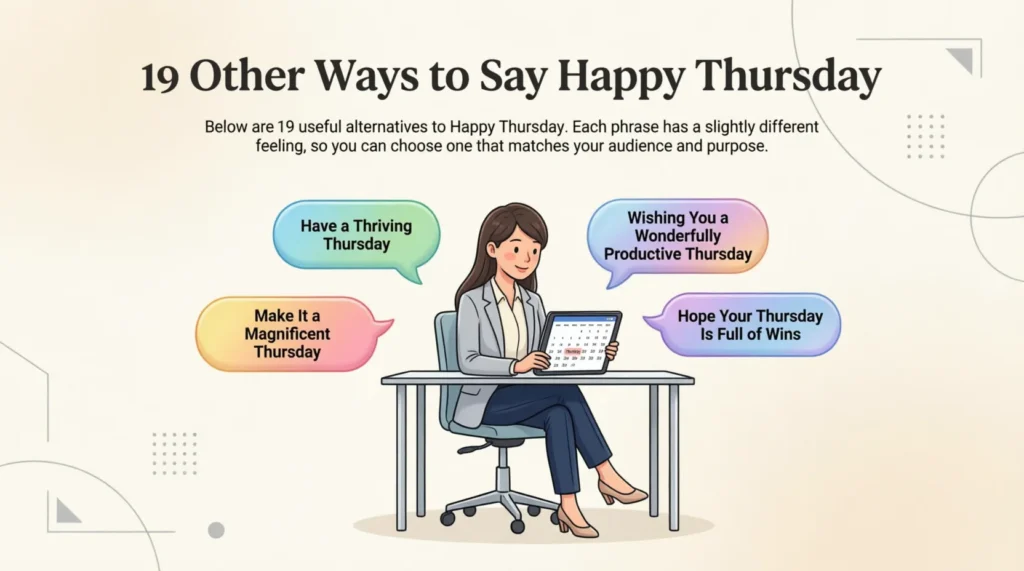
19 Other Ways to Say Happy Thursday
Below are 19 useful alternatives to Happy Thursday. Each phrase has a slightly different feeling, so you can choose one that matches your audience and purpose.
1. Have a Great Thursday!
Meaning: A warm wish for someone to have a very good Thursday.
Explanation: “Have a great Thursday!” is one of the easiest alternatives to “Happy Thursday.” It sounds natural and positive. It works well when you want to wish someone a pleasant day without sounding too formal.
Example Sentence:
Have a great Thursday! I hope everything goes smoothly today.
Best Use: Friendly, Casual, Business
Worst Use: Very formal letters or highly serious professional notices
Tone: Friendly
2. Have a Wonderful Thursday!
Meaning: A wish for someone to have an especially pleasant Thursday.
Explanation: “Have a wonderful Thursday!” sounds warm and slightly more enthusiastic than “Have a great Thursday!” It is useful for messages to friends, coworkers, customers, or family.
It can also sound thoughtful when someone has an important event planned.
Example Sentence:
Have a wonderful Thursday! Good luck with your presentation today.
Best Use: Friendly, Business, Personal
Worst Use: Very serious or formal situations where emotional language is unnecessary
Tone: Warm
3. Have a Fantastic Thursday!
Meaning: A strong wish for an excellent Thursday.
Explanation: “Fantastic” adds more energy than “good” or “great.” Use this phrase when you want your message to feel enthusiastic.
It is especially suitable for friends, team chats, social media, and positive workplace messages.
Example Sentence:
Have a fantastic Thursday, team! Let’s finish the week strong.
Best Use: Casual, Friendly, Workplace
Worst Use: Formal complaints or serious business notices
Tone: Emphatic
4. Have a Terrific Thursday!
Meaning: A cheerful wish for a very good Thursday.
Explanation: “Terrific” creates an upbeat and lively tone. The repeated “T” sound also makes the phrase catchy.
It works well in greeting cards, social media captions, classroom messages, and friendly conversations.
Example Sentence:
Have a terrific Thursday! Keep smiling and enjoy your day.
Best Use: Casual, Friendly
Worst Use: Formal corporate documents
Tone: Cheerful
5. Wishing You a Wonderful Thursday
Meaning: A polite wish for someone to enjoy their Thursday.
Explanation: “Wishing you…” sounds a little more polished than “Happy Thursday.” It is useful in written communication because it feels thoughtful without being too formal.
You can use it in emails, cards, social posts, and professional messages.
Example Sentence:
Wishing you a wonderful Thursday and a successful end to the week.
Best Use: Business, Written, Friendly
Worst Use: Very casual conversations where a shorter phrase is more natural
Tone: Polite
6. Hope You Have a Great Thursday
Meaning: An expression of hope that someone enjoys their day.
Explanation: This phrase sounds natural and conversational. It is especially useful when you already have a conversation with someone.
The word “hope” makes it sound personal and caring.
Example Sentence:
Thanks for your help today. Hope you have a great Thursday!
Best Use: Casual, Friendly, Business
Worst Use: Formal legal or official documents
Tone: Friendly
7. Enjoy Your Thursday!
Meaning: A wish for someone to enjoy their day.
Explanation: “Enjoy your Thursday!” is direct and simple. It does not sound overly enthusiastic, which makes it useful when you want a positive but neutral message.
It can work well after a conversation or at the end of an email.
Example Sentence:
Thanks for joining the meeting. Enjoy your Thursday!
Best Use: Business, Friendly, Spoken
Worst Use: Situations involving bad news or serious matters
Tone: Neutral
8. Cheers to Thursday!
Meaning: A cheerful expression celebrating Thursday.
Explanation: “Cheers to Thursday!” sounds more playful than “Happy Thursday.” It suggests that Thursday is worth celebrating or enjoying.
The phrase is common in casual conversations and social media.
Example Sentence:
Cheers to Thursday! We’re getting closer to the weekend.
Best Use: Casual, Social Media, Friendly
Worst Use: Formal business emails
Tone: Playful
9. Here’s to a Great Thursday!
Meaning: A positive wish for a successful and enjoyable Thursday.
Explanation: “Here’s to…” is often used to celebrate or encourage something. This phrase gives Thursday a more energetic and optimistic feeling.
It is useful when motivating a group or marking progress during the week.
Example Sentence:
Here’s to a great Thursday and a productive day ahead!
Best Use: Friendly, Workplace, Social
Worst Use: Formal reports
Tone: Positive
10. Have a Productive Thursday!
Meaning: A wish for someone to accomplish useful work during Thursday.
Explanation: This is a good choice in professional environments. Instead of focusing only on happiness, it focuses on progress and achievement.
It works particularly well in team messages.
Example Sentence:
Have a productive Thursday, everyone. Let’s make good progress on our projects.
Best Use: Business, Workplace
Worst Use: Romantic or highly personal messages
Tone: Professional
11. Have a Positive Thursday!
Meaning: A wish for someone to maintain a positive and pleasant day.
Explanation: “Have a positive Thursday!” focuses on mindset and attitude. It is useful when you want to encourage someone who may be facing a busy or difficult day.
Example Sentence:
Have a positive Thursday! Take things one step at a time.
Best Use: Friendly, Motivational
Worst Use: Formal corporate documents
Tone: Encouraging
12. Make the Most of Your Thursday!
Meaning: A wish for someone to use their Thursday well and enjoy it.
Explanation: This phrase is more motivational than “Happy Thursday.” It encourages action rather than simply offering a greeting.
It is excellent when someone has goals, work, study, or an event planned.
Example Sentence:
Make the most of your Thursday and finish the week with confidence!
Best Use: Motivational, Casual, Workplace
Worst Use: Formal legal or technical writing
Tone: Encouraging
13. Enjoy the Rest of Your Thursday!
Meaning: A wish for someone to have a pleasant remaining part of Thursday.
Explanation: This phrase is especially useful later in the day. If it is already afternoon or evening, “Happy Thursday” can feel less natural.
“Enjoy the rest of your Thursday!” fits the timing better.
Example Sentence:
It was great speaking with you. Enjoy the rest of your Thursday!
Best Use: Business, Friendly, Spoken
Worst Use: Early Thursday morning
Tone: Polite
14. Hope Your Thursday Is Going Well
Meaning: A friendly way to ask or suggest that someone is having a good Thursday.
Explanation: This is softer than a direct greeting. It can be useful when you are starting an email or checking in with someone.
It sounds natural because it focuses on the person’s experience rather than simply naming the day.
Example Sentence:
Hope your Thursday is going well. I wanted to follow up on our meeting.
Best Use: Business, Friendly, Written
Worst Use: Very formal official correspondence
Tone: Neutral
15. Have a Bright Thursday!
Meaning: A wish for a cheerful, positive, or uplifting Thursday.
Explanation: “Bright” gives the greeting a warm and optimistic feeling. It is more creative than the standard “Happy Thursday.”
It works best in personal messages, cards, and social posts.
Example Sentence:
Have a bright Thursday! I hope something wonderful happens today.
Best Use: Casual, Friendly, Social Media
Worst Use: Formal business writing
Tone: Warm
16. Keep Shining This Thursday!
Meaning: An encouraging message telling someone to stay confident and positive.
Explanation: This phrase is not a direct synonym for “Happy Thursday.” Instead, it adds encouragement. It is a good choice when you want to motivate someone.
It can sound especially natural in inspirational messages.
Example Sentence:
Keep shining this Thursday! You’re doing better than you think.
Best Use: Casual, Motivational, Social Media
Worst Use: Formal workplace communication
Tone: Encouraging
17. Thursday Greetings!
Meaning: A simple greeting sent on Thursday.
Explanation: “Thursday greetings!” is short and neutral. It can work in written communication when you want to mention the day without using the emotional word “happy.”
It can also be used in newsletters or community messages.
Example Sentence:
Thursday greetings to everyone! Here are this week’s updates.
Best Use: Written, Business, Community
Worst Use: Very casual one-to-one conversations
Tone: Neutral
18. Happy Thursday, Everyone!
Meaning: A cheerful Thursday greeting addressed to a group.
Explanation: This is a small variation of the original phrase, but adding “everyone” makes it useful for teams, classes, online communities, and group chats.
It creates an inclusive feeling.
Example Sentence:
Happy Thursday, everyone! Let’s have a productive day.
Best Use: Workplace, Classroom, Group Chats
Worst Use: One-to-one messages
Tone: Friendly
19. Almost Friday—Have a Great Thursday!
Meaning: A cheerful Thursday message that recognizes that Friday is close.
Explanation: This phrase adds a little humor and excitement. It works because Thursday is often seen as a day close to the end of the workweek.
It is best for relaxed environments where mentioning the weekend feels natural.
Example Sentence:
Almost Friday—have a great Thursday, team!
Best Use: Casual, Workplace, Social Media
Worst Use: Formal client communication
Tone: Playful
Quick Comparison of the Best Alternatives
| Alternative | Tone | Best Setting |
|---|---|---|
| Have a Great Thursday! | Friendly | General |
| Wishing You a Wonderful Thursday | Polite | Business/Written |
| Enjoy Your Thursday! | Neutral | Business/Friendly |
| Have a Productive Thursday! | Professional | Workplace |
| Cheers to Thursday! | Playful | Casual/Social |
| Hope Your Thursday Is Going Well | Neutral | Business/Written |
| Make the Most of Your Thursday! | Encouraging | Motivational |
The best formal ways to say Happy Thursday are usually “Wishing you a wonderful Thursday,” “Enjoy your Thursday,” and “Hope your Thursday is going well.”
For casual conversations, try “Cheers to Thursday!”, “Have a fantastic Thursday!”, or “Almost Friday—have a great Thursday!”
How to Choose the Right Alternative
Choosing the right phrase is more important than simply knowing many synonyms.
Think about three things: the person, the situation, and your purpose.
If you are talking to a close friend, a playful phrase is fine:
Cheers to Thursday!
If you are writing to a coworker, you can use:
Have a productive Thursday!
If you are emailing a customer, a more neutral phrase may be better:
Hope your Thursday is going well.
If you want to encourage someone, try:
Make the most of your Thursday!
This small change in word choice can make your English sound more natural.
Common Mistakes When Using Thursday Greetings
English learners sometimes use a phrase correctly but choose the wrong tone for the situation.
Using Very Casual Language at Work
“Thursday vibes!” may be fine with friends, but it can sound too casual in a formal business email.
Using Too Much Enthusiasm
Phrases such as “Have an absolutely incredible, amazing, wonderful Thursday!!!” can feel excessive in professional communication.
Simple language is often better.
Forgetting the Time of Day
If Thursday is nearly over, “Enjoy the rest of your Thursday!” is more natural than simply saying “Happy Thursday!”
Repeating the Same Phrase
There is nothing wrong with “Happy Thursday,” but using alternatives can make your English more flexible.
Why Learning Alternatives to “Happy Thursday” Helps
Learning different expressions does more than give you new greetings.
It helps you understand tone and context, which are important parts of natural English.
Compare these:
Have a productive Thursday!
and
Cheers to Thursday!
Both refer to Thursday, but they create very different feelings.
The first sounds professional and focused. The second sounds relaxed and playful.
This is why learning other ways to say Happy Thursday can improve your communication skills. You learn not only new words but also when and why to use them.
For English learners, this is especially useful because native speakers often change simple expressions depending on the situation.
Frequently Asked Questions
What is another way to say Happy Thursday?
Some common alternatives are “Have a great Thursday,” “Have a wonderful Thursday,” “Enjoy your Thursday,” and “Wishing you a wonderful Thursday.”
What is a professional way to say Happy Thursday?
A professional option is “Hope your Thursday is going well.” You can also say “Wishing you a wonderful Thursday” or “Have a productive Thursday.”
Can I say Happy Thursday to my boss?
Yes. “Happy Thursday” is generally polite, but workplace culture matters. For a more professional tone, try “Hope you’re having a good Thursday.”
What is a fun way to say Happy Thursday?
Try “Cheers to Thursday!”, “Have a fantastic Thursday!”, or “Almost Friday—have a great Thursday!”
Is Happy Thursday grammatically correct?
Yes. “Happy Thursday” is a standard greeting. It is a shortened form of a good wish, similar to “Have a happy Thursday.”
Conclusion
Knowing other ways to say Happy Thursday gives you more control over your English.
You can choose a phrase that sounds friendly, professional, playful, or encouraging instead of using the same greeting every time. “Have a great Thursday” is a safe choice for most situations, while phrases such as “Have a productive Thursday” work well at work.
For friends, “Cheers to Thursday!” adds more fun.
Try different alternatives and notice how each one changes the tone.
With regular practice, these small changes can help you sound more fluent, natural, and confident in everyday English communication.

Alden Rowen is the author behind Meanings Path, sharing clear and reliable insights into the meanings, origins, and significance of words, names, and phrases. His goal is to make language simple, useful, and easy to understand.