

“Happy to help” is a friendly way to tell someone that you are glad to assist them.
It is common in emails, chats, customer service, workplaces, and everyday conversations.
However, using the same phrase again and again can make your English sound repetitive.
Learning other ways to say happy to help gives you more choices and helps you match your words to the situation.
The right phrase can also change your tone.
Some alternatives sound more professional, while others feel warm, casual, or personal.
For example, “I’d be glad to assist” works well in a business email, while “Anytime!” is better with a friend.
In this guide, you will learn 17 alternatives to happy to help, including their meanings, examples, tones, and best uses.
What Does “Happy to Help” Mean?
“Happy to help” means “I am glad or willing to help you.”
It shows that you are offering assistance in a positive and friendly way. The phrase is usually polite and welcoming.
Grammar Explanation
“Happy” is an adjective. It describes how the speaker feels about helping.
The full idea is:
I am happy to help.
In natural conversation, the subject and verb are often removed:
“Happy to help!”
This shorter form is completely natural in English. It is especially common in spoken English, emails, customer service, and online chats.
For example:
“Thanks for explaining that.”
“Happy to help!”
The phrase does not always mean that the person is excited. It often simply means that helping is not a problem and that the speaker is willing to do it.
When to Use “Happy to Help”
“Happy to help” is useful in many situations.
In the Workplace
You can use it when a coworker thanks you for helping with a task.
“Thanks for helping me prepare the report.”
“Happy to help.”
It sounds friendly without being too casual.
In Emails
The phrase works well at the end of a professional email.
“Please let me know if you need anything else. I’m happy to help.”
This sounds warm and professional.
In Customer Service
Customer support workers often use “happy to help” because it makes the customer feel welcome.
“I’m happy to help you update your account.”
With Friends
You can also use it in casual conversations.
“Thanks for helping me move.”
“Happy to help!”
However, friends may prefer shorter phrases such as “Anytime!” or “No problem!”
In Written and Spoken English
The phrase works in both forms. In writing, “I’m happy to help” is slightly more complete. In conversation, “Happy to help!” sounds very natural.
Is It Professional or Polite to Say “Happy to Help”?
Yes. “Happy to help” is both polite and professional in most situations.
It has a positive tone and shows that you are willing to assist. It is especially useful when you want to sound friendly rather than overly formal.
For example:
“Thank you for reaching out. I’m happy to help with your request.”
This is suitable for a workplace email.
However, some situations need a more formal style. If you are writing to a senior executive, client, official organization, or important business contact, “I’d be glad to assist” or “I’d be pleased to assist” may sound more polished.
The key is context. “Happy to help” is not unprofessional. It is simply less formal than some business alternatives.
Pros and Cons of Using “Happy to Help”
Pros
- Friendly: It creates a warm feeling.
- Polite: It shows willingness to assist.
- Simple: English learners can use it easily.
- Flexible: It works in spoken and written English.
- Professional enough: It is suitable for many workplace situations.
- Positive: It avoids sounding forced or annoyed.
Cons
- Can become repetitive: Using it too often may sound predictable.
- Not very formal: Some official situations need more formal wording.
- Can sound generic: It does not always show personal attention.
- May feel automatic: Customer service workers may use it so often that it loses some warmth.
- Limited emotional range: It does not express strong enthusiasm or appreciation.
Learning synonyms for happy to help gives you more control over your tone.
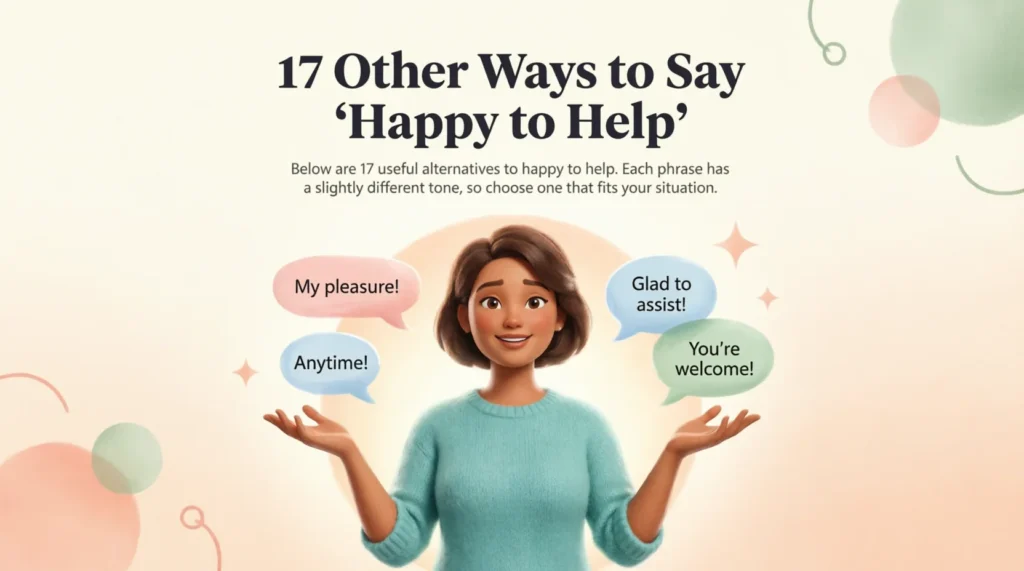
17 Other Ways to Say “Happy to Help”
Below are 17 useful alternatives to happy to help. Each phrase has a slightly different tone, so choose one that fits your situation.
1. Glad to Help
Meaning: You are pleased or happy that you could assist.
Explanation: “Glad to help” is one of the closest alternatives to “happy to help.” It sounds natural, friendly, and sincere. It works especially well after someone thanks you.
Example Sentence:
“Thanks for fixing the issue so quickly.”
“Glad to help!”
Best Use: Friendly, Casual, Business
Worst Use: Very formal legal or official writing
Tone: Friendly
2. Happy to Assist
Meaning: You are willing and pleased to provide assistance.
Explanation: “Happy to assist” is a little more formal than “happy to help.” It is useful in customer service, business emails, and professional communication.
Example Sentence:
“If you have any questions about the application, I’m happy to assist.”
Best Use: Business, Professional
Worst Use: Very casual conversations with close friends
Tone: Professional
3. Glad I Could Help
Meaning: You are pleased that your help was useful.
Explanation: This phrase is often used after you have already helped someone. It focuses on the result rather than simply offering help.
Example Sentence:
“Your advice made the presentation much easier. Thank you!”
“Glad I could help.”
Best Use: Friendly, Casual, Business
Worst Use: Before you actually provide assistance
Tone: Friendly
4. I’d Be Glad to Help
Meaning: You are willing and pleased to help.
Explanation: This phrase is useful when someone asks you to do something. It sounds warm while remaining professional.
Example Sentence:
“If you need someone to review the document, I’d be glad to help.”
Best Use: Business, Professional, Friendly
Worst Use: Extremely formal legal documents
Tone: Friendly
5. I’d Be Happy to Assist
Meaning: You are willing to provide assistance.
Explanation: This is a polished alternative for professional situations. It is common when responding to a request from a customer, client, or coworker.
Example Sentence:
“I’d be happy to assist you with the next step.”
Best Use: Business, Customer Service
Worst Use: Very casual texting
Tone: Professional
6. Always Happy to Help
Meaning: You are consistently willing to help.
Explanation: This phrase adds warmth. It suggests that you are happy to assist this person whenever they need support.
Example Sentence:
“Thanks again for your advice.”
“Always happy to help!”
Best Use: Friendly, Business
Worst Use: Highly formal documents
Tone: Warm
7. My Pleasure
Meaning: You are pleased to have helped.
Explanation: “My pleasure” is a classic polite response to “Thank you.” It can sound more polished than “No problem.”
Example Sentence:
“Thank you for arranging the meeting.”
“My pleasure.”
Best Use: Professional, Customer Service
Worst Use: Very casual conversations where a playful phrase would fit better
Tone: Polite, Professional
8. It’s My Pleasure to Help
Meaning: You are pleased to provide assistance.
Explanation: This is a fuller and more formal version of “My pleasure.” It can work well when you want to show respect and warmth.
Example Sentence:
“It’s my pleasure to help you find the information you need.”
Best Use: Professional, Customer Service
Worst Use: Quick informal text messages
Tone: Formal, Warm
9. I’m Here to Help
Meaning: You are available and willing to provide support.
Explanation: This phrase focuses on availability. It can sound reassuring, especially when someone is confused, worried, or facing a problem.
Example Sentence:
“If anything goes wrong during the process, I’m here to help.”
Best Use: Business, Support, Friendly
Worst Use: Situations where you cannot actually provide assistance
Tone: Supportive
10. Let Me Know How I Can Help
Meaning: You are asking the person to tell you what assistance they need.
Explanation: This is one of the best phrases when help has not yet been provided. It opens the door for further communication.
Example Sentence:
“Let me know how I can help with the project.”
Best Use: Business, Professional, Friendly
Worst Use: When you have no time or ability to help
Tone: Helpful, Neutral
11. I’m at Your Service
Meaning: You are offering yourself to help with someone’s needs.
Explanation: This phrase is more formal and can sometimes sound old-fashioned or playful. Use it carefully in modern business English.
Example Sentence:
“If you need anything else, I’m at your service.”
Best Use: Formal, Humorous
Worst Use: Ordinary casual texting
Tone: Formal, Emphatic
12. Count on Me
Meaning: You can depend on me for help.
Explanation: “Count on me” expresses stronger commitment than “happy to help.” It tells someone that they can rely on you.
Example Sentence:
“Don’t worry about the event. Count on me to handle the registration.”
Best Use: Friendly, Business, Teamwork
Worst Use: When you cannot guarantee that you will help
Tone: Confident, Supportive
13. Anytime
Meaning: You can ask me for help whenever you need it.
Explanation: “Anytime” is a short and natural response after someone thanks you. It is especially common in casual English.
Example Sentence:
“Thanks for helping me with my homework!”
“Anytime!”
Best Use: Casual, Friendly
Worst Use: Highly formal business correspondence
Tone: Friendly
14. No Problem
Meaning: Helping was easy and did not cause difficulty.
Explanation: “No problem” is common in everyday English. It can respond to thanks, but it is not always the best choice in formal communication.
Example Sentence:
“Thanks for sending that file.”
“No problem!”
Best Use: Casual, Friendly
Worst Use: Very formal customer or executive communication
Tone: Casual
15. Of Course
Meaning: You are saying that helping was natural or expected.
Explanation: “Of course” can make your response sound warm and reassuring. It is often used after a request or thank-you.
Example Sentence:
“Could you send me the details again?”
“Of course.”
Best Use: Friendly, Business
Worst Use: Situations where your answer could sound dismissive without context
Tone: Friendly, Neutral
16. Certainly
Meaning: You are willing to do something and agree politely.
Explanation: “Certainly” is more formal than “sure” or “of course.” It is useful in customer service and professional settings.
Example Sentence:
“Could you help me update my account?”
“Certainly. I’ll take care of that for you.”
Best Use: Business, Customer Service, Formal
Worst Use: Very relaxed conversations with close friends
Tone: Formal, Polite
17. I’d Be Pleased to Help
Meaning: You would be happy and willing to provide assistance.
Explanation: This is one of the more formal ways to say happy to help. It sounds respectful and polished. It works well with clients, senior professionals, and formal business communication.
Example Sentence:
“I’d be pleased to help you prepare the final proposal.”
Best Use: Formal, Business, Professional
Worst Use: Casual texting
Tone: Formal, Warm
Quick Comparison of the Best Alternatives
| Alternative | Tone | Best Setting |
|---|---|---|
| Glad to help | Friendly | Everyday and work |
| Happy to assist | Professional | Business |
| My pleasure | Polite | Customer service |
| Anytime | Casual | Friends and informal chats |
| Let me know how I can help | Helpful | Workplace |
| Certainly | Formal | Customer service |
| I’d be pleased to help | Formal | Professional emails |
How to Choose the Right Alternative
Choosing the right phrase depends on who you are talking to, what happened, and how formal the situation is.
For a close friend, you can keep things simple:
“Anytime!”
For a coworker, you might say:
“Glad to help.”
For a customer:
“I’d be happy to assist.”
For a formal business email:
“I’d be pleased to help with your request.”
For someone who needs reassurance:
“I’m here to help.”
For a stronger promise of support:
“Count on me.”
The goal is not to replace “happy to help” every time. Instead, learn several options so your English sounds natural and flexible.
Formal Ways to Say “Happy to Help”
If you need a professional alternative, these are strong choices:
- I’d be happy to assist.
- I’d be pleased to help.
- I’d be glad to assist.
- Certainly.
- It’s my pleasure to help.
- I’m pleased to assist you.
- Please let me know how I can assist.
These phrases are useful in business emails, customer support, workplace conversations, and professional meetings.
Avoid using very casual phrases such as “Anytime!” or “No problem!” when writing highly formal messages.
Casual Alternatives to “Happy to Help”
For friends, classmates, and relaxed conversations, try:
- Anytime!
- No problem!
- Of course!
- Glad to help!
- Sure thing!
- You got it!
- Count on me!
These phrases sound natural because everyday English often uses short responses.
Why Learning Synonyms for “Happy to Help” Matters
Knowing different phrases does more than prevent repetition. It helps you communicate your attitude and intention.
Compare these examples:
“No problem.”
This sounds relaxed.
“My pleasure.”
This sounds polite and professional.
“Count on me.”
This sounds confident and supportive.
“I’d be pleased to help.”
This sounds formal and respectful.
The basic meaning is similar, but the emotional message changes.
This is why English learners should study phrases in context rather than memorizing only dictionary definitions.
Frequently Asked Questions
What is another way to say “happy to help”?
Some common alternatives are “glad to help,” “happy to assist,” “my pleasure,” “anytime,” and “I’d be glad to help.” The best choice depends on the level of formality.
What is a professional way to say “happy to help”?
“I’d be happy to assist,” “I’d be pleased to help,” and “I’d be glad to assist” are strong professional alternatives.
Is “happy to help” formal or informal?
“Happy to help” is neutral and friendly. It can work in both professional and informal settings, although some situations may call for a more formal phrase.
Can I say “happy to help” in an email?
Yes. “Happy to help” is perfectly natural in many work emails. For more formal communication, you can use “I’d be pleased to assist.”
What can I say instead of “happy to help” after someone says thank you?
You can say “Glad to help,” “My pleasure,” “Anytime,” “No problem,” or “Of course.” Choose one based on your relationship and the situation.
Conclusion
Learning other ways to say happy to help can make your English sound more natural, flexible, and confident.
While “happy to help” is already polite and useful, different alternatives let you match your words to the situation.
Use “anytime” with friends, “glad to help” in everyday communication, and “I’d be pleased to assist” in more formal business settings.
The most important skill is knowing the difference in tone.
Try using one new phrase at a time in your emails, conversations, and workplace communication.
With practice, you will have more natural ways to show that you are willing to help.

Alden Rowen is the author behind Meanings Path, sharing clear and reliable insights into the meanings, origins, and significance of words, names, and phrases. His goal is to make language simple, useful, and easy to understand.