
Sometimes, we need to apologize because we took too much of someone’s time.
Maybe we asked too many questions, kept someone waiting, had a long conversation, or made them deal with an issue that could have been handled faster.
In these situations, saying “Sorry for wasting your time” is clear, but it can sound a little harsh or negative.
Learning other ways to say sorry for wasting your time can help you sound more polite, professional, and natural.
The right words can also make your apology feel more sincere.
For example, “I apologize for taking up your time” sounds more professional, while “Sorry to keep you” sounds friendly and casual.
This guide explains useful synonyms for sorry for wasting your time, including formal, business, polite, and informal alternatives.
These phrases can help English learners and professionals choose the right expression for emails, meetings, conversations, and everyday situations.
What Does “Sorry for Wasting Your Time” Mean?
“Sorry for wasting your time” is an apology used when you believe you have used another person’s time without giving them enough value in return.
The phrase has three main parts:
- Sorry — an expression of apology.
- For — a preposition used before the reason for the apology.
- Wasting your time — spending someone’s time in a way that was unnecessary or unhelpful.
For example:
“Sorry for wasting your time. I should have checked the information first.”
The phrase is grammatically correct, but “wasting your time” can sound quite strong. It may suggest that the speaker believes the other person’s time was completely wasted. Because of this, softer alternatives are often better in professional communication.
When to Use “Sorry for Wasting Your Time”
You can use this phrase in both spoken and written English, but the situation matters.
Formal Situations
In formal situations, especially at work, you may want to use a softer alternative. Instead of saying:
“Sorry for wasting your time.”
you could say:
“I apologize for taking up your time.”
This sounds more respectful and professional.
Informal Conversations
With friends, family members, or people you know well, the original phrase is usually fine.
For example:
“Sorry for wasting your time. I thought I had the right answer.”
Emails
In professional emails, avoid making the apology sound too dramatic. A phrase such as “Thank you for your time, and I apologize for the delay” may sound more constructive.
Meetings
If a meeting takes longer than expected, you can say:
“I apologize for taking up more of your time than expected.”
This recognizes the other person’s time without saying that the entire meeting was useless.
Spoken English
Short alternatives work well when speaking:
- “Sorry to keep you.”
- “Thanks for your patience.”
- “I appreciate your time.”
The best choice depends on why you are apologizing.
Is It Professional or Polite to Say “Sorry for Wasting Your Time”?
Yes, “Sorry for wasting your time” is polite because it clearly expresses regret. However, it may not always be the best professional choice.
The word “wasting” has a negative meaning. In a workplace, it can sound as if you believe the entire conversation, meeting, or interaction had no value.
For example:
“Sorry for wasting your time during the meeting.”
This is understandable, but it may sound more negative than necessary.
A softer option is:
“I apologize for taking up more of your time than expected.”
This sounds professional and focuses on the amount of time used rather than calling the time “wasted.”
In business communication, phrases such as “I appreciate your time,” “Thank you for your patience,” and “I apologize for the delay” can often sound more positive.
Pros and Cons of Using “Sorry for Wasting Your Time”
Pros
- It is clear and easy to understand.
- It directly expresses an apology.
- It works in casual conversations.
- It shows that you respect the other person’s time.
- It can sound sincere when used with close colleagues or friends.
Cons
- “Wasting” can sound overly negative.
- It may make a professional situation feel more serious.
- It can suggest that the conversation had no value.
- It may sound less polished in a business email.
- It can make you appear more apologetic than necessary.
For professional communication, softer alternatives to sorry for wasting your time are often a better choice.
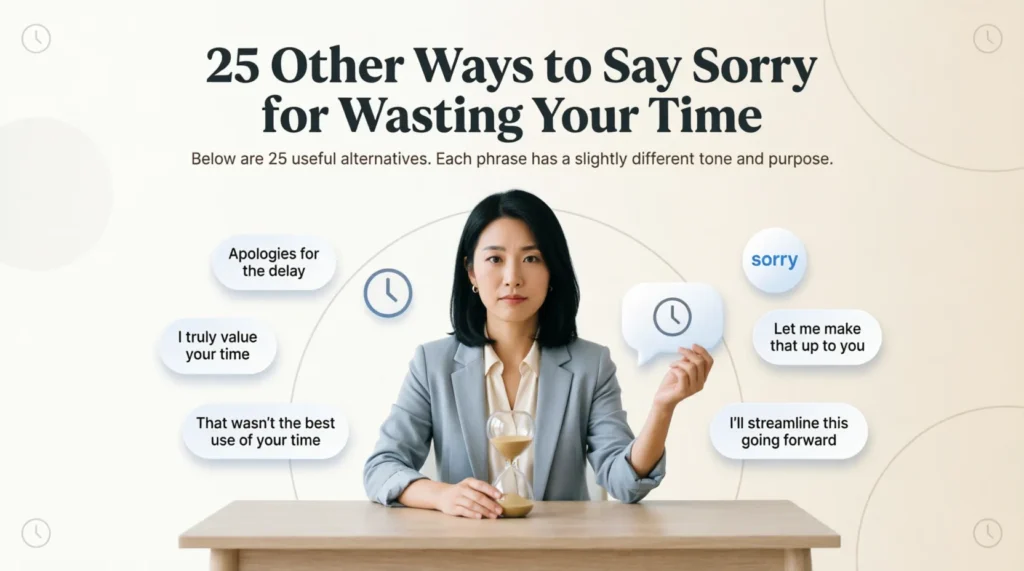
25 Other Ways to Say Sorry for Wasting Your Time
Below are 25 useful alternatives. Each phrase has a slightly different tone and purpose.
1. I apologize for taking up your time.
Meaning: You are sorry for using someone’s time.
Explanation: This is one of the best formal alternatives. It avoids the negative word “wasting” and sounds respectful.
Example Sentence: “I apologize for taking up your time with this issue.”
Best Use: Formal / Business
Worst Use: Very casual conversations with close friends.
Tone: Formal
2. Sorry to take up your time.
Meaning: You are sorry for using someone’s time.
Explanation: This is shorter and more natural than the formal version. It works well in everyday professional conversations.
Example Sentence: “Sorry to take up your time, but could I ask one quick question?”
Best Use: Professional / Spoken
Worst Use: Highly formal written documents.
Tone: Friendly
3. I’m sorry for taking so much of your time.
Meaning: You regret spending a large amount of someone’s time.
Explanation: Use this when a conversation, meeting, or request has taken longer than expected.
Example Sentence: “I’m sorry for taking so much of your time today.”
Best Use: Formal / Informal
Worst Use: When you only needed a few seconds.
Tone: Neutral
4. I apologize for taking so long.
Meaning: You are sorry that something took longer than expected.
Explanation: This phrase is useful when you have delayed someone or needed too much time to complete something.
Example Sentence: “I apologize for taking so long to respond to your email.”
Best Use: Business / Formal
Worst Use: When there was no real delay.
Tone: Formal
5. Sorry to keep you waiting.
Meaning: You apologize for making someone wait.
Explanation: Use this when another person has been waiting for you.
Example Sentence: “Sorry to keep you waiting. The meeting took longer than expected.”
Best Use: Informal / Business
Worst Use: When the person was not actually waiting.
Tone: Friendly
6. I’m sorry for the delay.
Meaning: You apologize because something happened later than expected.
Explanation: This is a common professional phrase. It is especially useful in emails and customer service.
Example Sentence: “I’m sorry for the delay in getting back to you.”
Best Use: Business / Formal
Worst Use: When there was no delay.
Tone: Neutral
7. Please accept my apologies for the delay.
Meaning: You formally apologize for something being late.
Explanation: This is more formal than simply saying “I’m sorry for the delay.”
Example Sentence: “Please accept my apologies for the delay in processing your request.”
Best Use: Formal / Business
Worst Use: Casual conversations.
Tone: Formal
8. I apologize for the inconvenience.
Meaning: You are sorry for causing a problem or difficulty.
Explanation: This phrase is common in customer service and business communication.
Example Sentence: “I apologize for the inconvenience caused by the schedule change.”
Best Use: Business / Formal
Worst Use: Simple personal conversations.
Tone: Formal
9. Thank you for your time.
Meaning: You appreciate the time someone gave you.
Explanation: This does not directly say “sorry,” but it can be a positive alternative when you want to recognize someone’s effort.
Example Sentence: “Thank you for your time and for answering all my questions.”
Best Use: Business / Professional
Worst Use: When you actually need to give a direct apology.
Tone: Neutral
10. I appreciate your patience.
Meaning: You are thankful that someone waited or remained patient.
Explanation: This is useful when your actions caused a delay.
Example Sentence: “I appreciate your patience while I looked into the issue.”
Best Use: Business / Customer Service
Worst Use: When nobody had to wait.
Tone: Friendly
11. Thank you for bearing with me.
Meaning: You thank someone for being patient with you.
Explanation: This phrase is friendly and polite. It works well when something takes longer than expected.
Example Sentence: “Thank you for bearing with me while I worked through the problem.”
Best Use: Professional / Informal
Worst Use: Very formal legal writing.
Tone: Friendly
12. I’m sorry for the inconvenience.
Meaning: You apologize for causing trouble or difficulty.
Explanation: This is useful when your actions create extra work or inconvenience for another person.
Example Sentence: “I’m sorry for the inconvenience caused by the last-minute change.”
Best Use: Business / Formal
Worst Use: When the situation caused no inconvenience.
Tone: Neutral
13. I regret taking up so much of your time.
Meaning: You feel sorry about using too much of someone’s time.
Explanation: This is more formal and serious than “Sorry for wasting your time.”
Example Sentence: “I regret taking up so much of your time during the meeting.”
Best Use: Formal / Business
Worst Use: Casual chats.
Tone: Formal
14. I hope I haven’t taken up too much of your time.
Meaning: You hope you did not use more time than was reasonable.
Explanation: This is a softer way to express concern about taking someone’s time.
Example Sentence: “I hope I haven’t taken up too much of your time with these questions.”
Best Use: Professional / Spoken
Worst Use: When you know you have caused a major delay.
Tone: Polite
15. I’m sorry this took longer than expected.
Meaning: You apologize because something required more time than planned.
Explanation: This phrase focuses on the unexpected length of the situation rather than blaming yourself.
Example Sentence: “I’m sorry this took longer than expected. Thank you for waiting.”
Best Use: Business / Informal
Worst Use: When the time was exactly as planned.
Tone: Neutral
16. Sorry for the extra time.
Meaning: You apologize for requiring additional time.
Explanation: This is short and natural in conversations.
Example Sentence: “Sorry for the extra time. I just wanted to make sure everything was correct.”
Best Use: Informal / Workplace
Worst Use: Very formal correspondence.
Tone: Friendly
17. I appreciate you giving me your time.
Meaning: You are thankful that someone spent time helping or speaking with you.
Explanation: This phrase changes the focus from apology to appreciation.
Example Sentence: “I appreciate you giving me your time to discuss the project.”
Best Use: Business / Professional
Worst Use: Quick casual interactions.
Tone: Warm
18. Thank you for your patience with me.
Meaning: You thank someone for being patient.
Explanation: This is useful when you made someone wait or needed extra time.
Example Sentence: “Thank you for your patience with me while I checked the details.”
Best Use: Formal / Informal
Worst Use: When patience was not required.
Tone: Friendly
19. I’m sorry for the unnecessary delay.
Meaning: You apologize for a delay that could have been avoided.
Explanation: This is direct and useful when you accept responsibility for an avoidable delay.
Example Sentence: “I’m sorry for the unnecessary delay in sending the report.”
Best Use: Business / Formal
Worst Use: When the delay was outside your control.
Tone: Emphatic
20. I apologize for any time lost.
Meaning: You apologize for time that may have been lost because of the situation.
Explanation: This is a professional alternative that avoids directly saying someone’s time was wasted.
Example Sentence: “I apologize for any time lost while we resolved the technical issue.”
Best Use: Business / Formal
Worst Use: Friendly personal conversations.
Tone: Formal
21. Sorry for making you spend so much time on this.
Meaning: You apologize for requiring someone to spend a lot of time on an issue.
Explanation: This is direct but still polite. It works when another person had to help you with something.
Example Sentence: “Sorry for making you spend so much time on this problem.”
Best Use: Informal / Workplace
Worst Use: Highly formal emails.
Tone: Friendly
22. I’m sorry for any time I’ve taken from you.
Meaning: You apologize for using someone’s time.
Explanation: This is thoughtful and respectful. It can be used when you want to show strong awareness of another person’s schedule.
Example Sentence: “I’m sorry for any time I’ve taken from you during this process.”
Best Use: Formal / Professional
Worst Use: Very casual situations.
Tone: Formal
23. Thank you for sticking with me.
Meaning: You thank someone for continuing to help or listen.
Explanation: This is warmer than a direct apology. It works especially well when someone has been patient during a long process.
Example Sentence: “Thank you for sticking with me while we figured this out.”
Best Use: Informal / Friendly
Worst Use: Very formal corporate letters.
Tone: Friendly
24. I’m sorry for the time this has taken.
Meaning: You apologize for the amount of time something required.
Explanation: This is a useful professional phrase when a task, problem, or conversation has lasted longer than planned.
Example Sentence: “I’m sorry for the time this has taken, and I appreciate your understanding.”
Best Use: Business / Formal
Worst Use: Quick social conversations.
Tone: Neutral
25. I hope the time you spent was worthwhile.
Meaning: You hope the person received enough value from the time they gave.
Explanation: This is a positive alternative when you want to recognize someone’s time without focusing heavily on the apology.
Example Sentence: “I hope the time you spent discussing the project with me was worthwhile.”
Best Use: Professional / Business
Worst Use: Situations where you clearly caused a serious delay.
Tone: Polite
Quick Comparison Table
| Alternative | Tone | Best Setting |
|---|---|---|
| I apologize for taking up your time. | Formal | Business |
| Sorry to keep you waiting. | Friendly | Spoken |
| I’m sorry for the delay. | Neutral | Emails |
| I appreciate your patience. | Friendly | Business |
| Thank you for your time. | Neutral | Professional |
| I regret taking up so much of your time. | Formal | Formal situations |
| Thank you for sticking with me. | Friendly | Casual |
The best phrase depends on what actually happened. If someone waited, mention the delay. If a conversation was long, mention taking up their time. If someone helped you patiently, show appreciation.
FAQs
1. What is a polite way to say sorry for wasting your time?
A polite option is “I apologize for taking up your time.” It sounds respectful and professional without using the negative word “wasting.”
2. What is a professional way to say sorry for wasting someone’s time?
You can say “I apologize for taking up more of your time than expected.” This works well in business emails, meetings, and workplace conversations.
3. Is “sorry for wasting your time” rude?
Not necessarily. It is a clear apology, but the word “wasting” can sound negative. A softer phrase may be better in professional situations.
4. How do I say sorry for taking too much time in an email?
Try “I apologize for taking up so much of your time” or “I’m sorry for the time this has taken.” Both sound polite and professional.
5. What can I say instead of “sorry” for taking someone’s time?
You can focus on appreciation by saying “Thank you for your time,” “I appreciate your patience,” or “Thank you for bearing with me.”
Conclusion
Knowing other ways to say sorry for wasting your time gives you more control over your tone.
The best phrase depends on the situation.
In business settings, “I apologize for taking up your time” is professional and respectful.
In casual conversations, “Sorry to keep you waiting” sounds natural and friendly.
You can also replace an apology with appreciation by saying “Thank you for your time” or “I appreciate your patience.” Learning these alternatives to sorry for wasting your time can make your English sound more fluent, confident, and thoughtful.
Try using different expressions based on the person, situation, and level of formality.

Alden Rowen is the author behind Meanings Path, sharing clear and reliable insights into the meanings, origins, and significance of words, names, and phrases. His goal is to make language simple, useful, and easy to understand.