If you’ve seen IMA in a text message, social media comment, or online chat, you may have wondered what it means.
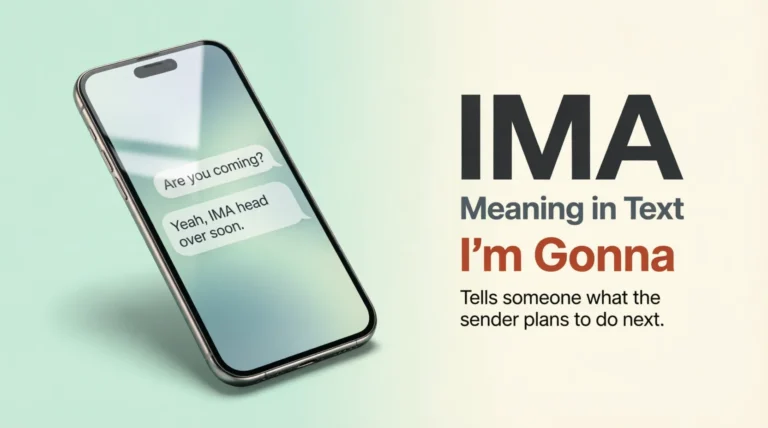
In most conversations, IMA is simply a casual way of writing “I’m gonna” or “I’m going to.” People use it to type faster, especially in informal chats with friends or family.
You will often find IMA on WhatsApp, Instagram, TikTok, Snapchat, Discord, X, and text messages.
While its most common meaning stays the same, the exact tone depends on the conversation and the people involved.
In rare cases, IMA can also represent an abbreviation for organizations or technical terms, but those meanings are usually obvious from the context.
This guide explains the meaning of IMA, where it came from, how people use it today, common misunderstandings, practical examples, and the best ways to reply.
| Term | Most Common Meaning | Full Form | Typical Tone | Common Usage |
|---|---|---|---|---|
| IMA | I’m gonna / I’m going to | Informal shortening of “I’m going to” | Casual, friendly, conversational | Text messages, chats, social media |
What Does IMA Mean in Text & Chat?
Direct Answer
IMA usually means “I’m gonna” or “I’m going to.” It tells someone what the sender plans to do next.
Unlike many internet abbreviations, IMA is not typically pronounced as individual letters. Instead, it reflects the way many people naturally speak in casual conversation.
Examples include:
- “IMA call you after dinner.”
- “IMA head home now.”
- “IMA finish this later.”
The abbreviation saves time while keeping messages relaxed and conversational.
The tone is generally:
- Friendly
- Informal
- Neutral
- Casual
It is rarely suitable for formal emails, business messages, or academic writing.
Full Form, Stands For & Short Meaning of IMA
The most common expansion of IMA is:
IMA = I’m gonna = I’m going to
Although “gonna” is technically a spoken contraction of “going to,” many people shorten it even further while texting.
Quick Summary
| Version | Meaning |
|---|---|
| IMA | I’m going to |
| I’m gonna | Informal spoken English |
| I’m going to | Standard English |
Some people type Imma instead of IMA. Both usually express the same idea.
Outside texting, IMA may also stand for organizations, educational institutions, or professional associations. Those meanings depend entirely on the subject being discussed and should not be confused with the texting slang.
Origin, History & First Known Use of IMA
The texting version of IMA developed naturally from spoken English rather than from a single invention or event.
As text messaging became more popular, people started shortening common phrases to type faster. Expressions such as:
- gonna
- wanna
- gotta
- imma
- ima
became common in casual online conversations.
There is no confirmed first person or exact date credited with creating IMA as internet slang. Instead, it gradually spread through messaging apps, online forums, gaming communities, and social media.
Because of this organic development, slight spelling differences exist. Some users prefer:
- IMA
- Ima
- imma
- Imma
In most casual conversations, these versions communicate the same basic idea.
How People Use IMA in Daily Conversations
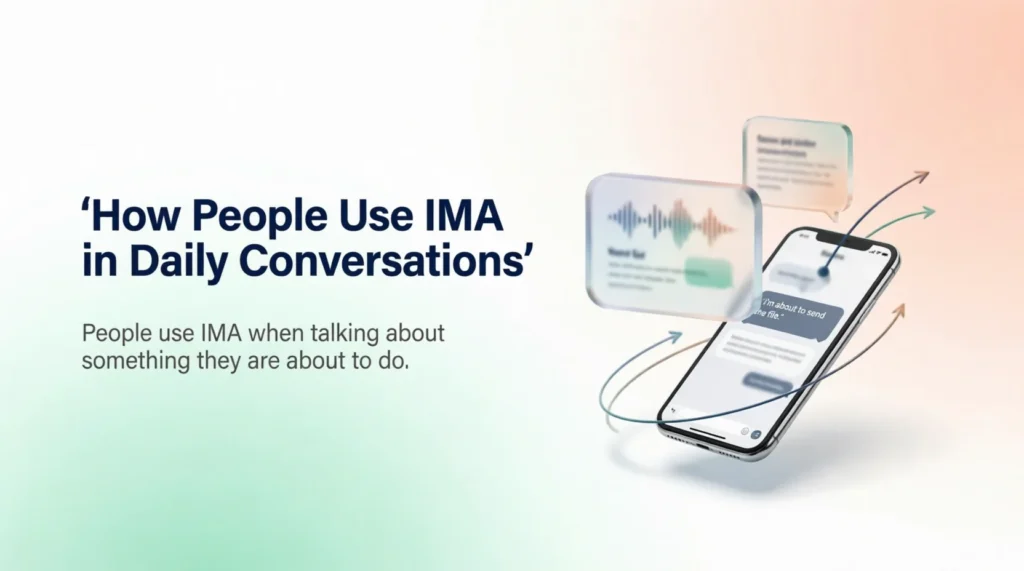
People use IMA when talking about something they are about to do.
Examples include making plans, giving updates, or announcing a decision.
Everyday Situations
- Leaving home
- Starting homework
- Calling someone
- Watching a movie
- Going to sleep
- Ordering food
Example:
Person A: “Are you free tonight?”
Person B: “IMA finish work first, then I’ll text you. 😊”
Here, IMA simply introduces the speaker’s next action.
The tone may become:
| Situation | Tone |
|---|---|
| Talking with friends | Casual |
| Sending exciting news | Happy |
| During arguments | Firm |
| With emojis | Friendlier |
| With all caps | More emphatic |
Context always matters more than the abbreviation itself.
IMA Meaning Across WhatsApp, Instagram, TikTok & Snapchat
The meaning of IMA stays remarkably consistent across most platforms.
| Platform | Typical Meaning |
|---|---|
| I’m going to | |
| I’m going to | |
| TikTok | I’m going to |
| Snapchat | I’m going to |
| Discord | I’m going to |
| X | I’m going to |
What changes is the style rather than the meaning.
On TikTok or Instagram comments, users often write very short messages:
- “IMA try this recipe.”
- “IMA buy one.”
On WhatsApp or texting, it appears naturally in conversations.
On Snapchat, it often accompanies quick updates:
- “IMA be there in 10.”
- “IMA send a pic.”
The abbreviation remains informal regardless of platform.
Different Meanings of IMA in Other Fields
Although texting is the focus of this article, IMA has several unrelated meanings.
Examples include professional organizations, educational institutions, medical references, and business abbreviations.
These meanings only apply when the conversation clearly involves those subjects.
| Context | Possible Meaning |
|---|---|
| Texting | I’m going to |
| Professional organizations | Organization name abbreviation |
| Education | Institution abbreviation |
| Business | Company or association initials |
| Healthcare | Context-specific abbreviation |
If someone writes:
“I joined the IMA.”
they are almost certainly referring to an organization rather than texting slang.
Always use surrounding words to determine the intended meaning.
Common Confusions, Mistakes & Wrong Interpretations
Many readers confuse IMA with other abbreviations.
Common misunderstandings include:
| Term | Actual Meaning |
|---|---|
| IMA | I’m going to |
| IMO | In my opinion |
| IMHO | In my humble opinion |
| IDC | I don’t care |
| IRL | In real life |
Another mistake is assuming every appearance of IMA refers to texting slang.
For example:
- “IMA conference”
- “IMA certification”
These almost certainly refer to an organization or professional abbreviation.
Reading the surrounding sentence usually removes any confusion.
Similar Terms, Alternatives & Related Slang
Many internet expressions communicate nearly the same idea.
| Slang | Meaning |
|---|---|
| Imma | I’m going to |
| Gonna | Going to |
| Bouta | About to |
| Finna | Going to (common in some dialects) |
| BRB | Be right back |
Each has slightly different cultural or regional usage.
For example:
- “IMA leave.”
- “Imma leave.”
- “Bouta leave.”
All describe an upcoming action, although the wording differs.
Choose the version that matches your audience and writing style.
Examples of IMA in Real Chat Situations
Friendly Conversation
Person A: “Movie starts in fifteen minutes.”
Person B: “IMA grab snacks first. 🍿”
Meaning: The speaker plans to buy snacks before the movie.
Playful Conversation
Person A: “Bet you can’t beat my score.”
Person B: “IMA prove you wrong. 😄”
Meaning: Lighthearted confidence.
Serious Conversation
Person A: “Everything okay?”
Person B: “IMA call you in a few minutes.”
Meaning: A genuine promise to call soon.
Slightly Frustrated
Person A: “Why aren’t you answering?”
Person B: “IMA explain everything later.”
Meaning: The speaker wants to continue the conversation later.
Notice how punctuation and emojis influence tone:
- “IMA be there!”
- “IMA be there 😊”
- “IMA be there…”
Each creates a different emotional impression even though the core meaning stays the same.
How to Reply When Someone Says IMA
Your reply depends on the situation.
| Situation | Suitable Reply |
|---|---|
| Serious | “Sounds good. I’ll wait.” |
| Friendly | “Awesome! See you soon.” |
| Playful | “I’ll believe it when I see it. 😄” |
| Confused | “Do you mean you’re about to do it?” |
| Upset conversation | “Okay, let’s talk when you’re ready.” |
Examples:
Person A: “IMA head home.”
Person B: “Drive safely! 😊”
Person A: “IMA send the photos.”
Person B: “Great, thanks!”
Person A: “IMA beat your record.”
Person B: “Challenge accepted! 😄”
Matching the other person’s tone usually leads to the most natural conversation.
Is IMA Still Popular? Trends & Online Usage
IMA continues to appear in casual online conversations, although spelling preferences vary.
Many people now use:
- Imma
- imma
- I’ma
- IMA
The intended meaning is usually identical.
There is no reliable public data showing that one spelling has permanently replaced the others across every platform. Usage often depends on age, personal habit, community, and regional writing style.
The abbreviation remains most common in:
- Text messaging
- Social media comments
- Gaming chats
- Private messaging
- Group conversations
Formal communication still favors writing the complete phrase “I’m going to.”
Frequently Asked Questions
What does IMA mean in text messages?
In most text messages, IMA means “I’m going to” or “I’m gonna.” It introduces something the sender plans to do.
Is IMA the same as Imma?
Yes. In everyday texting, IMA and Imma are commonly used with the same meaning, although spelling preferences differ.
Is IMA rude?
No. By itself, IMA is neutral and informal. The surrounding words determine whether the message sounds friendly, sarcastic, serious, or frustrated.
Can I use IMA in professional emails?
It is better not to. Professional writing should use the complete phrase “I’m going to.”
Does IMA mean the same thing on WhatsApp, Instagram, TikTok, and Snapchat?
Usually yes. Across these platforms, IMA almost always means “I’m going to.” The tone may change depending on emojis, punctuation, and the conversation.
Can IMA have other meanings?
Yes. Outside texting, IMA may represent the initials of organizations, institutions, or technical terms. Context makes the intended meaning clear.
Conclusion
The most common IMA meaning in text is “I’m going to” or “I’m gonna.” It is a simple, informal shortcut people use to type quickly while chatting with friends, family, or online communities.
Whether you see it on WhatsApp, Instagram, TikTok, Snapchat, or in a text message, the core meaning usually stays the same: the sender is describing something they plan to do next.
As with many internet expressions, context matters.
Emojis, punctuation, and the relationship between the people chatting can make the message sound playful, serious, excited, or even slightly sarcastic.
If you keep the surrounding conversation in mind, understanding IMA becomes easy.
Learning abbreviations like this can also help you follow modern online conversations with greater confidence.

Alden Rowen is the author behind Meanings Path, sharing clear and reliable insights into the meanings, origins, and significance of words, names, and phrases. His goal is to make language simple, useful, and easy to understand.