STFU in text usually means “Shut the F* Up.”** It is a popular internet abbreviation that people use in text messages, social media comments, and online chats.
Most of the time, it tells someone to stop talking or be quiet. However, its tone can change depending on the situation.
Friends may use STFU jokingly when they hear surprising or unbelievable news.
In other situations, it can sound angry, rude, or disrespectful. You may see this abbreviation on WhatsApp, Instagram, TikTok, Snapchat, Discord, and other messaging platforms.
Understanding its meaning helps you avoid confusion and respond in the right way. In this guide, we will explain what STFU means, where it comes from, how people use it, and how to reply when someone sends it to you.
STFU Quick Reference
| Category | Meaning |
|---|---|
| Term | STFU |
| Most common meaning | Shut the F*** Up |
| Full form | Shut the F*** Up |
| Typical tone | Rude, angry, joking, or sarcastic |
| Common usage | Text messages, social media, and online chats |
| Type | Internet slang / Acronym |
| Suitable for formal use | No |
Quick answer: STFU means “Shut the F*** Up.” It usually tells someone to stop talking, but friends may also use it as a playful reaction to shocking or exciting news.
What Does STFU Mean in Text & Chat?
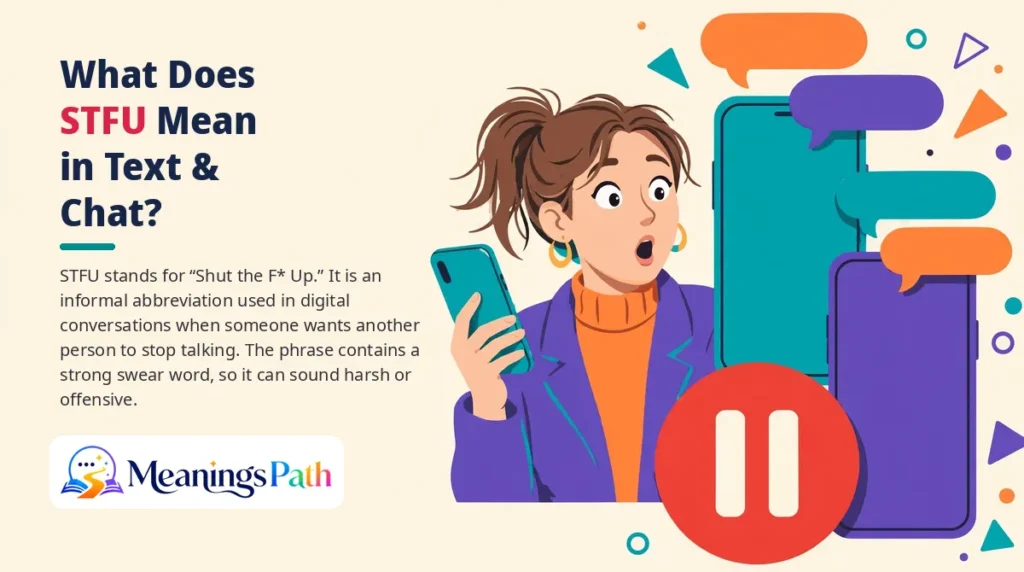
STFU stands for “Shut the F* Up.”** It is an informal abbreviation used in digital conversations when someone wants another person to stop talking. The phrase contains a strong swear word, so it can sound harsh or offensive.
People often use STFU when they feel annoyed, frustrated, surprised, or overwhelmed by something someone has said. However, the meaning is not always negative. Close friends sometimes use it as a funny reaction when they hear unexpected news.
For example, imagine your friend tells you that they met a famous singer. You might reply:
“STFU! Are you serious right now?”
In this situation, you are probably not asking your friend to stop talking. Instead, you are showing surprise and excitement.
On the other hand, consider this message:
“STFU. I’m tired of hearing your excuses.”
Here, the sender sounds angry and wants the other person to stop speaking.
Is STFU Always Rude?
No. Its tone depends on the conversation and the relationship between the people.
- Angry: Someone wants another person to stop talking.
- Playful: Friends use it to react to surprising news.
- Sarcastic: Someone expresses disbelief or makes a sharp joke.
- Annoyed: A person has lost patience with a conversation.
- Excited: Someone reacts dramatically to unexpected information.
The safest way to understand STFU is to look at the surrounding words, punctuation, emojis, and relationship between the sender and receiver.
Full Form, Stands For & Short Meaning of STFU
The full form of STFU is “Shut the F* Up.”** Each letter represents a word in the original phrase:
| Letter | Word |
|---|---|
| S | Shut |
| T | The |
| F | F*** |
| U | Up |
It is a four-letter internet acronym that makes a strong and sometimes offensive expression shorter to type.
The basic meaning is simple: someone wants another person to be quiet or stop speaking. However, people also use it as an emotional reaction rather than a direct command.
STFU Short Meaning
In simple English, STFU can mean:
- Be quiet.
- Stop talking.
- Don’t say another word.
- I can’t believe what you just said.
- You’re joking, right?
These are possible interpretations rather than separate full forms. The original expression remains the same.
Why Do People Use STFU Instead of the Full Phrase?
People use abbreviations because they make online conversations faster and shorter. STFU is also widely understood in internet slang, especially among people who regularly communicate through text messages and social media.
However, shortening an offensive phrase does not make it polite. Even when written as four letters, STFU can hurt someone’s feelings or create an argument.
If you want a softer expression, you can use alternatives such as “Be quiet,” “No way!” or “Are you serious?”
Origin, History & First Known Use of STFU
STFU comes from the English expression “Shut the F*** Up.” Its history is connected to informal speech, online communication, and the growth of internet abbreviations.
Before social media became popular, people already used the full expression in everyday conversations. As digital messaging developed, users began shortening common phrases to save time and space.
STFU became one of the recognizable abbreviations used in online conversations. Like many internet acronyms, it allowed people to express strong emotions without typing an entire sentence.
How Did STFU Become Internet Slang?
The growth of online chat rooms, instant messaging, discussion forums, and text messaging helped spread abbreviations like STFU.
People wanted quick ways to communicate feelings such as anger, frustration, surprise, and excitement. Short expressions were easy to type and became familiar within online communities.
Later, social networking platforms made internet slang more visible. Users began including abbreviations in comments, captions, private messages, and replies.
When Was STFU First Used?
There is no single universally established date for the first use of STFU in digital communication. It is difficult to identify exactly when the abbreviation first appeared because informal online conversations were not always recorded.
It is more accurate to describe STFU as an established internet slang abbreviation that developed from an older spoken expression.
Today, people still recognize it in many online communities. Its meaning remains closely connected to the original phrase.
How People Use STFU in Daily Conversations
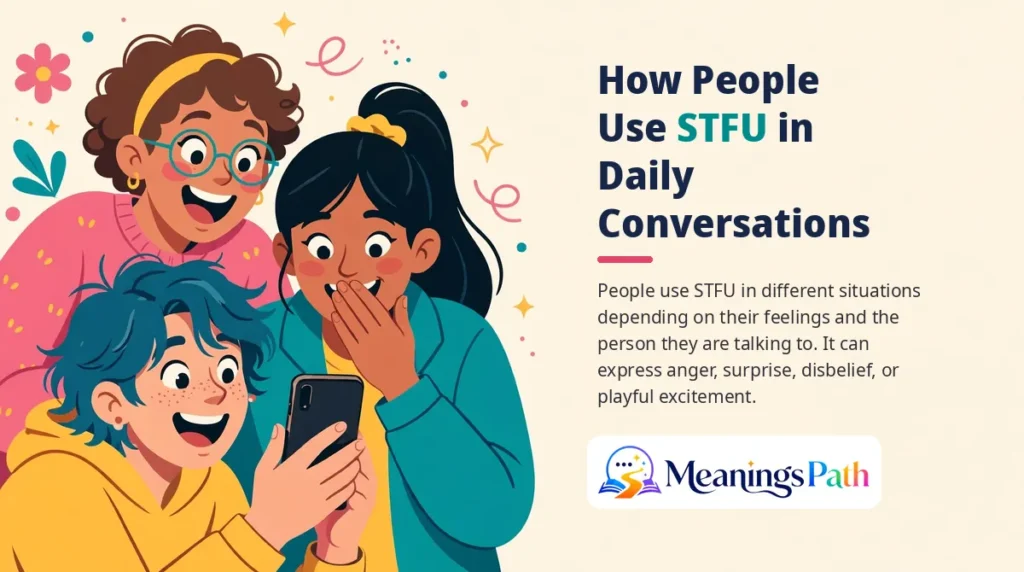
People use STFU in different situations depending on their feelings and the person they are talking to. It can express anger, surprise, disbelief, or playful excitement.
Although the abbreviation has a strong meaning, close friends sometimes use it casually. Their shared sense of humor can make the expression feel less serious.
1. When Someone Is Annoyed
A person may use STFU when they are frustrated with repeated comments or arguments.
Example:
“STFU, you keep repeating the same thing.”
This message sounds angry and disrespectful. The sender wants the other person to stop talking.
2. When Someone Shares Surprising News
Friends sometimes use STFU when they hear something unbelievable.
Example:
Person A: “I just found out I’m moving to New York!”
Person B: “STFU! That’s amazing! 😭”
Here, the sender is expressing excitement and surprise rather than making a serious demand.
3. When Someone Is Joking
People may use STFU as part of friendly teasing.
Example:
Person A: “I finished the whole pizza by myself.”
Person B: “STFU 😂 How were you even hungry after that?”
The expression adds humor to the conversation.
4. When Someone Wants to End an Argument
STFU can also appear during heated discussions.
Example:
Person A: “You never listen to anyone.”
Person B: “STFU. I’m done arguing.”
This use is confrontational and may make the disagreement worse.
The important point is that STFU can communicate very different emotions. Always consider the situation before deciding what the sender means.
STFU Meaning Across WhatsApp, Instagram, TikTok & Snapchat
STFU generally has the same meaning across social media and messaging platforms: “Shut the F* Up.”** The abbreviation does not have a different official meaning on each platform.
However, the way people use it can change depending on the type of conversation.
| Platform | Common Usage | Possible Tone |
|---|---|---|
| Private messages and group chats | Angry or playful | |
| Comments, DMs, and replies | Sarcastic or surprised | |
| TikTok | Video comments and discussions | Funny, shocked, or rude |
| Snapchat | Casual conversations with friends | Playful or serious |
| Discord | Gaming chats and community discussions | Teasing or confrontational |
| Comments and private messages | Argumentative or humorous |
STFU on WhatsApp
On WhatsApp, people commonly use STFU in personal messages and group chats. Friends may use it when reacting to unexpected news or making jokes.
However, during an argument, it can sound like a direct insult.
STFU on Instagram
On Instagram, STFU may appear in comments, reels discussions, and direct messages.
For example, someone might comment “STFU 😭” after watching a surprising or funny video. The crying emoji may suggest laughter or disbelief rather than anger.
STFU on TikTok
TikTok users may write STFU under videos, especially when reacting to unexpected moments, funny statements, or controversial opinions.
Its tone depends on the video and the surrounding discussion.
STFU on Snapchat
On Snapchat, the abbreviation often appears in quick conversations between friends. It may be used for teasing, surprise, or frustration.
Remember: The platform does not determine the meaning. The conversation itself provides the best clues.
Different Meanings of STFU in Other Fields
STFU has one widely recognized meaning in everyday internet slang: “Shut the F*** Up.”
Unlike some abbreviations, it does not have a large number of commonly accepted alternative meanings across professional or technical fields.
Still, its interpretation can vary based on the situation.
1. STFU as a Direct Command
This is the most literal use. Someone uses the abbreviation to tell another person to stop speaking.
Example:
“STFU and let me finish.”
The message is forceful and may sound disrespectful.
2. STFU as an Expression of Surprise
Sometimes people use STFU when they cannot believe what they are hearing.
Example:
Person A: “I won two concert tickets!”
Person B: “STFU! You’re so lucky! 😭”
Here, the sender is reacting with excitement.
3. STFU as a Sarcastic Reaction
People may use it to show disbelief or respond to something they think is ridiculous.
Example:
“STFU, you really believe that?”
This could be playful between friends or insulting during a disagreement.
4. STFU in Gaming and Online Communities
In gaming chats, STFU may appear when players are frustrated, teasing teammates, or reacting to competitive situations.
Its meaning is generally the same as in ordinary texting.
Does STFU Have a Professional Meaning?
STFU is not a standard professional abbreviation. It is not suitable for formal emails, business reports, workplace communication, or academic writing.
If you encounter it in an unusual technical document, check the surrounding context instead of assuming it has the internet slang meaning.
Common Confusions, Mistakes & Wrong Interpretations
STFU is easy to recognize once you know its full form. However, people sometimes misunderstand its tone or mistake a playful reaction for an insult.
Here are some common mistakes to avoid.
1. Thinking STFU Is Always Angry
STFU can sound angry, but it is not always intended as an insult.
Close friends may use it when they hear surprising news.
For example:
“STFU, you actually got the job?! 😭”
This sounds more like excitement than anger.
2. Thinking STFU Is a Polite Way to Say Be Quiet
Although both expressions can communicate a similar message, they do not have the same level of politeness.
“Please be quiet” is respectful.
“STFU” is much stronger and contains profanity. It may offend the receiver.
3. Assuming Emojis Always Make It Friendly
Emojis can soften the tone, but they do not automatically make an offensive expression harmless.
For example:
“STFU 😂”
This may be playful between close friends.
However:
“STFU 😒”
This may suggest irritation or frustration.
4. Confusing STFU With Other Internet Abbreviations
Some internet expressions look similar but have different meanings.
| Abbreviation | Meaning |
|---|---|
| STFU | Shut the F*** Up |
| GTFO | Get the F*** Out |
| WTF | What the F*** |
| IDGAF | I Don’t Give a F*** |
| SMH | Shaking My Head |
| LOL | Laughing Out Loud |
| LMFAO | Laughing My F***ing Ass Off |
5. Using STFU in the Wrong Situation
Using STFU with a teacher, manager, customer, or someone you do not know well can create a negative impression.
Even if you intend it as a joke, the other person may take it seriously.
The best approach is to understand the relationship and tone before using it.
Similar Terms, Alternatives & Related Slang
Several internet abbreviations express similar feelings to STFU. Some are equally rude, while others are more polite or suitable for everyday conversations.
Knowing these alternatives can help you choose the right expression.
Similar Abbreviations
| Slang | Full Form | Meaning |
|---|---|---|
| GTFO | Get the F*** Out | Leave or go away |
| WTF | What the F*** | Expresses surprise or confusion |
| STFD | Shut the F*** Down | Context-dependent expression |
| ZIP IT | Not an acronym | Tells someone to be quiet |
| HUSH | Not an acronym | Asks someone to be quiet |
| IDC | I Don’t Care | Shows a lack of interest |
| SMH | Shaking My Head | Shows disappointment or disbelief |
Polite Alternatives to STFU
If you want to ask someone to stop talking without sounding offensive, try these expressions:
- Please be quiet: A polite request.
- Can we stop talking about this? Useful when you want to change the subject.
- Let’s take a break: Suitable for a heated discussion.
- Give me a moment, please: Shows that you need some time.
- Let’s keep it down: Useful when someone is speaking too loudly.
- I need some silence right now: Clearly expresses your need for quiet.
Playful Alternatives
If you are joking with friends, these expressions may work better:
- No way!
- You’re kidding!
- Are you serious?
- Stop it! 😂
- I can’t believe you!
- That’s unbelievable!
These alternatives help you express surprise without using strong language.
Examples of STFU in Real Chat Situations
The best way to understand STFU is to see how people use it in everyday conversations.
The following examples show different situations and tones.
Example 1: Reacting to Surprising News
Person A: “I just found out that my favorite actor is coming to our city.”
Person B: “STFU! We have to get tickets! 😭”
Meaning: Person B is excited and cannot believe the news. The abbreviation is playful.
Example 2: During an Argument
Person A: “You always blame everyone else for your mistakes.”
Person B: “STFU. You don’t know the whole story.”
Meaning: Person B sounds angry and wants the other person to stop speaking.
Example 3: Friendly Teasing
Person A: “I stayed awake all night watching movies.”
Person B: “STFU 😂 You must be exhausted today.”
Meaning: Person B is joking with a friend. It is not meant as a serious insult.
Example 4: Expressing Disbelief
Person A: “She got the highest score without studying.”
Person B: “STFU! How is that even possible?”
Meaning: Person B is surprised and finds the news difficult to believe.
Example 5: Showing Frustration
Person A: “You need to listen to my advice for once.”
Person B: “STFU. I’m tired of this conversation.”
Meaning: Person B is frustrated and wants to end the discussion.
Example 6: Reacting to a Funny Story
Person A: “My brother walked into the wrong classroom today.”
Person B: “STFU 😭 What did he do next?”
Meaning: Person B finds the situation funny and wants to hear more.
Example 7: Responding to an Unwanted Comment
Person A: “Your presentation was terrible.”
Person B: “STFU. That was completely unnecessary.”
Meaning: Person B is offended and responds defensively.
Example 8: Showing Excitement About a Relationship
Person A: “He finally asked me out!”
Person B: “STFU!!! I’m so happy for you! ❤️”
Meaning: Person B is excited and celebrating the good news. The punctuation and heart emoji make the message feel affectionate.
Example 9: Making a Sarcastic Comment
Person A: “I’m always right about everything.”
Person B: “STFU 😂 Nobody is perfect.”
Meaning: Person B is using the abbreviation sarcastically to tease the other person.
Example 10: Ending a Heated Conversation
Person A: “You never understand what I’m trying to say.”
Person B: “STFU. I don’t want to argue anymore.”
Meaning: Person B is upset and wants the conversation to stop.
These examples show why context matters. The same abbreviation can express excitement between friends or anger during a disagreement.
How to Reply When Someone Says STFU
Your response should depend on the sender’s tone and your relationship with them. You do not need to react angrily every time someone uses STFU.
Sometimes it is a joke. Other times, it may be a sign that the person is annoyed or being disrespectful.
Here are some ways to respond.
1. If Someone Says STFU as a Joke
If a close friend uses it playfully, you can reply with humor.
Examples:
- “You know I’m telling the truth 😂”
- “Don’t be jealous!”
- “I knew you’d react like that!”
- “Haha, I can’t help it!”
These responses keep the conversation light.
2. If Someone Says STFU Because They Are Surprised
You can respond by confirming what you said.
Examples:
- “Yes, I’m serious!”
- “I promise it’s true!”
- “I know, it’s unbelievable!”
- “Believe it or not, it happened!”
These replies make it clear that you are sharing real news.
3. If Someone Says STFU Rudely
If the message feels disrespectful, you can set a boundary without using the same language.
Examples:
- “There’s no need to be rude.”
- “Please speak to me respectfully.”
- “I was only trying to explain.”
- “We can talk when you’re calmer.”
You can also choose not to reply if the conversation is becoming unpleasant.
4. If You Do Not Understand Their Tone
Sometimes it is difficult to know whether someone is joking or angry.
Try asking:
- “Are you joking or serious?”
- “What do you mean by that?”
- “Did I say something wrong?”
- “Why are you reacting like that?”
These questions help clear up confusion.
5. If You Want to End the Conversation
If someone is being aggressive, you do not have to continue the discussion.
You can say:
- “Let’s talk later.”
- “I’m not interested in arguing.”
- “I think we should take a break.”
- “I’ll leave this conversation here.”
Helpful tip: Do not assume every use of STFU is an attack. Look at the full conversation first. However, you should not feel pressured to accept disrespect just because someone says they are joking.
Is STFU Still Popular? Trends & Online Usage
STFU remains a recognizable abbreviation in internet slang and casual digital communication. Its short form makes it easy to type, and its strong expression can communicate emotions quickly.
People may use it in private messages, social media comments, gaming chats, memes, and online discussions.
Why Do People Still Use STFU?
There are several reasons why this abbreviation continues to appear in online conversations.
- Quick communication: Four letters are faster to type than the complete expression.
- Strong emotions: It communicates frustration, surprise, or disbelief.
- Internet culture: Many people recognize it from online conversations and memes.
- Humor: Friends sometimes use it as a dramatic reaction to unexpected news.
- Casual language: It fits informal conversations where people use internet slang.
Is STFU Common Among Younger Internet Users?
STFU is recognizable across different age groups, particularly among people familiar with online messaging and internet culture. However, not everyone uses it regularly.
Some people prefer newer slang, emojis, or softer expressions. Others continue using established abbreviations because their meanings are widely understood.
Should You Use STFU in 2026?
You can use STFU in casual conversations if you understand its meaning and the person receiving it is comfortable with that type of language.
However, avoid using it in professional settings or with people you do not know well.
The main thing to remember is that STFU contains profanity. Even when it is meant as a joke, it can sound disrespectful to someone who does not share your sense of humor.
Frequently Asked Questions
What does STFU mean from a girl?
When a girl sends STFU, it usually means “Shut the F*** Up.” She may be annoyed, joking, surprised, or expressing excitement. Her tone and the surrounding conversation help explain what she means.
What does STFU mean from a guy?
When a guy texts STFU, it generally has the same meaning. He may use it to tell someone to stop talking or as a playful reaction to surprising news.
Is STFU a bad word?
Yes. STFU contains a swear word and is generally considered rude or offensive. However, close friends sometimes use it jokingly when they are comfortable with that type of language.
Does STFU mean shut up?
Yes. STFU is the abbreviation for “Shut the F*** Up.” It is a stronger and more offensive version of “shut up.”
What does STFU mean on WhatsApp?
On WhatsApp, STFU usually means “Shut the F*** Up.” People use it in private messages and group chats to express frustration, surprise, or playful disbelief.
What does STFU mean on Instagram and TikTok?
On Instagram and TikTok, STFU has the same common meaning. It may appear in comments, direct messages, and video discussions as a reaction to something surprising, funny, or annoying.
How do you reply to STFU in a text?
Your reply depends on the situation. If someone is joking, you can respond with humor. If they are being rude, you can say, “Please speak respectfully,” or choose not to continue the conversation.
Is STFU playful or disrespectful?
It can be either. Friends may use it playfully, while strangers or angry people may use it as an insult. The relationship, context, and tone help determine its intention.
What is a polite alternative to STFU?
Polite alternatives include “Please be quiet,” “Can we stop talking about this?” and “Let’s take a break.” These expressions communicate a similar idea without using profanity.
What does STFU mean with a laughing emoji?
STFU with 😂 often suggests joking, teasing, or disbelief. The sender may be laughing at something surprising rather than seriously asking someone to stop talking.
Conclusion
STFU in text stands for “Shut the F* Up.”** It is a common internet abbreviation used in messages, social media comments, and online conversations.
Most often, it tells someone to stop talking, but it can also express surprise, excitement, disbelief, or playful teasing between friends.
The meaning depends on the situation, the relationship between the people, and the words or emojis surrounding it.
Since STFU contains profanity, it can sound rude even when the sender intends it as a joke. It is best to understand the tone before replying or using it yourself.
If you enjoy learning internet slang and texting abbreviations, explore more guides to understand common expressions and communicate with confidence.

Alden Rowen is the author behind Meanings Path, sharing clear and reliable insights into the meanings, origins, and significance of words, names, and phrases. His goal is to make language simple, useful, and easy to understand.